2003 Honda HSC Concept
Honda HSC Concept: the 2003 Tokyo concept, V6 proposal, design analysis and credited show photography.
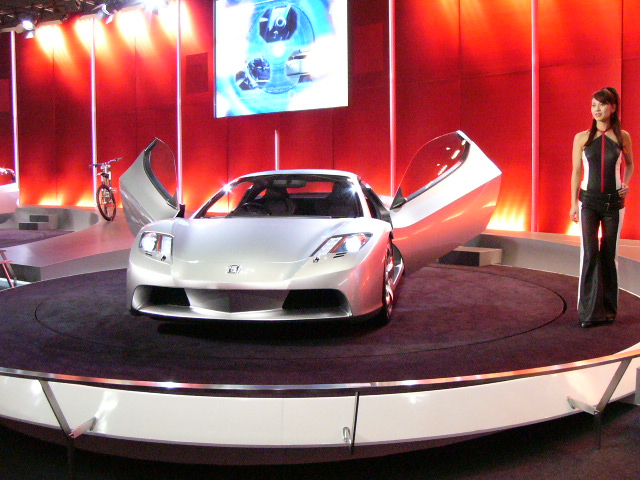
The Honda HSC presented a new sports-car proposal at the 2003 Tokyo Motor Show.
History and purpose
The Honda HSC presented a new sports-car proposal at the 2003 Tokyo Motor Show. Honda’s contemporary factbook identifies the physical concept and frames its purpose around accessible control as well as high performance. That positioning makes it more than an exercise in dramatic bodywork: it asks how a fast sports car can communicate with its driver. The original exhibit and the supplied event photograph establish a real archive subject. They do not establish a complete fabrication census or a customer production programme. This profile therefore keeps HSC as a concept identity, with an unknown construction tally and no count borrowed from any later NSX.
Design and engineering
Honda describes a compact mid-mounted V6 and calculated output above 300 PS, alongside dial and paddle shift controls. Calculated concept output is different evidence from an independently measured road test. The supplied silver car is shown with both doors raised, making the relationship between cabin access and the low body especially clear. Its short-looking nose and compact cabin emphasize the sports-car proposal visually. The open doors also make this an unmistakable display photograph rather than a customer-car image. That setting helps readers understand the presentation, while leaving operating condition and the installed power unit’s individual history for additional documentation.
Identifying the original configuration
The included file identifies HSC at Tokyo Motor Show 2003 and is dated 30 October. Preserve that precise event identity with the image, since a later NSX or a generic Honda sports concept would illustrate a different subject. Honda’s factbook records details such as shift controls and information display design; those descriptions should be kept attached to HSC. For the physical object, a custodial record could add construction markings, transport dates, exhibition changes and any restoration. A single public display cannot establish that only one HSC was built, and a proposed performance figure cannot certify the condition of the show car years later.
Collector context and preservation
HSC offers a particularly useful comparison with the Project 2&4 concept. Both can be read as questions about the driver’s relationship with a sports machine, yet their photographs organize that relationship very differently. HSC wraps the occupants within a conventional-looking body, while Project 2&4 exposes much more of its structure. The comparison is editorial design analysis rather than a claim of common hardware. Additional side, rear and interior views would strengthen an HSC archive. Retain their dates and original creators, and distinguish original design features from any later exhibition modifications so the concept’s history can grow without becoming a speculative production-car profile.
An exhibition label and a full-body photograph answer different questions. The label supplies the maker’s chosen identity, while the image shows how the cabin, doors and body meet. Retaining both gives HSC a stronger design record than an isolated specification list.
Reading the evidence for this profile
The original source links below identify the programme and the historical statements used in this article. The photograph has its own creator and licence record, separate from the manufacturer’s vehicle history. Keep both when transferring this profile into a collection catalogue. A manufacturing tally describes how many cars belong to a defined original programme; it does not measure how many survive, how many are publicly visible, or how many retain all their original components. Those individual questions require dated chassis and restoration evidence. The reference year likewise describes the programme’s introduction or named historic configuration, while the supplied caption states the photographed setting and any established individual identity. This lets future research expand the car’s history without blurring the scope of the record already assembled here.
Specifications and verified rarity
| Reference year | 2003 |
|---|---|
| Model / programme | HSC Concept |
| Body / role | Mid-engine sports-car show concept |
| Power unit / proposal | Compact V6; Honda published a calculated output exceeding 300 PS |
| Layout / transmission | Mid-engine concept; dial selection and steering-wheel paddle controls described by Honda |
| Exact manufacturing tally | Not established |
| Rarity evidence | Physical concept archive scope; tally unknown |
| Rarity scope | Physical Honda HSC shown at the 2003 Tokyo Motor Show. Verified concept archive identity; complete fabrication tally unknown. No retail NSX production total or one-car assumption assigned. |
| Inventory reference | HON-057 — Verified |
Frequently asked questions
What is the Honda HSC Concept?
A physical Honda sports concept exhibited in Tokyo in 2003, with a mid-engine V6 proposal and an unknown complete construction tally.
What engineering defines this vehicle?
Compact V6; Honda published a calculated output exceeding 300 PS. Mid-engine concept; dial selection and steering-wheel paddle controls described by Honda. The specifications describe the original programme or published concept proposal. An individual example’s installed equipment and any later changes need their own dated evidence.
Why does this profile use 2003?
This is the documented introduction or original configuration year. Photograph dates and market model years can differ. Keeping those dates separate makes it possible to follow the car’s development without creating a second identity for the same programme.
How should an individual HSC Concept be authenticated?
Connect the chassis identifier to original delivery, edition or custodial records. Compare period exterior, cabin and mechanical photographs with the documented configuration. Record replacement parts, paint changes and restoration work as dated events. A badge or colour alone cannot establish that a car belongs to this original programme.
What rarity or archive scope is verified?
Physical Honda HSC shown at the 2003 Tokyo Motor Show. Verified concept archive identity; complete fabrication tally unknown. No retail NSX production total or one-car assumption assigned.
Who took the supplied photograph?
160SX (talk) via Wikimedia Commons, under CC BY-SA 3.0. The original file and licence links accompany the image. Retain that credit when the photograph is uploaded, exported or reused.
Related Honda family profiles
Sources and photo credits
Photograph: 160SX (talk) via Wikimedia Commons original file, CC BY-SA 3.0. Source-provided photograph supplied without local cropping, retouching or text removal. A source thumbnail is used where available. Honda HSC at the Tokyo Motor Show on 30 October 2003, photographed with both doors raised.
Built in limited numbers
Physical Honda HSC shown at the 2003 Tokyo Motor Show. Verified concept archive identity; complete fabrication tally unknown. No retail NSX production total or one-car assumption assigned.
Gallery
Specifications
Factory specifications may vary by model year, market and configuration.
Identity & production
- Official model
- HSC Concept