1959 Ferrari 400 Superamerica Series I
Explore 400 Superamerica Series I: verified history, design, rarity scope and specifications, with a credited documentary photograph.
The Ferrari 400 Superamerica began with a particularly individual commission.
History and purpose
The Ferrari 400 Superamerica began with a particularly individual commission. Ferrari’s model history identifies the first car as chassis 1517 SA, built for Gianni Agnelli and shown at Turin in October 1959. That dated event supports the inventory’s 1959 introduction reference even though the model page also uses 1960 in its headline. The wider programme developed through two series and several coachwork forms. This profile follows the original first-series identity, using the factory’s 46-car whole-programme tally as its rarity bound. It does not claim that all 46 were Series I or that all received the same body as Agnelli’s first car.
Design and engineering
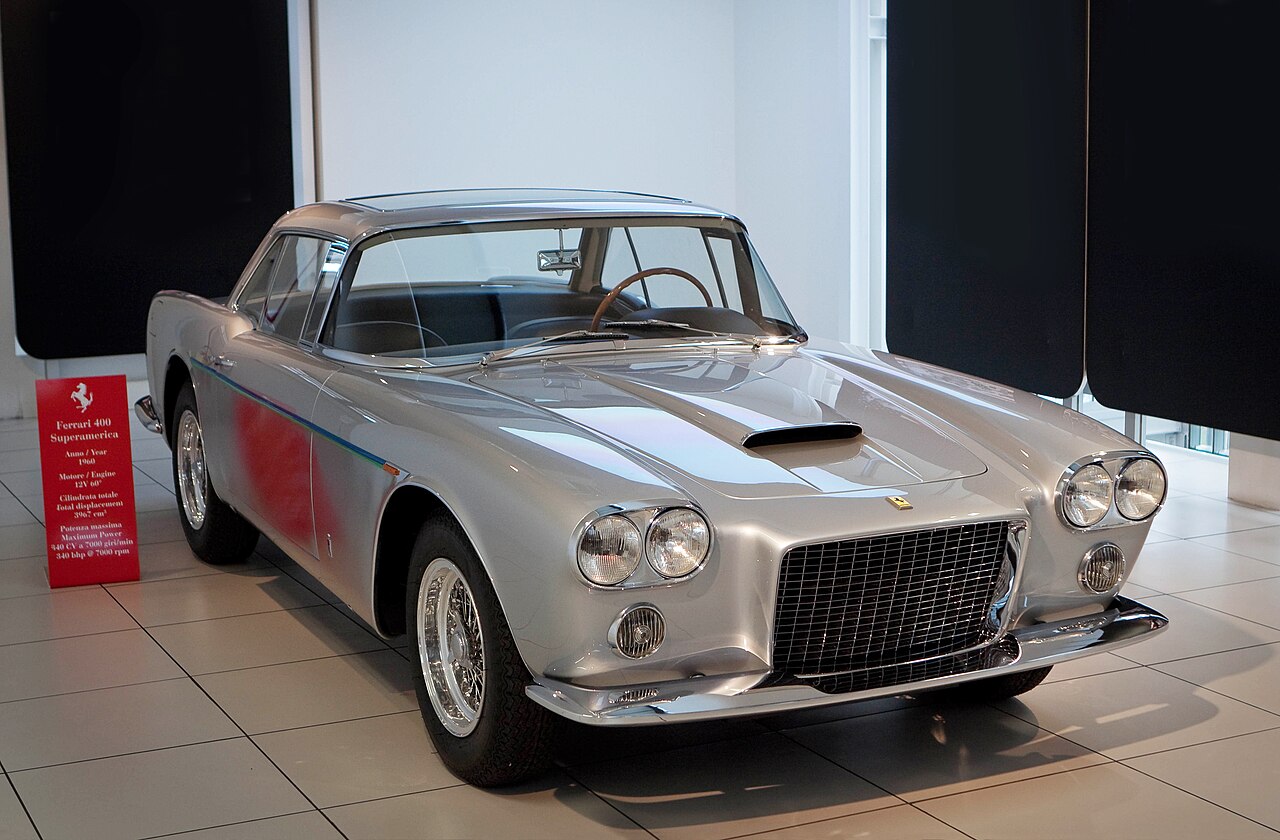
The museum photograph shows the special car’s unusually formal front: a broad, rectangular grille, paired lamps and an upright-looking windscreen frame. Its long bonnet and restrained cabin place it firmly within the grand touring tradition, but the treatment of the nose differs markedly from more familiar rounded Ferrari sports bodies. Ferrari’s history explains that the first car’s front treatment was revised between exhibition and delivery. The photograph therefore needs to be read as a later presentation of a historically evolving object. It supplies a visible reference for the Agnelli commission, while the factory account explains why period and present photographs may not match in every detail.
Identifying the original configuration
The 400 designation refers to the model’s total displacement class, rather than repeating the usual single-cylinder naming logic used on many other Ferraris. The factory record identifies a four-litre V12 and an overdrive-equipped transmission. Those programme facts should not be treated as a complete specification for every bespoke body or later series change. First-series cars and special Superfast show treatments require careful individual classification. The original Agnelli body is not a generic illustration of every aerodynamic coupé. This profile deliberately records both levels: the small early programme and the unique original commission used as its photographic reference.
Collector context and preservation
For collectors, the first 400 Superamerica illustrates how a flagship Ferrari could be created around a client’s requirements as much as around a standardised body. That makes delivery photographs and correspondence especially useful alongside chassis records. A factory-documented revision is part of the car’s story, not necessarily a deviation to be concealed. The model’s elegance is also more complex than a single adjective: grille shape, windscreen treatment and restrained cabin proportions produce a formal presence that can be compared with the lighter visual language of a competition berlinetta. Preserve the commission, body evolution and broader series identity together. They explain why this early Superamerica deserves a distinct profile even without an invented exact first-series production number.
Reading the evidence for this profile
The original source links below identify the programme and the historical statements used in this article. The photograph has its own creator and licence record, separate from the manufacturer’s vehicle history. Keep both when transferring this profile into a collection catalogue. A manufacturing tally describes how many cars belong to a defined original programme; it does not measure how many survive, how many are publicly visible, or how many retain all their original components. Those individual questions require dated chassis and restoration evidence. The reference year likewise describes the programme’s introduction or named historic configuration, while the supplied caption states the photographed setting and any established individual identity. This lets future research expand the car’s history without blurring the scope of the record already assembled here.
Specifications and verified rarity
| Reference year | 1959 |
|---|---|
| Model / programme | 400 Superamerica Series I |
| Body / role | Coachbuilt flagship grand touring car |
| Engine architecture | Front-mounted 4.0-litre V12 |
| Transmission | Manual with overdrive |
| Exact manufacturing tally | Not established |
| Eligibility bound | 46 for the documented scope or parent programme |
| Rarity scope | Original first-series 400 Superamerica cars within the complete 46-car model programme. Exact Series I tally is not asserted. Photo identifies the original Agnelli special, chassis 1517 SA. |
| Inventory reference | FER-055 — Verified |
Frequently asked questions
Why is the profile dated 1959?
Ferrari documents the first chassis, 1517 SA, at the October 1959 Turin Salon.
Were all 46 cars Series I?
No. Forty-six is Ferrari’s complete model-programme tally; the Series I subset is left unquantified.
Which special car is photographed?
The source and factory history identify the original Agnelli commission, chassis 1517 SA.
Why can early and later photographs differ?
Ferrari documents changes to the first car between exhibition and delivery.
What rarity or archive scope is verified?
Original first-series 400 Superamerica cars within the complete 46-car model programme. Exact Series I tally is not asserted. Photo identifies the original Agnelli special, chassis 1517 SA.
Who took the supplied photograph?
File:1960 Ferrari 400 Superamerica.jpg: ravas51
derivative work: Mr.choppers via Wikimedia Commons, under CC BY-SA 2.0. The original file and licence links accompany the image. Retain that credit when the photograph is uploaded, exported or reused.
Related Ferrari profiles
Sources and photo credits
Photograph: File:1960 Ferrari 400 Superamerica.jpg: ravas51
derivative work: Mr.choppers via Wikimedia Commons original file, CC BY-SA 2.0. Source-provided photograph supplied without local cropping, retouching or text removal. A source thumbnail is used where available. Original Agnelli 400 Superamerica special, chassis 1517 SA, displayed at the Ferrari museum; its bespoke body is not presented as universal Series I coachwork.
Built in limited numbers
Original first-series 400 Superamerica cars within the complete 46-car model programme. Exact Series I tally is not asserted. Photo identifies the original Agnelli special, chassis 1517 SA.
Gallery
Specifications
Factory specifications may vary by model year, market and configuration.
Identity & production
- Official model
- 400 Superamerica Series I