2018 Citroën E-Méhari Art Car by Jean-Charles de Castelbajac
Explore the 2018 Citroën E-Méhari Art Car by Jean-Charles de Castelbajac: sourced history, design, specifications and rarity evidence, with credited documentary photos.
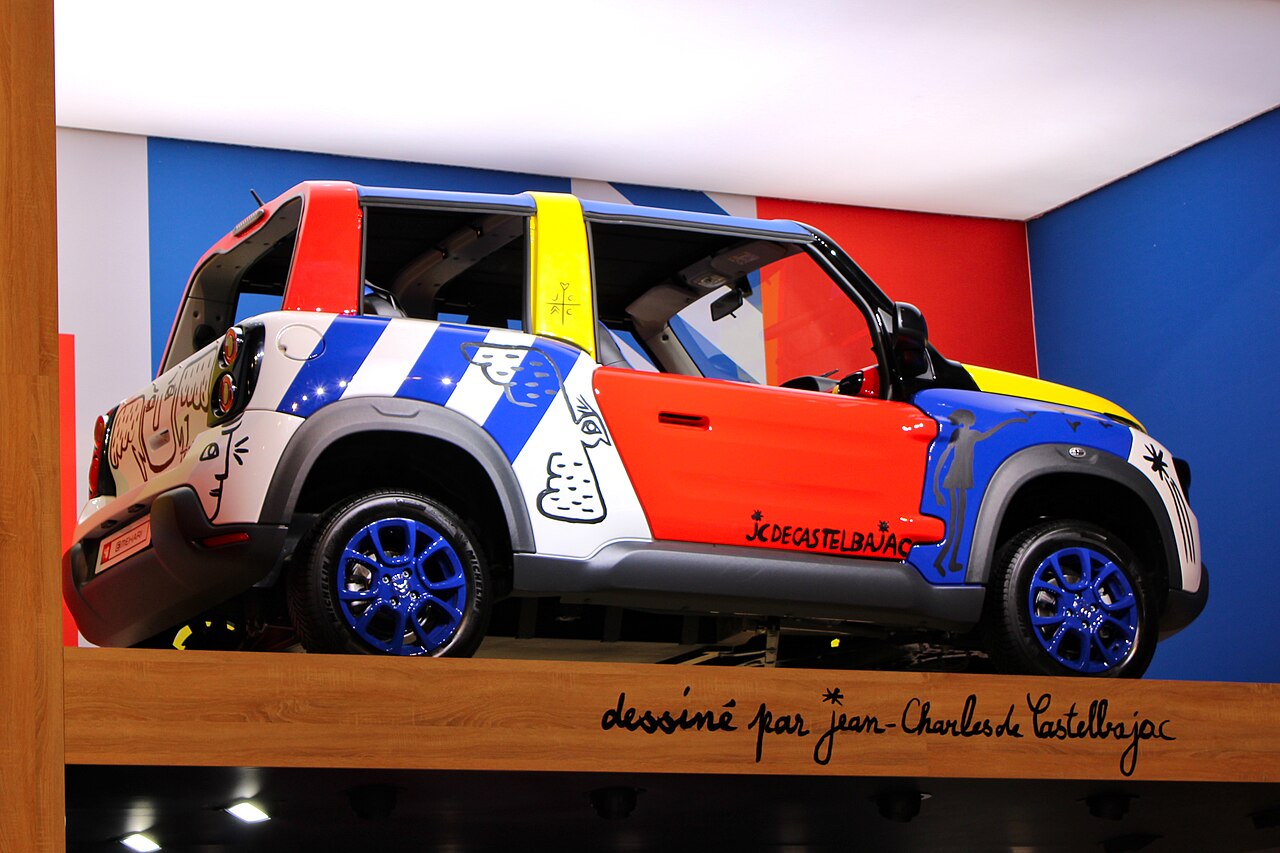
The 2018 Citroën E-Méhari Art Car by Jean-Charles de Castelbajac transforms an electric leisure vehicle into a moving surface for colour and drawing. Its uniqueness belongs to the commissioned artwork, not to every E-Méhari carrying a special finish.
An artwork for the Méhari anniversary
Citroën’s May 2018 announcement describes a unique art car created by Jean-Charles de Castelbajac to mark fifty years since the original Méhari. The electric E-Méhari supplied the base vehicle. The manufacturer’s singular artwork description supports the one-car scope used here; it is not a count of all production E-Méharis or all vehicles designed by the artist.
The distinction is useful because an art car and a numbered edition represent different collecting subjects. An edition repeats a defined treatment across a finite series. An art car can use the vehicle as one individual work. Its identity depends on the connection between artist, object and commission. Reproducing similar colours on another car would not, without documentary evidence, give that car the history of the original artwork.
Reading the painted vehicle
The Paris 2018 photograph shows strong blocks of blue, white and orange-red across the body. Drawn and handwritten elements move over the pale surfaces. The open cabin leaves the artwork visible as a sequence of individual panels, rather than surrounding it with a continuous closed roof.
The painting uses the vehicle’s own divisions as part of its composition. Colour can distinguish the nose from the side while the marks connect them visually. The result invites a viewer to move around the object, because a single front view cannot show the entire work. This is interpretation of the visible artwork. The image alone does not establish the paint medium, the artist’s workshop process or the conservation treatment of every panel.
The electric base and the historical reference
The anniversary links the work to the original Méhari’s 1968 introduction. That historical reference does not make the electric E-Méhari mechanically identical to the older vehicle. The artwork belongs to its modern electric base, and this record keeps the two generations distinct.
The comparison remains meaningful at the level of character. An open leisure vehicle gives an artist exposed surfaces and an informal passenger setting to work with. The anniversary commission can therefore be read as a conversation about the vehicle’s cultural role as well as its appearance. It should not become an excuse to import engine specifications, production totals or ownership stories from the earlier Méhari.
What matters in an art-car provenance file
A complete record would connect the named artist and commission to the object through dated photographs, original correspondence where available, and a custodial history. Conservation records deserve special attention: repainting a functional car and conserving an artwork are different activities, even when they concern the same panel.
The supplied photograph identifies the displayed artwork but does not document a chassis number. Its licence covers the photographer’s image under the stated terms; it is not presented as a separate transfer of the artist’s underlying intellectual-property rights. Retain the visible creator and source credits when reusing the image. The art car’s value as an archive subject comes from preserving both identities—the vehicle as a constructed object and the artist’s intervention as an individually scoped work.
Specifications and verified rarity
| Reference year | 2018 |
|---|---|
| Model / project | E-Méhari Art Car by Jean-Charles de Castelbajac |
| Body / role | Unique electric art car |
| Artwork total | One unique art car |
| Artist | Jean-Charles de Castelbajac |
| Occasion | Fiftieth anniversary of the original Méhari |
| Base | Electric E-Méhari |
| Rarity scope | Manufacturer-described unique 2018 anniversary art car; one artwork vehicle, not the entire E-Méhari production programme. |
| Exact manufacturing tally | 1 |
| Inventory reference | CIT-159 — Verified |
Frequently asked questions
Is the one-car count supported?
Yes. Citroën described this commissioned anniversary art car as unique.
Was it made for the original Méhari’s anniversary?
Yes, for the fiftieth anniversary in 2018.
Does the art-car count cover the Courrèges edition?
No. That is a separate numbered production programme.
Does the photograph establish the car’s chassis number?
No. It identifies the exhibited artwork rather than a published chassis record.
What rarity or archive scope is verified?
Manufacturer-described unique 2018 anniversary art car; one artwork vehicle, not the entire E-Méhari production programme.
Who took the supplied photograph?
Alexander Migl via Wikimedia Commons, under CC BY-SA 4.0. Keep the photographer, original-file link and licence credit with the image.
Related Citroën profiles
Sources and photo credits
Photograph: Alexander Migl via Wikimedia Commons original file, CC BY-SA 4.0. Source photograph supplied without local cropping, retouching or text removal. A source-provided thumbnail is used where available. Unique Castelbajac E-Méhari anniversary art car at the Paris Motor Show 2018. No chassis number assigned.
Built in limited numbers
Manufacturer-described unique 2018 anniversary art car; one artwork vehicle, not the entire E-Méhari production programme.
Gallery
Specifications
Factory specifications may vary by model year, market and configuration.
Identity & production
- Official model
- E-Méhari Art Car by Jean-Charles de Castelbajac