1972 Citroën GS Camargue by Bertone
Explore the 1972 Citroën GS Camargue by Bertone: sourced history, design, specifications and rarity evidence, with credited documentary photos.
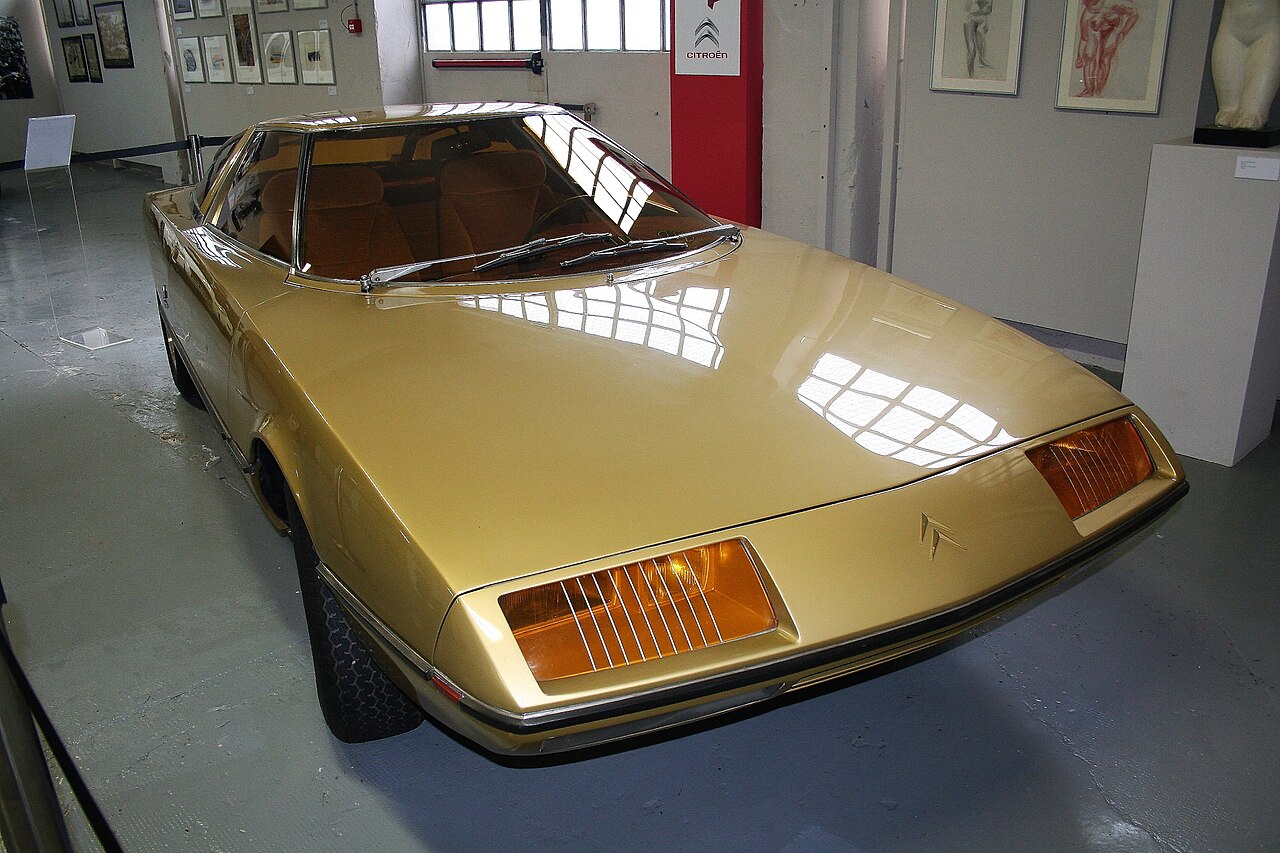
The Citroën GS Camargue by Bertone gives the GS a strikingly different visual identity. A broad wedge, a low glass enclosure and a restrained front turn the familiar family-car context into an exercise in compact, futuristic grand touring.
A 1972 project, rather than a 1973 debut
Citroën’s own history dates the Camargue to 1972 and attributes the project to Bertone. That evidence supplies the reference year used here, correcting the inventory’s 1973 entry. The subject is the physical GS-based concept, not a customer special edition. The profile does not convert the presence of a surviving show car into an unsupported global manufacturing total.
The choice of a GS foundation is useful historical context. A concept can explore a new body and a new image without requiring the reader to assume a completely unrelated mechanical programme. The interesting design question is how much the character of a car can change when the proportions, glazing and visual emphasis are rearranged.
The wedge and the glass enclosure
In the supplied photograph, the gold bonnet occupies a broad uninterrupted plane. Rectangular lamps sit low at the corners, and the glass cabin rises as a dark enclosure behind it. The front bumper traces a thin line across the width. There is little decoration to distract from the relationship between the flat nose and the cabin.
The image makes the Camargue feel more like a single designed volume than a collection of separate panels. Reflections reveal the smooth surface, while the amber lamp sections provide small points of colour within the front. This is a reading of the photographed object. It does not establish an aerodynamic coefficient or the effectiveness of any cooling arrangement.
Bertone authorship deserves a careful description
The design-house attribution is secure in the manufacturer’s account. Individual designer credits have been presented differently in historical retellings, so this profile uses Bertone without assigning a disputed personal authorship. That choice keeps the essential relationship clear while leaving the finer attribution question open to drawings, project records and first-hand testimony.
A coachbuilder’s archive can add considerable depth: early sketches explain alternatives, mock-up images reveal the development of the glasshouse, and construction photographs distinguish styling decisions from fabrication solutions. For a car with such clean surfaces, even small changes in a window outline or lamp position can alter the visual balance.
The Camargue’s place in a concept collection
Place the Camargue beside Karin and the contrast is immediate. The Camargue’s wedge spreads outward across the front; Karin’s geometry draws attention upward into a pyramidal cabin. Both invite discussion about how a few strong geometric ideas can carry a complete vehicle identity. Their comparison is more informative than treating “futuristic” as a single interchangeable style.
A useful collector record should follow the photographed car through displays and conservation work while keeping those dates separate from the original project year. The present image documents an appearance in the ASI Bertone collection at Volandia. It is a later collection view, not a photograph of the 1972 unveiling.
Specifications and verified rarity
| Reference year | 1972 |
|---|---|
| Model / project | GS Camargue by Bertone |
| Body / role | Two-seat concept coupé |
| Design house | Bertone |
| Reference year | 1972, corrected from inventory’s 1973 |
| Underlying project | GS-based concept |
| Accommodation | Two-seat design study |
| Rarity scope | Documented physical Bertone GS Camargue concept project, presented in 1972. Exact global fabrication tally unset. |
| Exact manufacturing tally | Not established |
| Inventory reference | CIT-053 — Verified |
Frequently asked questions
What is the correct reference year?
1972, supported by Citroën’s project history.
Who is credited with the project?
Bertone. No disputed individual designer attribution is asserted here.
Was Camargue a production GS edition?
It is a physical concept design project.
Is the supplied photograph from its debut?
No. It is a later view in the ASI Bertone collection at Volandia.
What rarity or archive scope is verified?
Documented physical Bertone GS Camargue concept project, presented in 1972. Exact global fabrication tally unset.
Who took the supplied photograph?
Andrea Volpato from pv Novara, Italia via Wikimedia Commons, under CC BY-SA 2.0. Keep the photographer, original-file link and licence credit with the image.
Related Citroën profiles
Sources and photo credits
Photograph: Andrea Volpato from pv Novara, Italia via Wikimedia Commons original file, CC BY-SA 2.0. Source photograph supplied without local cropping, retouching or text removal. A source-provided thumbnail is used where available. GS Camargue in the ASI Bertone collection at Volandia. Later display of the 1972 concept.
Built in limited numbers
Documented physical Bertone GS Camargue concept project, presented in 1972. Exact global fabrication tally unset.
Gallery
Specifications
Factory specifications may vary by model year, market and configuration.
Identity & production
- Official model
- GS Camargue by Bertone