Auto Union Type C Grand Prix Car
The Auto Union Type C is the V16 Grand Prix design associated with Bernd Rosemeyer’s 1936 European Championship. It belongs to Audi’s corporate heritage archive, with its period manufacturer and racing identity preserved. Original museum material, restored cars and demonstration recreations require separate descriptions, particularly when a photograph cannot establish the history of one chassis.
The Auto Union Type C is the V16 Grand Prix design associated with Bernd Rosemeyer’s 1936 European Championship. It belongs to Audi’s corporate heritage archive, with its period manufacturer and racing identity preserved. Original museum material, restored cars and demonstration recreations require separate descriptions, particularly when a photograph cannot establish the history of one chassis.
Auto Union Type C Grand Prix Car at a glance
| Manufacturer | Auto Union |
|---|---|
| Archive connection | Audi corporate heritage |
| Model / programme | Type C |
| Profile scope | Auto Union works Grand Prix heritage archive |
| Historical reference year | 1936 |
| Inventory reference | AUDI-003 |
| Historical engine reference | Six-litre supercharged V16 |
| Exact original build total | Unresolved; no certified production number populated |
The mature V16 Grand Prix design
The Type C represents a later stage of the Auto Union racing concept introduced with the Type A. Its historical importance comes from the documented programme rather than a contemporary retail allocation. A reader should understand it as a racing type first, with individual cars then examined through their own records. This avoids two opposite mistakes: treating every Type C as a single unique vehicle, or assuming that a familiar name makes all exhibits equivalent in originality, configuration and competition history.
Rosemeyer and the 1936 championship
Audi’s account identifies Bernd Rosemeyer as European Champion in 1936, the major accolade of that Grand Prix era. The guide connects that achievement with the Type C programme without calling it a modern Formula One world championship. It also leaves individual chassis participation unresolved unless a separate record supplies it. A later car carrying a Rosemeyer-style number can convey the historical setting effectively, but the number and livery cannot establish that the displayed object delivered a championship result in period.
The six-litre engine and its positioning
Audi’s historical account describes the final V16 form as six litres, located behind the driver. This gives the model a clear engineering identity, while detailed power and performance references remain attached to their source and configuration. For an individual engine, a specialist would need its identity and rebuild history rather than a generic Type C specification. The appeal is the way the engine and chassis formed an unusual Grand Prix package, not a claim that every surviving or recreated example retains an untouched period unit.
Grand Prix bodywork and the streamliner
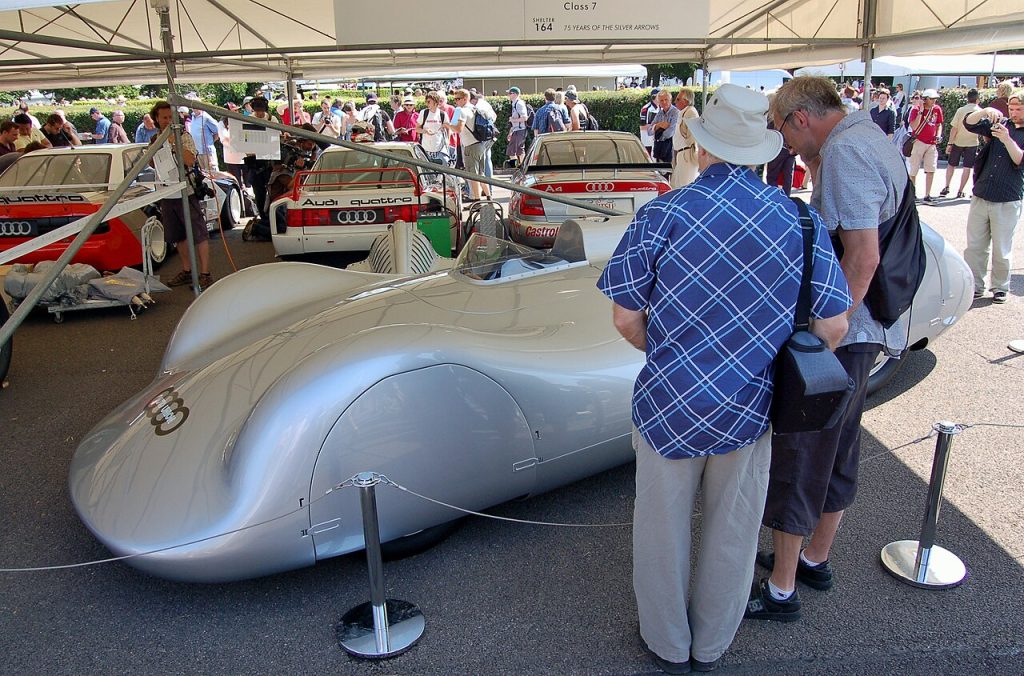
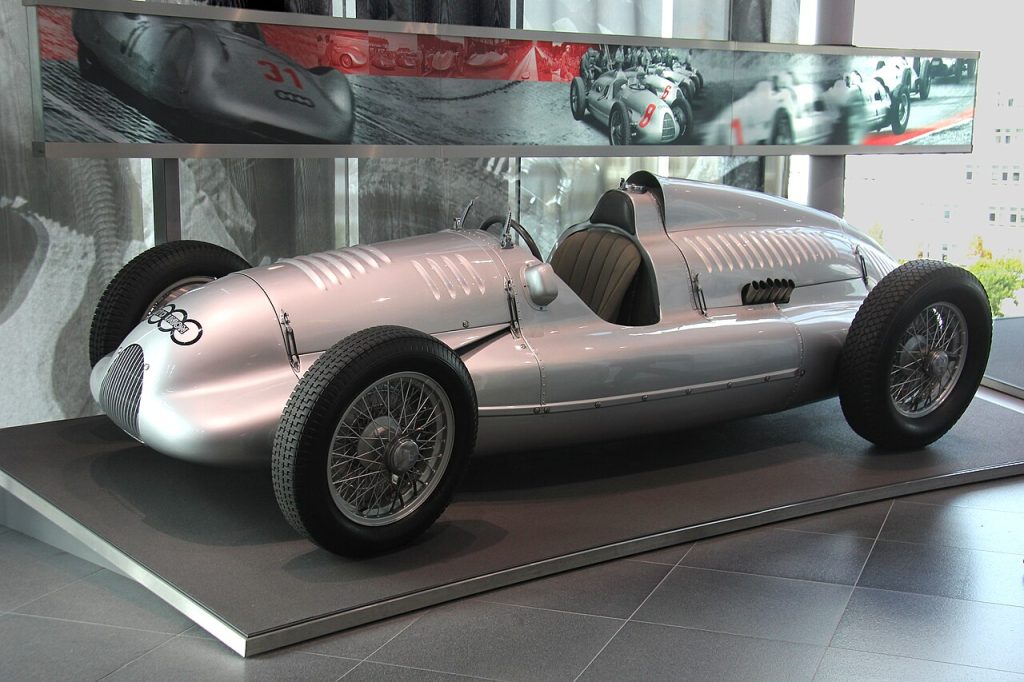
The open-wheel Grand Prix Type C and the enveloping streamlined version are related but distinct archive subjects. A photograph of one should not silently illustrate the other as though the bodies and uses were identical. Record attempts introduce additional date and configuration questions, especially when a later exhibit reproduces a famous shape. Separate profiles make those distinctions visible. They also allow readers to compare the same general engine concept serving circuit competition and high-speed aerodynamic experiments without blending all achievements into one car.
Rarity and the missing original census
The retrieved Audi material supports the works-racing programme but does not settle a complete original Type C chassis total. Production metadata remains unset. A statement about cars accessible after the war is not a manufacture count, and a museum’s present display inventory is not necessarily a complete survival register. Counting race starts would be equally misleading because one physical car could appear repeatedly. The rarity explanation therefore keeps the programme’s scale and surviving-object questions separate rather than inventing an exact numerical badge for the profile.
The Deutsches Museum connection
Audi’s 2012 retrospective describes a Type C presented to the Deutsches Museum before the war and damaged during a bomb attack. That record explains why the museum context matters, but it should not be expanded into a full restoration or race history for a particular photograph without an object record. A surviving car can contain genuine historical material and later replacement work together. Readers benefit from knowing how that material was identified, what was rebuilt and which claims remain attached only to the broader type.
Original material, restoration and recreation
These terms describe different aspects of a vehicle and should not be used as interchangeable praise. Original material refers to components; restoration describes work on an object; recreation describes a later construction reproducing a lost or historic design. A restoration can require new parts without turning every statement about the object into a replica claim. Conversely, a faithful recreation does not inherit period competition provenance automatically. The most informative caption and collector account explain the actual evidence instead of relying on a single broad authenticity adjective.
Demonstration appearances are a later history
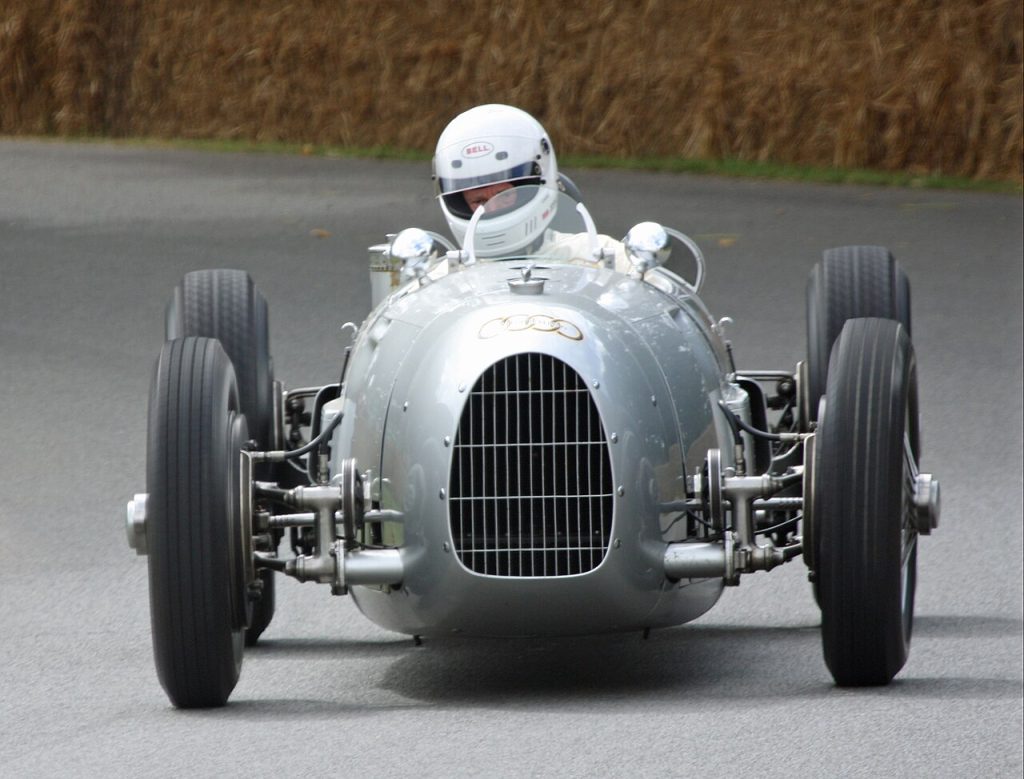
Audi’s heritage programme uses recreated racing cars for public appearances, and its own magazine identifies a faithfully built Type C replica. That gives modern audiences access to the shape and sound of the design. Such appearances belong in the demonstration vehicle’s later chronology. They do not add another car to an original 1930s production census or certify that the driver at a modern event is associated with the pictured vehicle’s period race history. Both stories can be told clearly when their dates and objects remain distinct.
What the supplied museum image establishes
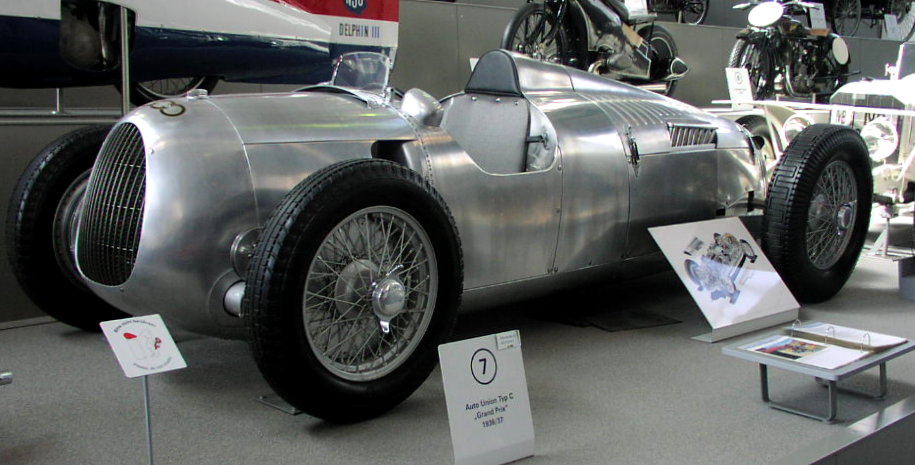
The photo source identifies a 1936 Type C exhibit at the Deutsches Museum Verkehrszentrum. This is a modern museum illustration rather than a period race photograph. The caption does not assign a specific Grand Prix, build number or current mechanical condition to it. The source is useful for visual identity and location, while the primary manufacturer account supplies historical context. An expanded gallery should add the museum’s object identification and restoration notes before making stronger assertions about the particular frame or engine seen in the photograph.
A practical provenance review for a works car
For a claimed original works object, start with component identities and their earliest traceable documentation. Then examine how those components were assembled during and after the competition period. Record gaps rather than bridging them through similarity to another car. Restoration invoices, dated photographs and archive correspondence can explain later changes and help separate representative specification from retained race-period configuration. A technical inspection and a historical attribution should support one another, but neither should be presented as a replacement for the other.
Comparisons that make the Type C understandable
The Type A is the natural comparison for the programme’s origin, the streamliner for aerodynamic development and the Type D for the next rules and engine configuration. Those links make the archive more useful than a list of unrelated rare cars. Each comparison should answer a concrete question: what changed in purpose, architecture or specification? It should not imply that the later V12 shared every characteristic of the Type C or that the streamlined record body was simply an optional consumer specification.
Why it remains a significant archive subject
The Type C brings together corporate identity, racing achievement and the problem of preserving machinery whose original context has disappeared. That combination rewards a guide with careful naming and documented distinctions. For a collector, the decisive issue is the evidence attached to the actual object; for a reader, the model history explains why that evidence matters. A profile can make the design vivid without claiming exclusive ownership, a market value or an exact survivor total that the available sources do not establish.
Frequently asked questions
What championship is associated with the Type C?
Audi identifies Bernd Rosemeyer as the 1936 European Champion, rather than a modern Formula One world champion.
Did the Type C use a V16?
Yes. Audi describes the mature engine as a six-litre V16 behind the driver.
Is the Streamliner the same profile?
It is a separate body/use subject developed from the Type C programme.
Does a modern Type C demonstration prove period originality?
No. Audi also uses recreations; the history of the pictured physical object requires its own record.
Explore related vehicle profiles
Sources
- Audi — The age of the Silver Arrows
- Audi — How the Silver Arrow legend was born
- Audi — Type D recovery and restoration, 2012
- Audi Magazine Australia — Motorsport royalty
Programme history and specifications follow the linked manufacturer and heritage records. Where figures or dates differ, their source contexts are retained. Collector-file and inspection guidance is editorial analysis; exact physical-car identity requires its own evidence.
Photography and credit
Source-identified 1936 Auto Union Type C exhibit at the Deutsches Museum Verkehrszentrum, Munich. Modern museum photograph; specific race participation and component originality not assigned. Photo: MartinHansV / Wikimedia Commons · Public domain (photographer release recorded on Commons). Original image supplied without visual changes.
Why this machine matters
The Auto Union Type C is the V16 Grand Prix design associated with Bernd Rosemeyer’s 1936 European Championship. It belongs to Audi’s corporate heritage archive, with its period manufacturer and racing identity preserved. Original museum material, restored cars and demonstration recreations require separate descriptions, particularly when a photograph cannot establish the history of one chassis.
Built in limited numbers
The retrieved Audi material supports the works-racing programme but does not settle a complete original Type C chassis total. Production metadata remains unset. A statement about cars accessible after the war is not a manufacture count, and a museum’s present display inventory is not necessarily a complete survival register. Counting race starts would be equally misleading because one physical car could appear repeatedly. The rarity explanation therefore keeps the programme’s scale and surviving-object questions separate rather than inventing an exact numerical badge for the profile.
Gallery
Specifications
Factory specifications may vary by model year, market and configuration.
Identity & production
- Official model
- Auto Union Type C Grand Prix Car
- Base model
- Type C
Powertrain & performance
- Engine
- Six-litre supercharged V16