Aston Martin A3
A3 is the oldest surviving Aston Martin identified by the Aston Martin Heritage Trust. It is a 1921 prototype with a long history of modification and a documented restoration toward its original specification. The surviving object provides a tangible connection to the marque’s earliest engineering, distinct from the missing Coal Scuttle.
A3 is the oldest surviving Aston Martin identified by the Aston Martin Heritage Trust. It is a 1921 prototype with a long history of modification and a documented restoration toward its original specification. The surviving object provides a tangible connection to the marque’s earliest engineering, distinct from the missing Coal Scuttle.
Aston Martin A3 at a glance
| Manufacturer | Aston Martin |
|---|---|
| Model / family | A-series |
| Profile scope | Historic prototype archive |
| Historical reference year | 1921 |
| Inventory reference | AST-002 |
| Object / count scope | One identified surviving prototype; among five original prototype chassis |
| Historical chassis identifier | A3 / 1918 |
| Historical registration reference | XN 2902 |
The oldest survivor, with a precise identity
The Heritage Trust identifies A3 as the third Aston Martin built and the oldest still in existence. That is a statement about this surviving prototype, not a claim that it was the first car bearing the name or the first retail production model. The distinction matters to a rare-vehicle catalogue. A3 can be inspected and documented as a surviving object, while earlier names belong to a different chronology. Its collecting significance comes from that specific place in the marque’s history and the evidence that connects the present vehicle to its early identity.
A prototype rather than a normal production edition
The Trust places A3 among five original prototype chassis developed by Bamford and Martin. This corrects the supplied inventory’s description of it as a production car. Prototype classification makes the history clearer: development objects can undergo changes before a settled customer model exists. Do not assign a conventional edition allocation or infer a production-series total from the number of prototypes. One named surviving chassis is the subject of this guide. Other early objects should have separate identities, so an archive can describe the development programme without counting A3 more than once.
Identification became important in 2001
The Trust’s account explains that the significance of the car emerged when it was offered at auction in 2001 and its A3 identity was recognized. This is an important provenance milestone because appearance and later configuration had obscured the early object. The finding should be presented with its source, not expanded into an unsupported story about every earlier owner. For research, retain identification reports and supporting documents alongside the public summary. A recognition event becomes useful to later custodians when they can understand what evidence established the identity and which physical material was assessed.
Rarity: a documented individual prototype
A3 is an individual prototype, with the Trust’s object record providing the basis for the profile. Its significance does not require a fabricated numbered edition or a global survival census for all early cars. Keep one-object scope separate from the broader prototype programme and from current ownership claims. The record lists A3 or 1918 as chassis identification and XN 2902 as registration. Those labels are identifiers; 1918 should not silently become its build year. Accurate field definitions prevent a historic number from creating a misleading chronology or a duplicate vehicle entry.
The restoration toward 1921 specification
The Heritage Trust records a full rebuild by Ecurie Bertelli beginning in 2006, returning A3 toward its 1921 specification. That is central to interpreting the present appearance. A restored early object is not automatically untouched, and historically correct replacement material can have its own documented purpose. Describe the work and retained fabric rather than using original as a blanket adjective. A conservation file should show which evidence guided decisions. Readers can then appreciate the car’s restored presentation while understanding that physical condition, configuration and continuity are related but distinct parts of its history.
Modification is part of the survival story
The Trust notes repeated modification during the car’s life. An individual history should record those stages where evidence exists rather than treating every departure from early appearance as a recent mistake. A development vehicle’s useful life can include changes made by its creators and later owners. The conservation decision is to explain those layers and the chosen reference period. Retain earlier photographs alongside restoration views so that a future reader can see how the current state was reached. This makes the archive more informative than a simple before-and-after claim that erases the intermediate history.
Authenticating components and the whole object
A specialist file should correlate chassis identification, construction, components, restoration documentation and custody records. A registration plate alone cannot establish the complete material history. Likewise, a replacement component does not by itself erase a documented vehicle identity. The useful account explains what survives and how each important claim is supported. Where provenance is incomplete, distinguish the object-level finding from a claim about an individual engine, body panel or control. This lets the prototype’s historical continuity remain understandable without suggesting that every visible part necessarily dates from its earliest period.
Learning from a restored early prototype
A3 offers a way to study an early design at human scale: seating, controls, structure and the relationship between mechanical parts can be examined together. This is an interpretive opportunity, not an assertion that modern observers are seeing every exact detail of a particular day in 1921. Use the restoration record to establish the chosen specification. Dated technical drawings and photographs should guide comparisons with later models. A vehicle can be a powerful educational object while the archive remains clear about reconstruction, replacement material and the evidence behind the presentation.
The supplied modern photograph
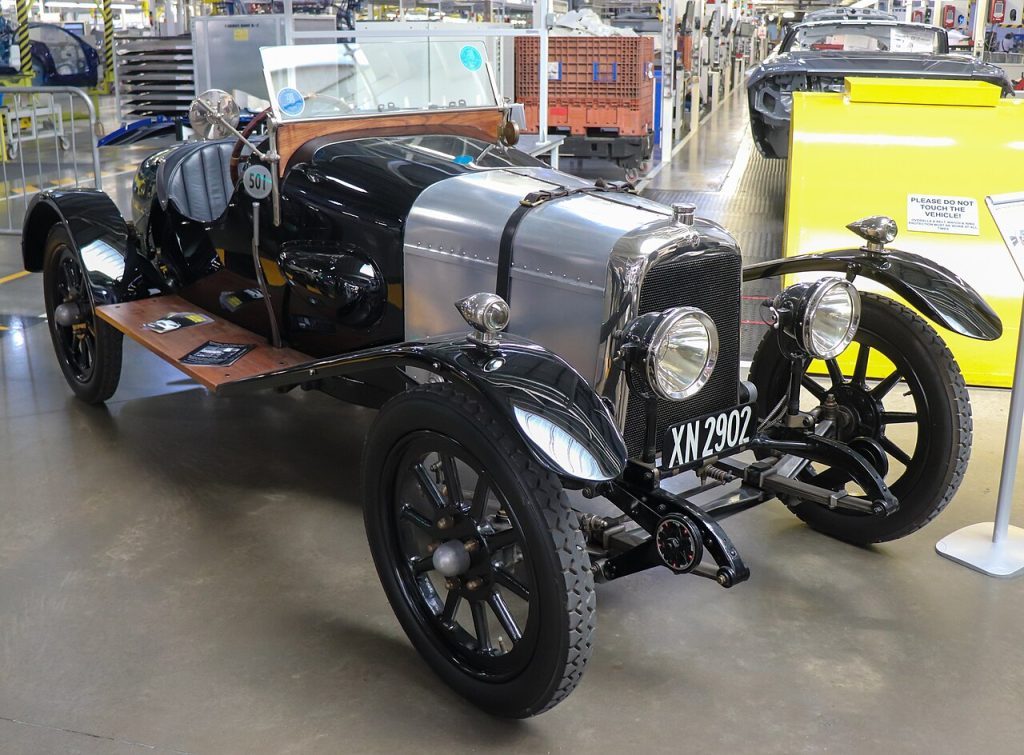
The bundled licensed photograph shows A3 in a later restored presentation at Gaydon. Its caption and photographer attribution keep that setting distinct from a period image. It provides direct visual context for the surviving prototype without proving the age of each fitted part. The linked source and licence explain how the photo may be reused, with its resizing note retained. A more detailed individual-object feature could add close views under their own rights records. The model guide already gives readers a real subject image while preserving the restoration context needed to interpret what they see.
A3 and the racing cars that followed
TT1 and Razor Blade represent different objectives within the early marque: Grand Prix participation and specialized speed or race work. A3 belongs to the prototype history. Compare programme purpose and dated technical evidence before interpret a shared badge as a common specification. Early racing hardware should not be copied into A3’s missing fields. Related guides help readers follow those separate paths, while this profile remains attached to one documented vehicle. The collection becomes richer when development, racing and survival are explained together without flattening their different physical identities.
Preservation before operation
Any proposed operation should follow a qualified assessment of the present systems, condition and support. A museum or heritage appearance does not substitute for a current mechanical inspection. Preserve operating records, maintenance and component changes with the restoration file. Static display and running demonstration can impose different needs on surviving material. A sensible plan should define the purpose first, then explain how it protects the object and documents any intervention. This is especially useful for an early prototype whose importance depends on physical continuity and research value as well as a convincing restored appearance.
Keeping the prototype record useful
Maintain one chassis record with its recognized identifiers, source dates, restoration history and later appearances. Keep administrative inventory labels separate from the public definition of the vehicle. New evidence can refine a component finding or an ownership date without changing the car into a different type of edition. The aim is a durable account that another editor can check. A3’s place as the oldest documented surviving Aston Martin deserves a clear explanation of both its historical identity and its restored state, with the evidence preserved alongside the attractive image.
Frequently asked questions
Is A3 a production-series model?
The Heritage Trust describes it as an original prototype; the inventory wording is corrected.
What does the number 1918 mean here?
It is an alternative chassis identifier in the Trust record, not a substituted build year.
Was A3 restored?
The Trust records a rebuild by Ecurie Bertelli beginning in 2006 toward 1921 specification.
Does the photo show a period scene?
No. It shows the surviving A3 in a later restored presentation at Gaydon.
Explore related Aston Martin profiles
Sources
- Aston Martin Heritage Trust: A3 identity and restoration
- Tim Cottingham: Coal Scuttle chronology and missing-car account
Historical claims follow the linked manufacturer, archive, specialist and catalogue records, with disputed findings retained. Inspection and collecting guidance is editorial analysis. Catalogue condition and custody statements remain dated to their sources.
Photography and credit
A3 in a later restored presentation at Gaydon in 2019; not a period photograph or proof that every fitted part dates from 1921. Photo: Vauxford / Wikimedia Commons · CC BY-SA 4.0. Wikimedia thumbnail resized from original; no cropping or colour changes.
Why this machine matters
A3 is the oldest surviving Aston Martin identified by the Aston Martin Heritage Trust. It is a 1921 prototype with a long history of modification and a documented restoration toward its original specification. The surviving object provides a tangible connection to the marque’s earliest engineering, distinct from the missing Coal Scuttle.
Built in limited numbers
A3 is an individual prototype, with the Trust’s object record providing the basis for the profile. Its significance does not require a fabricated numbered edition or a global survival census for all early cars. Keep one-object scope separate from the broader prototype programme and from current ownership claims. The record lists A3 or 1918 as chassis identification and XN 2902 as registration. Those labels are identifiers; 1918 should not silently become its build year. Accurate field definitions prevent a historic number from creating a misleading chronology or a duplicate vehicle entry.
Gallery
Specifications
Factory specifications may vary by model year, market and configuration.
Identity & production
- Official model
- Aston Martin A3
- Base model
- A-series