Aston Martin V12 Vantage V600 Coupé
The 2018 V12 Vantage V600 Coupé is the closed-body half of a fourteen-car Q commission. Aston Martin’s retrospective confirms seven coupes and seven Roadsters, combining the previous-generation VH Vantage with a naturally aspirated V12 and manual transmission. The coupe’s significance lies in that bespoke final expression of a familiar architecture.
The 2018 V12 Vantage V600 Coupé is the closed-body half of a fourteen-car Q commission. Aston Martin’s retrospective confirms seven coupes and seven Roadsters, combining the previous-generation VH Vantage with a naturally aspirated V12 and manual transmission. The coupe’s significance lies in that bespoke final expression of a familiar architecture.
Aston Martin V12 Vantage V600 Coupé at a glance
| Manufacturer | Aston Martin |
|---|---|
| Model / family | Vantage |
| Profile scope | Factory Q commissioned coupe archive |
| Historical reference year | 2018 |
| Inventory reference | AST-141 |
| Original series total | 7 — Completed 2018 V12 Vantage V600 coupe body series; seven Roadsters separately profiled |
| Parent / broader count scope | 14; not additive to this profile |
| Documented customer delivery year | 2018; not an inferred production-start year |
| Historical engine reference | Naturally aspirated V12; factory 600 PS reference |
An exceptionally small factory commission
The V600 coupe belongs to a complete commissioned vehicle programme, rather than a trim combination that happened to be ordered infrequently. Its history is therefore best anchored in the factory project and the actual completed specification. Establishing that identity helps explain why it deserves a separate archive entry within the Vantage family. It also gives a prospective owner a clear documentary task: connect the individual chassis to the commission before comparing condition, equipment and presentation with another example.
Rarity: seven coupes within fourteen V600s
The manufacturer’s Historic Models account says fourteen V12 Vantage V600s were produced, divided equally between coupes and Roadsters. This supports a seven-car completed coupe scope. The two body entries are components of that fourteen-car programme and should not be added again as extra vehicles. No survival count is implied. An individual coupe can change configuration or custody over time without changing the original programme total, so its present history belongs in a separate dated record.
A 2018 car with an earlier Vantage architecture
The programme uses the previous-generation VH Vantage, despite its 2018 reference year. That point matters because a calendar date alone can direct a reader toward the wrong Vantage generation. Record the factory model identity and underlying architecture together when cataloguing the car. Replacement parts, service procedures and comparative profiles should follow the actual vehicle. The historical interest is partly in how a mature platform was revisited through a small commission as the manufacturer moved forward with a different product generation.
The V600 name and the earlier V8 connection
The launch release connects the name with the V8 Vantage V600 of the late 1990s. This is a historical naming relationship, not an assertion that the two cars share an engine or identical engineering. The modern coupe’s identity should be written as V12 Vantage V600 whenever ambiguity is possible. A collection can explore both uses of the name, but their specifications, body histories and production scopes need separate treatment. That approach makes the shared theme interesting without flattening decades of development into one model.
Naturally aspirated V12 and manual transmission
The modern V600’s factory reference is a naturally aspirated V12 producing 600 PS, paired with a seven-speed manual. Preserve the stated unit instead of relabelling the figure as bhp. The manual gearbox is central to the commission’s appeal, but it does not make every driving experience or maintenance requirement identical across the seven coupes. Assess clutch operation, shift quality and the dated service history of the actual vehicle. Mechanical originality and current mechanical health are related questions with different forms of evidence.
A new body expression around the familiar platform
The launch describes a carbon exterior with a distinctive bonnet, grille, side treatment and rear diffuser. As design interpretation, these features give the coupe a coherent presence instead of relying on one prominent spoiler to announce its identity. Record the junctions, panel surfaces and original finishes carefully. A repair to a rare body component may require a more detailed explanation than a general description of cosmetic work. The archive should preserve that explanation without making unsupported assumptions about the availability or price of replacement parts.
Wheels, exhaust and the original configuration
The bespoke wheel and exhaust presentation forms part of the launch specification. For an individual car, the original order remains the reference for its exact finish and equipment. Clear photographs of the wheel arrangement, tailpipes and rear treatment help readers understand the design, while invoices establish any subsequent changes. Avoid using a single event image to certify that every item is original. A small commissioned series can still contain differences between what was shown publicly, what was delivered and what a later owner elected to replace.
A cabin organised around the driver
The factory presentation combines dark materials, carbon details and a machined gear lever. The collecting interest comes from the relationship between those finishes and the manual control layout. A detailed interior record should include the instruments, console, seats and identifying plaques alongside the original specification. Wear, retrimming and replacement switchgear belong in the car’s dated history. They should be described concretely, because a broad statement that an interior is immaculate can leave a reader uncertain about whether the surfaces are original or newly restored.
Launch schedules versus documented deliveries
The May 2018 release discussed a third-quarter delivery timetable. The H1 investor presentation later records that the first coupe units had already been delivered in the second quarter. Use that retrospective delivery statement for the documented milestone, while retaining the earlier release as a schedule. Neither statement independently establishes the final delivery date of all seven coupes. This distinction keeps the timeline precise enough to be useful and leaves registration or handover dates attached to the individual chassis that they actually describe.
Authenticating the V600 coupe
Begin with original factory identity, the commission order and handover material. Reconcile those records with the body, cabin, gearbox and edition details, using a specialist familiar with the programme. An apparently similar V12 Vantage should not receive V600 status from exterior resemblance alone. Conversely, a documented repair should not be confused with a different model identity. The useful result is a complete account of what the chassis was built as and how its current specification relates to that original record.
Inspection and conservation priorities
A collector inspection should consider carbon panels and low-mounted parts, the manual driveline, wheel condition, cooling equipment, brakes and tires. These are areas to evaluate, not claimed universal defects. Ask how storage, use and maintenance have been managed, especially if mileage is low. Conservation decisions deserve written records when rare finishes or parts are involved. A well-documented car gives a future owner a basis for choosing between preserving an aged original component and commissioning a sympathetic repair.
The coupe photograph and related manual Vantages
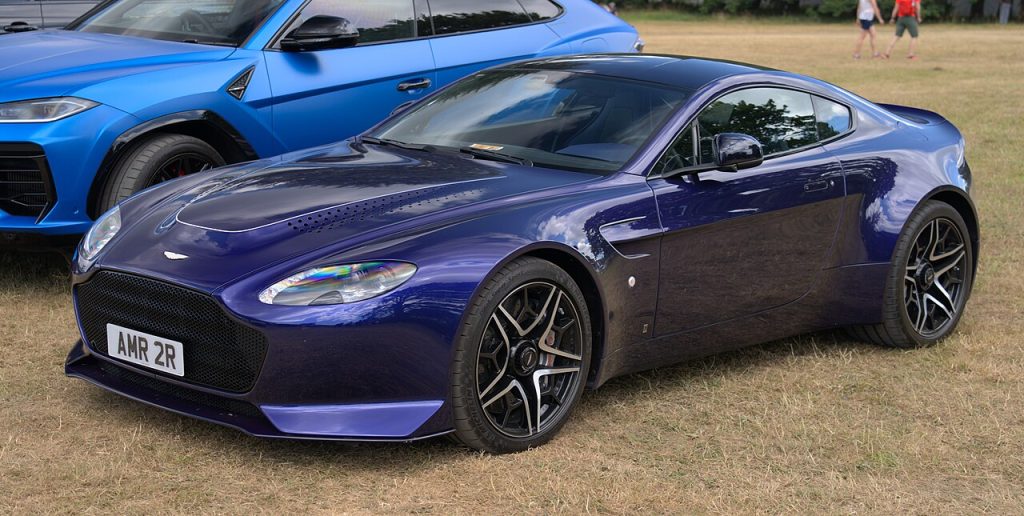
The supplied Goodwood photograph shows a source-identified V600 coupe in 2025. It illustrates the closed body while leaving its build number and present condition unassigned. Compare it with the Roadster entry to understand the body split, and with the earlier V12 Vantage AMR to explore different approaches to a manual Vantage. The GT12 provides another useful sporting reference. Each comparison should retain its own gearbox, production scope and engineering brief, rather than allowing a shared cylinder count to substitute for the model history.
Frequently asked questions
How many V12 Vantage V600 coupes were built?
Aston Martin’s Historic Models account confirms seven coupes, within a completed fourteen-car programme also containing seven Roadsters.
Is this the supercharged V8 V600?
No. The 2018 car is a V12 Vantage commission using the earlier VH Vantage architecture. The V600 name deliberately recalls an older V8 model.
What gearbox does the modern V600 use?
The factory specifies a seven-speed manual transmission. Individual operation and condition should be checked on the actual car.
When did coupe deliveries begin?
The H1 2018 investor presentation records first coupe units delivered in Q2 2018, refining the earlier launch timetable. It does not certify every coupe’s handover date.
Explore related Aston Martin profiles
Sources
- Aston Martin Historic Models: completed V600 programme, seven coupes and seven roadsters
- Aston Martin: V600 customer commission launch, 9 May 2018
- Aston Martin H1 2018 investor presentation, slide 11: first V600 coupe deliveries in Q2, Roadsters expected Q4
Historical claims follow the linked manufacturer, archive, specialist and catalogue records, with disputed findings retained. Inspection and collecting guidance is editorial analysis. Catalogue condition and custody statements remain dated to their sources.
Photography and credit
Source-identified V12 Vantage V600 coupe at Goodwood Festival of Speed in July 2025. No individual build number or current condition assigned. Photo: MrWalkr / Wikimedia Commons · CC BY-SA 4.0. Wikimedia thumbnail resized from original; no cropping or colour changes.
Why this machine matters
The 2018 V12 Vantage V600 Coupé is the closed-body half of a fourteen-car Q commission. Aston Martin’s retrospective confirms seven coupes and seven Roadsters, combining the previous-generation VH Vantage with a naturally aspirated V12 and manual transmission. The coupe’s significance lies in that bespoke final expression of a familiar architecture.
Built in limited numbers
The manufacturer’s Historic Models account says fourteen V12 Vantage V600s were produced, divided equally between coupes and Roadsters. This supports a seven-car completed coupe scope. The two body entries are components of that fourteen-car programme and should not be added again as extra vehicles. No survival count is implied. An individual coupe can change configuration or custody over time without changing the original programme total, so its present history belongs in a separate dated record.
Gallery
Specifications
Factory specifications may vary by model year, market and configuration.
Identity & production
- Official model
- Aston Martin V12 Vantage V600 Coupé
- Base model
- Vantage
- Worldwide production
- 7
Powertrain & performance
- Engine
- Naturally aspirated V12; factory 600 PS reference