Aston Martin V12 Vantage Roadster
The 2022-announced V12 Vantage Roadster combines the modern twin-turbo V12 programme with an open body and its own 249-car allocation. Its factory specification shares core engineering with the coupe while preserving body-specific calibration and equipment choices. The Roadster remains a separate archive subject from earlier open V12 Vantages.
The 2022-announced V12 Vantage Roadster combines the modern twin-turbo V12 programme with an open body and its own 249-car allocation. Its factory specification shares core engineering with the coupe while preserving body-specific calibration and equipment choices. The Roadster remains a separate archive subject from earlier open V12 Vantages.
Aston Martin V12 Vantage Roadster at a glance
| Manufacturer | Aston Martin |
|---|---|
| Model / family | Vantage |
| Profile scope | Limited V12 Roadster programme |
| Historical reference year | 2022 |
| Inventory reference | AST-163 |
| Factory allocation limit | 249; completed census not independently certified |
| Historical engine reference | 5.2-litre twin-turbo V12 |
An open V12 programme introduced at Pebble Beach
The manufacturer introduced the new V12 Vantage Roadster at Pebble Beach in August 2022. Its identity concerns the modern twin-turbo generation, rather than every open Aston Martin carrying a V12 Vantage name. That distinction should lead the profile because search results can mix several eras. The open body provides a different collecting proposition from the coupe, while the factory release supplies the common engineering context. An individual example’s build records should establish its specification within this particular programme.
Rarity: a separate 249-car Roadster allocation
The release limited the Roadster to 249 customer examples globally and reported that the allocations were sold before reveal. The number belongs to this body programme and should not be folded into the coupe’s 333-car figure. It remains an announced ceiling rather than an independently reconciled completed chassis register in this guide. An example-specific account should connect the vehicle with its factory order and delivery documents, avoiding a further rarity claim for colour, market or equipment combinations unless a suitable record supports it.
The twin-turbo V12 in an open body
The factory specifies the same 5.2-litre twin-turbo V12 output of 700 PS and 753 Nm for the Roadster. Use the stated units and keep the generation clear. The presence of an open body does not turn those factory figures into a measured result for a particular car, and the guide has not road-tested the example in the photograph. A technical inspection should record its actual configuration, modifications and service findings. This preserves both the engineering story and the distinction between model data and condition evidence.
Automatic transmission and body-specific calibration
The Roadster uses an eight-speed ZF automatic, with factory-described damper tuning for its body. The historical account should explain that common hardware does not require identical calibration between coupe and Roadster. An inspector needs the correct records for the actual car, especially when assessing software, alignment or replacement parts. The guide does not invent a manual Roadster derivative by importing another generation’s specification. A carefully bounded technical account makes comparison useful while preserving what is particular to the open programme.
The roof adds an inspection dimension
An open car benefits from a recorded inspection of its roof, seals and associated mechanisms alongside the ordinary body assessment. Describe actual observations and work performed, rather than inferring a problem from age or an event photograph. Keep a dated demonstration and any repair invoices in the collector file. The aim is to explain condition and continuity clearly. A small allocation gives the car historical context, while its individual roof and interior history remain practical matters that should be supported by specific evidence.
The rear wing was an option on the Roadster
The factory supplied the Roadster without the large wing as standard and offered it as an option. This differs from the coupe’s wing-delete arrangement. Preserve that equipment distinction rather than describing every open car by the leading coupe publicity image. A winged Roadster can represent a factory choice, while a wingless example is not inherently incomplete. The original order should identify the configuration, and any subsequent addition or removal should be documented with its date and retained parts where applicable.
Widebody materials and repair documentation
The source describes carbon-fibre front body elements and composite rear components. An exterior inspection should therefore identify the relevant materials and any known repairs rather than assume that every panel shares the same construction. Photographs can help show finish and fit, while hidden condition needs suitable inspection evidence. Retain the reason, date and method of body work with the service history. This lets a later reader distinguish a well-documented intervention from an unsupported claim that a visually clean surface proves total originality.
Factory options and the character of an individual car
The Roadster release discusses optional lightweight wheels and carbon performance seats, together with Q personalisation. A collector can record those choices as part of the car’s original character without inferring a production subset from the number of similar cars currently advertised. Make the original order accessible and distinguish later changes. The archive’s purpose is to connect a particular configuration with reliable evidence. A distinctive specification remains interesting even when a manufacturer-wide count for its exact combination has not been established.
The announcement year and the photographed example year
The release body is dated August 19, 2022, while its webpage timestamp reads August 20. The photograph source describes a 2023 example and records a May 2024 capture. Those dates concern different events and can coexist without contradiction. The profile uses 2022 as the programme announcement reference. Third-quarter production and fourth-quarter 2022 deliveries were schedules in the reveal source, so individual completion and handover dates remain tied to the car’s own documentation rather than inferred from those plans.
The licensed open-body photograph
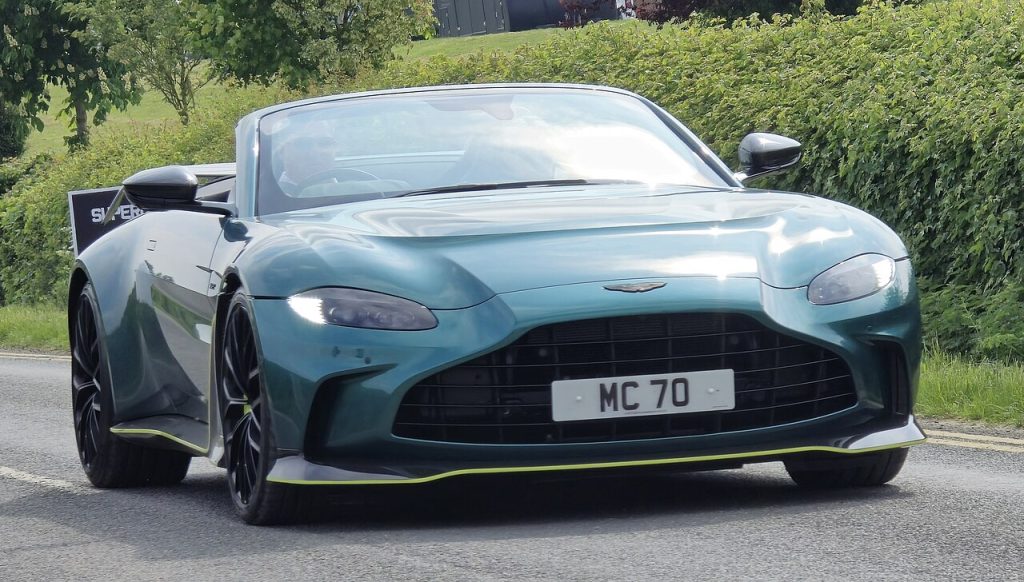
The included image is source-identified as a 2023 V12 Vantage Roadster and shows the appropriate modern open body. Its caption distinguishes the example year from the 2022 programme announcement. The photographer supplies it under a CC0 dedication; the package nevertheless retains a visible source and photographer credit. No current owner, build serial or present condition is assigned. This is a model illustration with a clear date and identity scope, allowing readers to understand the body distinction while editors retain a traceable image record.
Building an example-specific collector file
A useful collector file for the Aston Martin V12 Vantage Roadster connects the physical vehicle with its original specification, subsequent care and present description. Keep original documents in sequence and distinguish copies, later summaries and unverified notes. Service invoices should identify the work performed rather than merely supply a stamped date. Add photographs of relevant details and explanations of later changes. That structure gives a future reader a way to follow the evidence and reduces reliance on a general claim of rarity, low mileage or originality.
Condition and originality are separate questions
An original component can require repair, while a replacement component can be in excellent condition. A careful description should explain both identity and state, with the inspection date clearly attached. Ask a suitably qualified specialist to assess the actual car and record what could and could not be inspected. Photographs of exterior finish do not establish hidden structure, mechanical health or serviceability. The archive should preserve findings at their supported level and avoid converting a dated observation into a permanent guarantee about the vehicle.
Reading sale descriptions without inventing value
A production number supplies context, but it does not determine the value of a particular example. This guide assigns no current price, investment return or guaranteed premium. A useful sale record identifies the date, venue, currency, fee treatment, configuration and evidence of the transaction. An asking price and a completed sale are different observations. Compare documentation, condition and accompanying objects before drawing a conclusion from rarity alone, and leave any unsupported market claim outside the verified vehicle history.
Maintaining the archive as evidence develops
Keep new information attached to its source and date. When a later record resolves a production count, delivery event or photograph identity, update that specific finding while preserving the earlier evidence and the reason for the change. A revised fact should not silently rewrite unrelated parts of the car’s history. This approach makes the profile a useful research record rather than a collection of repeated claims. Readers should be able to distinguish confirmed programme information, individual-vehicle evidence and clearly identified editorial guidance.
Frequently asked questions
What is the V12 Vantage Roadster allocation?
The factory announced 249 customer examples worldwide, separate from the coupe.
Does it use a manual gearbox?
No. This generation uses an eight-speed ZF automatic.
Was the large rear wing standard?
No. The Roadster was supplied without it as standard, with a wing offered as an option.
Why does a 2022 profile use a 2023 car photograph?
The programme was announced in 2022; the source labels the pictured example 2023 and dates its photograph to May 2024.
Explore related Aston Martin profiles
- Aston Martin V12 Vantage Coupe
- Aston Martin Vantage Roadster A3
- Aston Martin V12 Vantage V600 Roadster
Sources
- Aston Martin: V12 Vantage Roadster reveal at Pebble Beach, release dated 19 August 2022
- Aston Martin: 2022 V12 Vantage coupe reveal, 16 March 2022
Historical claims follow the linked manufacturer, archive, specialist and catalogue records, with disputed findings retained. Inspection and collecting guidance is editorial analysis. Catalogue condition and custody statements remain dated to their sources.
Photography and credit
Source-identified 2023 example of the 2022-announced V12 Vantage Roadster, photographed in May 2024. Example year and programme announcement are distinct. Photo: Calreyn88 / Wikimedia Commons · CC0. Wikimedia thumbnail resized from original; no cropping or colour changes.
Why this machine matters
The 2022-announced V12 Vantage Roadster combines the modern twin-turbo V12 programme with an open body and its own 249-car allocation. Its factory specification shares core engineering with the coupe while preserving body-specific calibration and equipment choices. The Roadster remains a separate archive subject from earlier open V12 Vantages.
Built in limited numbers
The release limited the Roadster to 249 customer examples globally and reported that the allocations were sold before reveal. The number belongs to this body programme and should not be folded into the coupe’s 333-car figure. It remains an announced ceiling rather than an independently reconciled completed chassis register in this guide. An example-specific account should connect the vehicle with its factory order and delivery documents, avoiding a further rarity claim for colour, market or equipment combinations unless a suitable record supports it.
Gallery
Specifications
Factory specifications may vary by model year, market and configuration.
Identity & production
- Official model
- Aston Martin V12 Vantage Roadster
- Base model
- Vantage
Powertrain & performance
- Engine
- 5.2-litre twin-turbo V12