2024 NIO ET9 First Edition
Explore ET9 First Edition: factory identity, history, specifications, rarity evidence, identification notes and credited photos.
The ET9 First Edition is a named NIO flagship allocation limited to 999 units in the manufacturer’s December 2024 launch announcement. It is distinct from the regular ET9 and from unidentified vehicles used at reveal events. The edition’s launch year, scheduled delivery period and factory quantity remain separate parts of the record.
The 999-unit allocation at NIO Day 2024
NIO’s 21 December 2024 announcement at Guangzhou’s NIO Day identifies the regular ET9 and a limited First Edition of 999. It quotes separate launch prices of RMB 788,000 and RMB 818,000 respectively, with China deliveries scheduled from March 2025. These are period launch terms. They are not current retail values or evidence of the completed condition of every allocated vehicle.
NIO: original ET9 launch, 999 First Editions and delivery schedule
An edition with a precise naming boundary
First Edition is the factory name supported by the launch statement. The regular ET9, a later Signature name or a launch-display car should not be silently absorbed into its 999-unit total. Nor should an early delivery be counted again as an extra edition. The allocation provides the rarity boundary; original sales and vehicle-identification records are needed to place an individual car inside it.
The flagship’s technical context
The launch release presents the ET9 around its digital architecture and SkyRide chassis system, describing steer-by-wire, rear-wheel steering and active suspension as parts of an integrated vehicle. These are ET9 family-level technical descriptions from that announcement. They provide context for the First Edition without pretending that the source is a complete edition-specific build sheet or that every later software release was fitted at first delivery.
NIO: original ET9 launch, 999 First Editions and delivery schedule
Why integrated control changes the design brief
Steering, rear-wheel response and suspension control affect different aspects of how a large passenger vehicle moves. Considering them together is a useful engineering reading of the flagship brief. The appeal is not simply a list of electronic features; it is the attempt to coordinate the driver’s inputs with passenger comfort and body movement. That interpretation does not assign an unverified performance test result to a particular First Edition example.
An executive cabin as part of the vehicle’s purpose
NIO’s launch presentation describes a four-space cabin organised through its Sky Island and Executive Bridge concepts, including a rear table. Those are useful family-level reference points for the intended executive use. The exact materials, optional equipment and limited-edition identifiers of an individual car need matched documentation. This article does not invent a unique First Edition upholstery package from photographs of a regular ET9.
NIO: original ET9 launch, 999 First Editions and delivery schedule
What the reference photograph shows
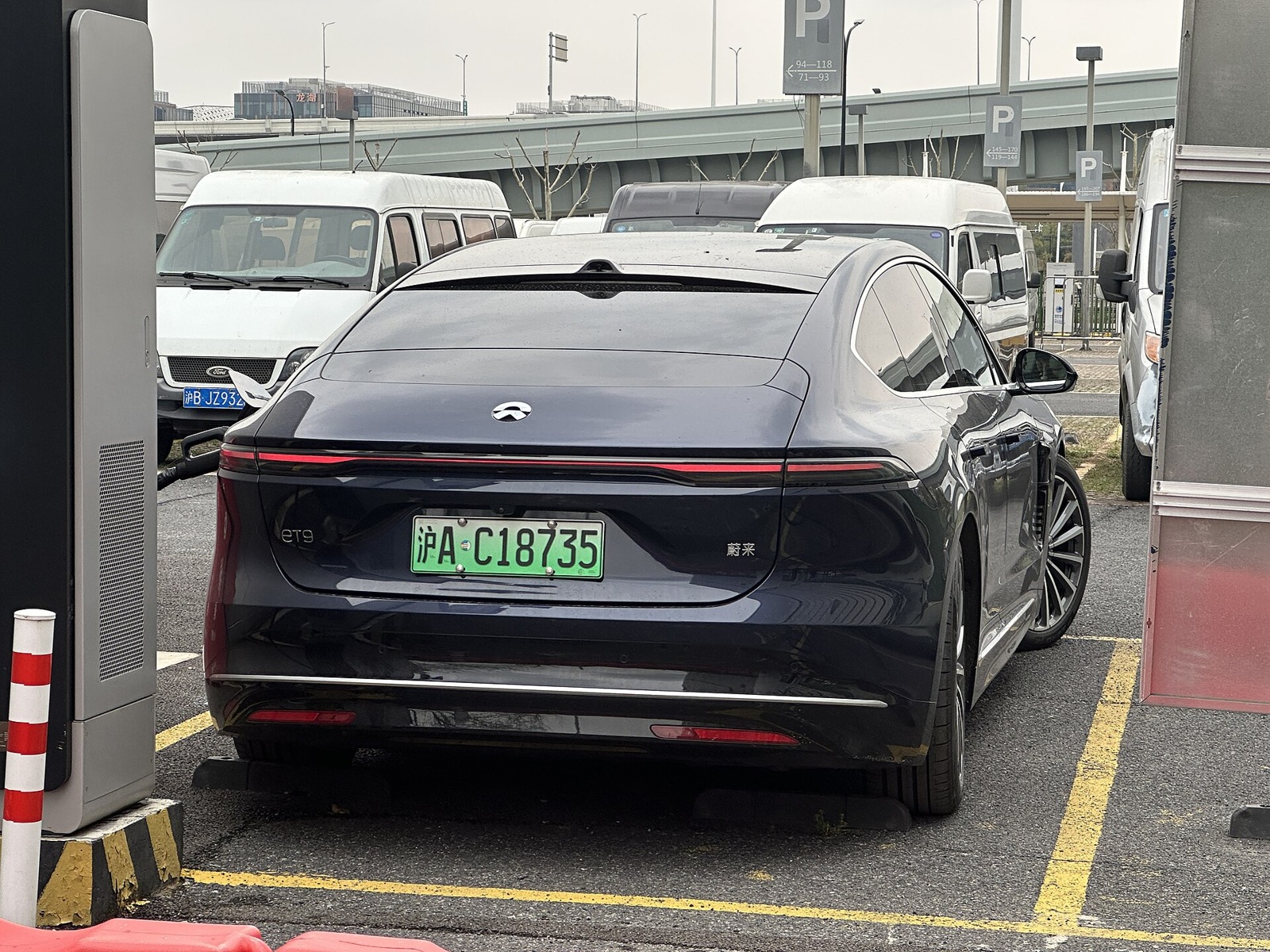
The included Creative Commons photograph is a NIO ET9 model reference. Its caption explicitly avoids claiming that the pictured car is one of the 999 or that it demonstrates authenticated First Edition-specific trim. The image helps readers recognise the model’s physical form. The edition count and naming come from NIO’s original release, keeping the visual and documentary roles clear.
Launch, delivery and completion are separate facts
The title uses 2024 because that is the edition’s announcement year. NIO’s original delivery schedule points to March 2025. A delivery-year description is therefore not automatically a different edition. This profile does not turn a sold-out report or an order allocation into proof of 999 completed and delivered cars. The manufacturer-announced limit remains in its own field, while the audited completed-production and survivor fields stay unset.
Authenticating an individual First Edition
The strongest evidence would link the vehicle’s complete identity to factory or original sales documentation explicitly naming First Edition. If a serial or plaque is present, record it alongside those documents rather than treating a detachable item as the entire proof. Later modifications, replaced trim or software changes can then be described separately. This gives the car a coherent history without assuming that every visible detail is original.
Comparing two bounded NIO launch programmes
The ES6 Premier Edition provides an earlier example of a factory-defined finite allocation. Its 6,000-car limit and model family are different from the ET9’s 999. Linking the two helps readers compare the role of launch editions while keeping each quantity attached to the correct name and date. Neither programme makes the surrounding regular production series rare by association.
Specification and identity reference
| Factory announcement | 21 December 2024 |
|---|---|
| Event / market | NIO Day, Guangzhou / China |
| Announced First Edition limit | 999 |
| Period launch price | RMB 818,000; historical announcement |
| Original delivery schedule | From March 2025 in China |
| Family technical context | SkyRide integrated steering and suspension systems |
| Completed production / survivors | Not assigned |
Rarity and production scope
Manufacturer-announced 999-unit factory edition limit. This is not an audited completed-production or current-survivor total.
Identifying the documented subject
Match the complete model name, date and programme to the linked evidence. Keep any chassis-specific provenance separate from a general description of the model. A period image confirms what was photographed, while a production or technical claim requires the corresponding document.
What the photograph represents
NIO ET9 model-family reference. This image does not authenticate one of the 999 First Edition cars or illustrate verified First Edition-specific trim.
Comparisons and related profiles
Continue through these connected NIO records, each with its own factory identity and production scope.
Frequently asked questions
Is the rarity figure a worldwide production total?
Manufacturer-announced 999-unit factory edition limit. This is not an audited completed-production or current-survivor total.
How should an individual example be authenticated?
Match the complete original model information to the appropriate dated documentation, then record the present condition and modifications separately. A badge, colour scheme or stripped interior alone is insufficient evidence of a factory grade.
Sources and further reading
- NIO: original ET9 launch, 999 First Editions and delivery schedule
- NIO: December 2024 SEC filing confirms the 999-unit First Edition
Research checked 16 October 2026. Original manufacturer announcements, official competition history and photographic evidence are identified separately. Design readings and documentation guidance are editorial interpretation.
Built in limited numbers
Manufacturer-announced 999-unit factory edition limit. This is not an audited completed-production or current-survivor total.
Gallery
Specifications
Factory specifications may vary by model year, market and configuration.
Identity & production
- Official model
- NIO ET9 First Edition
Sources and verification
Source citations are being prepared for this profile.