2018 Ferrari SP3JC
Explore the original Ferrari SP3JC: open F12tdf architecture, Pop Art graphics, carefully scoped rarity evidence and a credited Goodwood photograph.
The Ferrari SP3JC was officially handed to its owner in November 2018 as an uncompromising open interpretation of the F12tdf package.
History and purpose
The Ferrari SP3JC was officially handed to its owner in November 2018 as an uncompromising open interpretation of the F12tdf package. Ferrari’s original release identifies the donor chassis and running gear and describes a highly individual colour brief. The archive’s numerical scope requires more care: the workbook notes two related cars, while the original announcement concerns a single commission. This profile therefore leaves the wider body-programme tally unset. Its rarity remains bounded by the complete finite F12tdf donor programme, with the photographed original configuration identified separately from any later related appearance.
Design and engineering
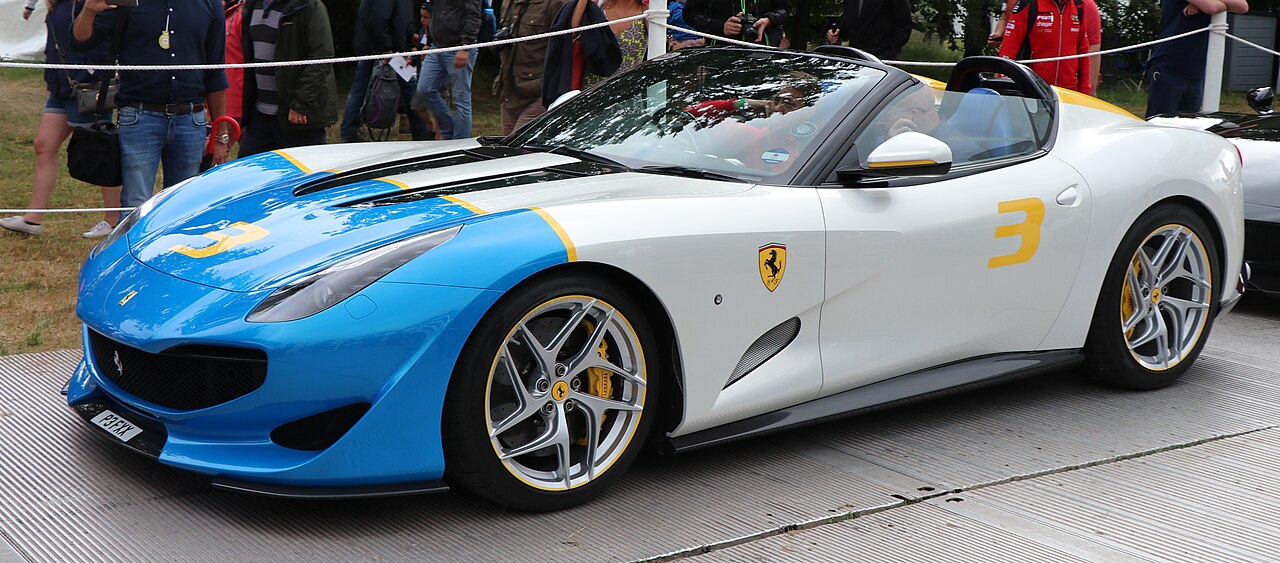
The Goodwood photograph shows a white car with a vivid blue front section and yellow accents. The open cabin, pronounced rear fairings and strong side graphics make the roadster visually different from the closed donor. Ferrari’s release links the finish to a Pop Art interest. That context makes the colour arrangement part of the brief rather than incidental decoration. The photograph also shows how the open passenger space interrupts the long front-V12 silhouette. A traditional engine-compartment proportion is retained, but the roofless upper body gives it a new balance and a much more exposed relationship between occupants and rear structure.
Identifying the original configuration
The image source identifies SP3JC at the 2019 Goodwood Festival of Speed, matching the blue, white and yellow original factory presentation. That configuration should not be replaced casually with a photo of a differently finished related car. The original commission is a clear physical subject, but a statement that exactly one SP3JC body exists worldwide would go beyond the unresolved wider tally. F12tdf’s finite programme supplies a conservative parent bound, not an exact SP3JC production number. Keeping those fields separate preserves both the strong factory identity evidence and the numerical question flagged by the inventory.
Collector context and preservation
Collectors can use the SP3JC to study how an open body changes a front-V12 special-series platform. The strongest comparison follows cabin opening, rear fairings and the relationship between graphic treatment and sculpted surfaces. A commission archive should retain the original handover record and dated colour references, then connect later related cars through their own chassis documents. The Goodwood image provides a public moment in that history. Leaving the wider tally open does not diminish the documented car; it creates a clearer catalogue that can absorb further original evidence without merging separate physical identities or rewriting an unsupported global count.
Reading the evidence for this profile
The original source links below identify the programme and the historical statements used in this article. The photograph has its own creator and licence record, separate from the manufacturer’s vehicle history. Keep both when transferring this profile into a collection catalogue. A manufacturing tally describes how many cars belong to a defined original programme; it does not measure how many survive, how many are publicly visible, or how many retain all their original components. Those individual questions require dated chassis and restoration evidence. The reference year likewise describes the programme’s introduction or named historic configuration, while the supplied caption states the photographed setting and any established individual identity. This lets future research expand the car’s history without blurring the scope of the record already assembled here.
Specifications and verified rarity
| Reference year | 2018 |
|---|---|
| Model / programme | SP3JC |
| Body / role | Bespoke open F12tdf-derived V12 roadster |
| Engine architecture | F12tdf-platform front-mounted 6.3-litre naturally aspirated V12 |
| Transmission / platform reference | F12tdf seven-speed dual-clutch platform |
| Exact manufacturing tally | Not established |
| Eligibility bound | 799 for the documented scope or parent programme |
| Rarity scope | Ferrari’s original 2018 SP3JC commission is verified. Inventory notes two related cars while the factory release describes one original commission; exact wider body-programme tally remains unset. Rarity bounded by the complete 799-car F12tdf donor programme. |
| Inventory reference | FER-208 — Verified |
Frequently asked questions
What is the SP3JC?
A documented 2018 open F12tdf-based commission. The pictured original is verified; the wider related-body tally remains unresolved and is not published as exactly one.
What engine and transmission does it use?
F12tdf-platform front-mounted 6.3-litre naturally aspirated V12. F12tdf seven-speed dual-clutch platform. These entries describe the documented vehicle or explicitly named donor architecture. They should be read alongside the body and programme scope, rather than transferred to every Ferrari carrying a similar badge.
Why is 2018 the reference year?
The title follows the documented introduction, public presentation or custodial model-year record explained in the history section. An individual delivery can occur later. Original workbook titles remain identity aliases when research corrects their year.
How should an individual example be identified?
Start with its chassis record and original configuration, then compare dated photographs, factory or commission paperwork and the service history. Model-level specifications explain the design, while the individual file establishes the identity and condition of the particular car.
What rarity or archive scope is verified?
Ferrari’s original 2018 SP3JC commission is verified. Inventory notes two related cars while the factory release describes one original commission; exact wider body-programme tally remains unset. Rarity bounded by the complete 799-car F12tdf donor programme.
Who took the supplied photograph?
Bryan S via Wikimedia Commons, under CC BY-SA 2.0. The original file and licence links accompany the image. Retain that credit when the photograph is uploaded, exported or reused.
Related Ferrari profiles
Sources and photo credits
- Original manufacturer, commission or custodial record
- Ferrari: documented platform architecture
- Original custodian: complete F12tdf donor scope
Photograph: Bryan S via Wikimedia Commons original file, CC BY-SA 2.0. Source-provided photograph supplied without local cropping, retouching or text removal. A source thumbnail is used where available. Original blue, white and yellow Ferrari SP3JC at the 2019 Goodwood Festival of Speed; the image is not substituted for a differently finished related example.
Built in limited numbers
Ferrari’s original 2018 SP3JC commission is verified. Inventory notes two related cars while the factory release describes one original commission; exact wider body-programme tally remains unset. Rarity bounded by the complete 799-car F12tdf donor programme.
Gallery
Specifications
Factory specifications may vary by model year, market and configuration.
Identity & production
- Official model
- SP3JC