2016 Ferrari J50
Explore the Ferrari J50: the distinct ten-car Japan anniversary roadster, 488 Spider architecture, bespoke design and credited museum photograph.
The Ferrari J50 celebrated the marque’s fifty-year relationship with Japan through a distinct ten-car body programme announced in 2016.
History and purpose
The Ferrari J50 celebrated the marque’s fifty-year relationship with Japan through a distinct ten-car body programme announced in 2016. Ferrari’s later anniversary feature confirms that ten examples were built and individually tailored. An original design-award release identifies the 488 Spider relationship and the Ferrari design team. The series therefore has a complete original scope even though its intended clients were Japanese. It is a separate design programme rather than a national delivery allocation from an otherwise identical worldwide model. That distinction gives the small number an intelligible meaning within the collector archive.
Design and engineering
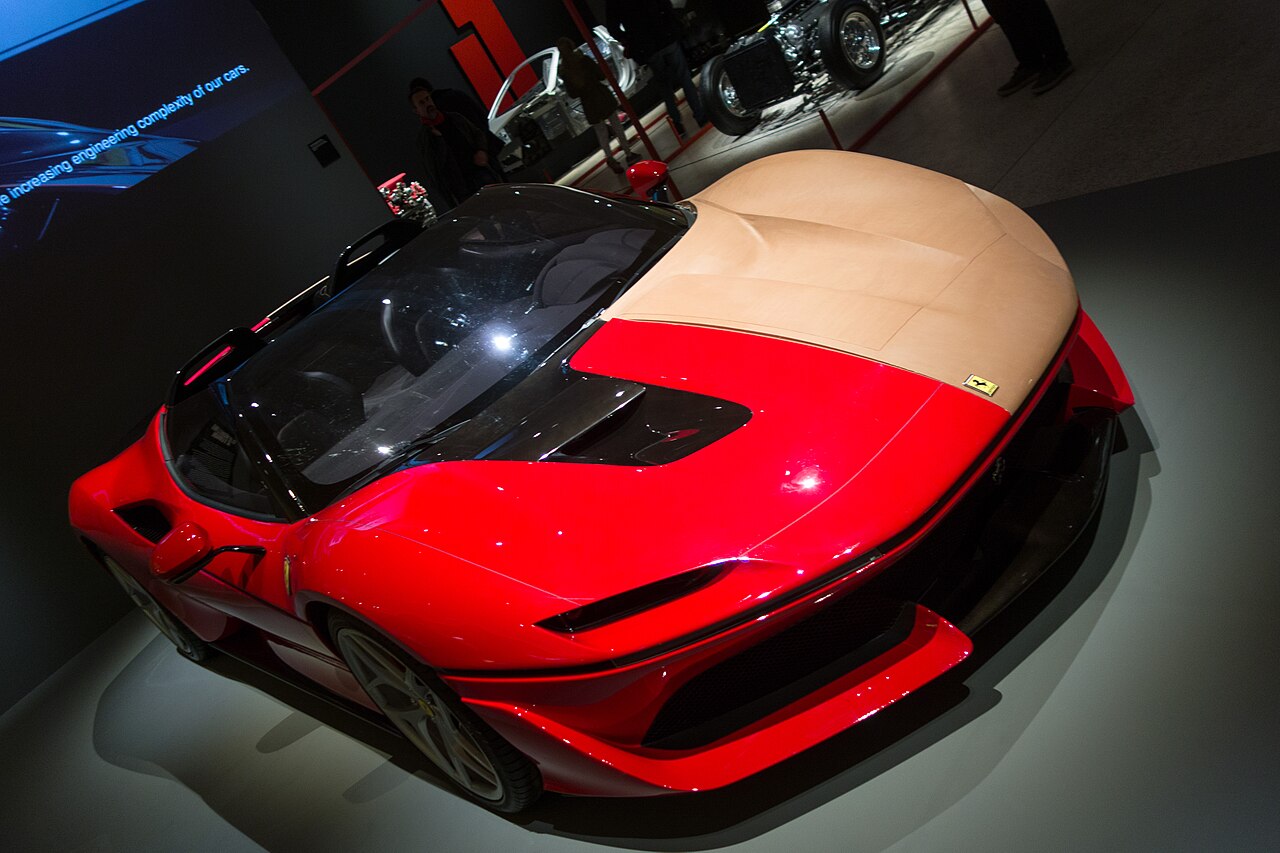
The supplied photograph shows the red J50 at the London Design Museum in 2018. A dark band runs around the cabin and across the nose, gathering the upper body into a strong horizontal theme. The open passenger compartment sits behind a long, low front volume, while the rear structure gives the roadster a pronounced shoulder line. Ferrari’s design release describes a new interpretation of the donor platform. In the image, colour contrast is part of that interpretation: the dark section appears to separate cabin from body, allowing the red surfaces to read as a continuous sculpted envelope.
Identifying the original configuration
J50 refers to the distinct anniversary roadster programme. An ordinary 488 Spider should not be counted among the ten merely because it was supplied in Japan or carries commemorative graphics. The source photograph explicitly names the J50 and its museum context, and the body matches the dedicated design. It is presented as a model reference rather than assigned an unverified client chassis. Ferrari’s retrospective built-count statement supplies the completed numerical scope. Individual finish and trim choices belong to each car’s original specification, so the red display configuration is not treated as compulsory for every member of the series.
Collector context and preservation
For collectors, the J50 is a useful example of a small series sitting between standard production and a single commission. The shared body provides a coherent model identity, while personalisation creates variation within the ten cars. An archive should preserve both levels. Platform servicing belongs with the individual chassis record; bespoke exterior panels and cabin materials deserve their own dated photographs. Comparing the J50 with the six-car Sergio reveals different approaches to a rare mid-engined open body. The museum setting adds a design-history perspective, showing how a functioning vehicle idea can also be studied as a resolved visual object.
Reading the evidence for this profile
The original source links below identify the programme and the historical statements used in this article. The photograph has its own creator and licence record, separate from the manufacturer’s vehicle history. Keep both when transferring this profile into a collection catalogue. A manufacturing tally describes how many cars belong to a defined original programme; it does not measure how many survive, how many are publicly visible, or how many retain all their original components. Those individual questions require dated chassis and restoration evidence. The reference year likewise describes the programme’s introduction or named historic configuration, while the supplied caption states the photographed setting and any established individual identity. This lets future research expand the car’s history without blurring the scope of the record already assembled here.
Specifications and verified rarity
| Reference year | 2016 |
|---|---|
| Model / programme | J50 |
| Body / role | Ten-car mid-engined bespoke roadster series |
| Engine architecture | 488 Spider-platform mid-rear 3.9-litre twin-turbo V8 |
| Transmission / platform reference | 488 Spider seven-speed dual-clutch platform |
| Exact manufacturing tally | 10 |
| Eligibility bound | 10 for the documented scope or parent programme |
| Rarity scope | Complete original Ferrari J50 programme: ten cars built for the Japan anniversary series. Distinct coachwork programme, not ten examples selected from the ordinary 488 Spider. |
| Inventory reference | FER-195 — Verified |
Frequently asked questions
What is the J50?
A distinct ten-car anniversary roadster programme based on 488 Spider architecture. The global model scope is ten, despite its Japanese client brief.
What engine and transmission does it use?
488 Spider-platform mid-rear 3.9-litre twin-turbo V8. 488 Spider seven-speed dual-clutch platform. These entries describe the documented vehicle or explicitly named donor architecture. They should be read alongside the body and programme scope, rather than transferred to every Ferrari carrying a similar badge.
Why is 2016 the reference year?
The title follows the documented introduction, public presentation or custodial model-year record explained in the history section. An individual delivery can occur later. Original workbook titles remain identity aliases when research corrects their year.
How should an individual example be identified?
Start with its chassis record and original configuration, then compare dated photographs, factory or commission paperwork and the service history. Model-level specifications explain the design, while the individual file establishes the identity and condition of the particular car.
What rarity or archive scope is verified?
Complete original Ferrari J50 programme: ten cars built for the Japan anniversary series. Distinct coachwork programme, not ten examples selected from the ordinary 488 Spider.
Who took the supplied photograph?
Surreal Name Given via Wikimedia Commons, under CC BY 2.0. The original file and licence links accompany the image. Retain that credit when the photograph is uploaded, exported or reused.
Related Ferrari profiles
Sources and photo credits
- Original manufacturer, commission or custodial record
- Ferrari: documented platform architecture
- Ferrari original J50 design-award release
Photograph: Surreal Name Given via Wikimedia Commons original file, CC BY 2.0. Source-provided photograph supplied without local cropping, retouching or text removal. A source thumbnail is used where available. Ferrari J50 at the London Design Museum in 2018; a documentary model display photograph rather than an assigned customer chassis.
Built in limited numbers
Complete original Ferrari J50 programme: ten cars built for the Japan anniversary series. Distinct coachwork programme, not ten examples selected from the ordinary 488 Spider.
Gallery
Specifications
Factory specifications may vary by model year, market and configuration.
Identity & production
- Official model
- J50