1987 Ford Sierra RS500 Cosworth
Explore 1987 Ford Sierra RS500 Cosworth: sourced history, design, specifications, rarity evidence and a real photograph with creator credits.
The Ford Sierra RS500 Cosworth was a finite homologation evolution built through Aston Martin Tickford.
History and purpose
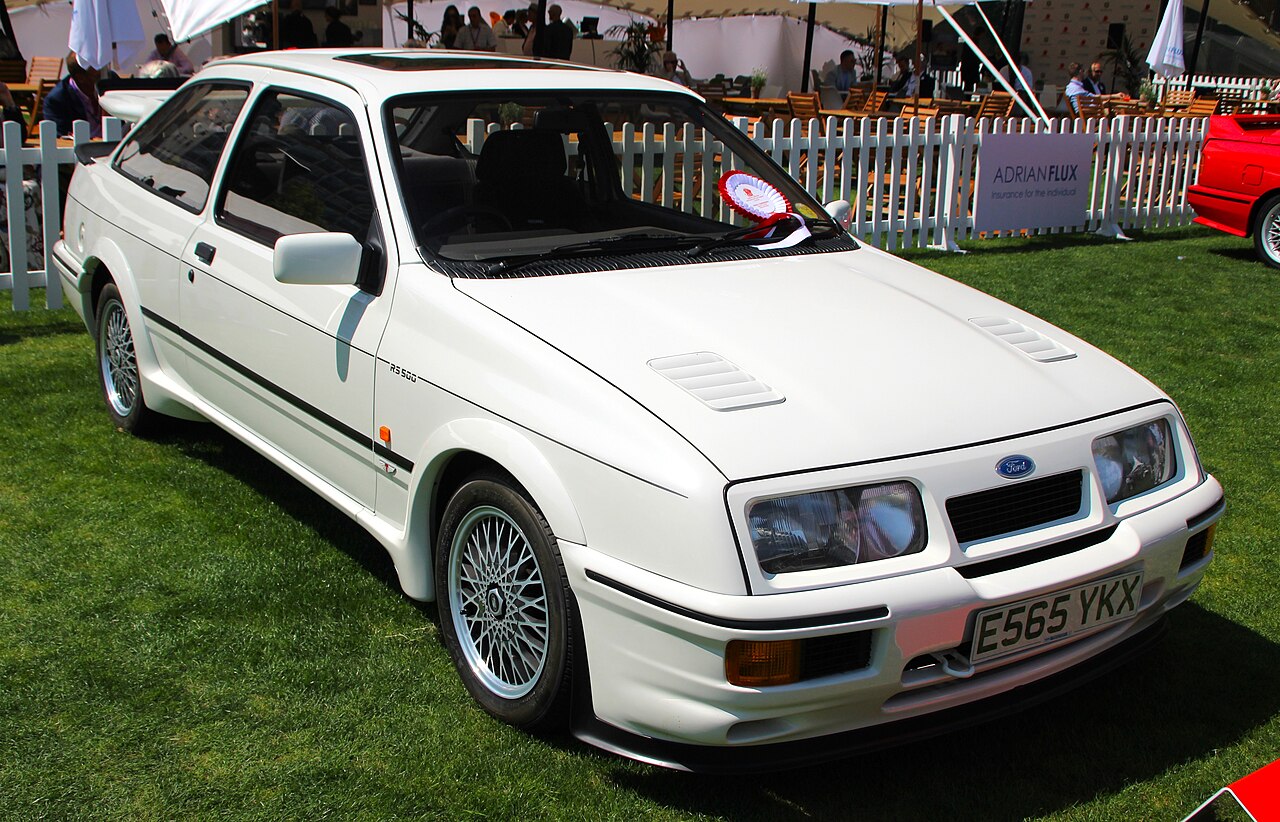
The Ford Sierra RS500 Cosworth was a finite homologation evolution built through Aston Martin Tickford. Original custodial histories describe the 500-car conversion programme and the Cosworth-developed turbocharged four-cylinder architecture. The number in its name corresponds to a defined series rather than a convenient slice of ordinary Sierra production. This article covers that complete original RS500 programme. It does not combine the road homologation specification with the much higher outputs of later racing preparations. The supplied photograph shows a road-car example, allowing the reader to see how an otherwise practical three-door hatchback became the basis for a specialised performance identity.
Design and engineering
The white car’s long glass area, broad rear quarter and distinctive double-level rear spoiler preserve the Sierra hatchback’s basic proportions. Bonnet vents and the lower frontal openings add a more technical appearance without turning it into a separate sports-car silhouette. The documented turbocharged Cosworth engine supplies the programme’s mechanical anchor. In the photo, the road body remains recognisable beneath the performance details, making the RS500 a useful contrast with the purpose-built RS200. The image is a later concours appearance and should be dated as such. A visible badge or spoiler cannot by itself establish that any other similar Sierra belongs to the original Tickford conversion series.
Identifying the original configuration
RS500 and RS Cosworth should remain separate named identities in a catalogue. The original conversion programme was a defined evolution within the broader three-door Cosworth family. A standard Cosworth subsequently fitted with matching exterior parts is not automatically an original RS500. The selected photographer identifies the specimen as an RS500, and its road configuration matches the custodial programme description. An individual file should connect chassis identity, conversion records and subsequent mechanical work. Competition histories require additional evidence rather than being inferred from the model’s reputation. This preserves the meaning of the complete 500-car count while leaving each car’s later development visible.
Collector context and preservation
A strong collection presentation can compare the RS500 with the Escort RS Cosworth to explain different stages of Ford’s turbocharged homologation history. Keep road-car photographs separate from racing images unless the same original chassis is documented across both. Preserve conversion paperwork, original specification evidence and later modifications in a dated sequence. Details such as wheels, intercooler arrangements and competition equipment can change, so whole-car appearance and engine records should work together. The finite 500-car figure describes the original named conversion programme. It does not measure present survival, untouched condition or the number of racing cars later assembled using related Sierra components.
Reading the evidence for this profile
The original source links below identify the programme and the historical statements used in this article. The photograph has its own creator and licence record, separate from the manufacturer’s vehicle history. Keep both when transferring this profile into a collection catalogue. A manufacturing tally describes how many cars belong to a defined original programme; it does not measure how many survive, how many are publicly visible, or how many retain all their original components. Those individual questions require dated chassis and restoration evidence. The reference year likewise describes the programme’s introduction or named historic configuration, while the supplied caption states the photographed setting and any established individual identity. This lets future research expand the car’s history without blurring the scope of the record already assembled here.
Specifications and verified rarity
| Reference year | 1987 |
|---|---|
| Model / programme | Sierra RS500 Cosworth |
| Body / role | Tickford-converted homologation hatchback |
| Documented engine | 1,993 cc turbocharged Cosworth twin-cam four-cylinder |
| Architecture / transmission | Front engine; rear-wheel drive; five-speed manual road configuration |
| Exact manufacturing tally | 500 |
| Eligibility bound | 500 for the documented scope or parent programme |
| Rarity scope | Complete original Sierra RS500 homologation conversion programme: 500 cars. A finite named evolution programme within the original three-door Sierra Cosworth parent series; not a regional or arbitrary year slice. Later racing rebuilds and lookalikes are not extra factory conversions. |
| Inventory reference | FRD-212 — Verified |
Frequently asked questions
What is the Ford Sierra RS500 Cosworth?
The complete 500-car original Sierra RS500 Cosworth homologation conversion series, built through Aston Martin Tickford.
What engineering defines this Ford?
1,993 cc turbocharged Cosworth twin-cam four-cylinder. Front engine; rear-wheel drive; five-speed manual road configuration. These are the documented programme or preserved-concept specifications. Connect an individual vehicle’s installed components to its own dated records before assigning a factory configuration to that particular example.
Why is 1987 the reference year?
It identifies the introduction or original historical configuration described in this article. The photograph can show a later example or a later display of the original subject. The source inventory’s original heading remains an identity alias wherever the date or model name has been corrected.
How should an individual Sierra RS500 Cosworth be documented?
Start with the chassis identity and connect it to dated construction, registration or custodial records. Keep exterior, interior, engine and underbody photographs together. Record changes to finish, equipment and mechanical specification as separate events, so the physical car’s history can grow without changing the definition of the original programme.
What rarity or archive scope is verified?
Complete original Sierra RS500 homologation conversion programme: 500 cars. A finite named evolution programme within the original three-door Sierra Cosworth parent series; not a regional or arbitrary year slice. Later racing rebuilds and lookalikes are not extra factory conversions.
Who took the supplied photograph?
MrWalkr via Wikimedia Commons, under CC BY-SA 4.0. The original file and licence links accompany the image. Retain that credit when the photograph is uploaded, exported or reused.
Related Ford profiles
Sources and photo credits
- Manufacturer, institutional or original custodial record
- Original Bonhams custodial RS500 engineering and series history
Photograph: MrWalkr via Wikimedia Commons original file, CC BY-SA 4.0. Source-provided photograph supplied without local cropping, retouching or text removal. A source thumbnail is used where available. 1987 Ford Sierra RS500 Cosworth road car at London Concours 2023; later documentary appearance, individual chassis not assigned.
Built in limited numbers
Complete original Sierra RS500 homologation conversion programme: 500 cars. A finite named evolution programme within the original three-door Sierra Cosworth parent series; not a regional or arbitrary year slice. Later racing rebuilds and lookalikes are not extra factory conversions.
Gallery
Specifications
Factory specifications may vary by model year, market and configuration.
Identity & production
- Official model
- Sierra RS500 Cosworth