1982 Ferrari 208 GTB Turbo
Explore 208 GTB Turbo: verified history, design, rarity scope and specifications, with a credited documentary photograph.
The Ferrari 208 GTB Turbo made forced induction part of Ferrari’s production road-car story in 1982.
History and purpose
The Ferrari 208 GTB Turbo made forced induction part of Ferrari’s production road-car story in 1982. Ferrari’s model record identifies the Turin introduction and describes the two-litre turbocharged V8 configuration. It also gives 437 cars for the complete original GTB Turbo programme. This is the early 308-shaped fixed-roof model, not the later GTB Turbo with 328-derived bodywork. The distinction matters because photographs and sale descriptions sometimes use 208 GTB Turbo loosely for both generations. Here, the original body, programme dates and factory count establish a complete rare-model scope rather than a small regional registration subset.
Design and engineering
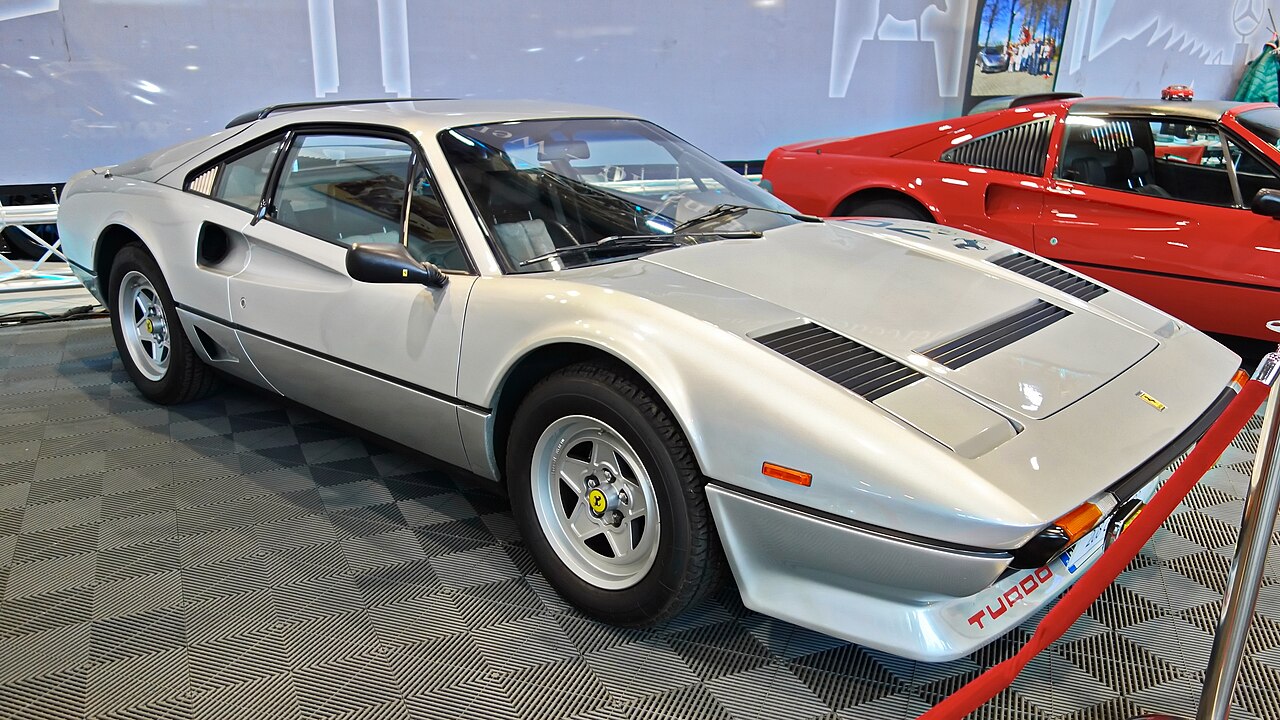
The supplied image shows a pale fixed-roof car with the original angular front and 308-family body proportions. The low nose, compact passenger compartment and engine-cover area behind the cabin organise the car around its rear-mid V8. The photograph’s source identifies the 208 GTB Turbo, and the visible roof distinguishes the berlinetta from the open GTS. Ferrari’s archive supplies the turbocharged two-litre specification; the body alone cannot prove engine displacement. Likewise, the later GTB Turbo’s technical equipment is not imported into this earlier profile simply because both names describe a small turbocharged Ferrari V8.
Identifying the original configuration
A correct 208 GTB Turbo record needs both the right generation and the right body form. A later car with integrated 328-style bumpers would be an unsuitable hero image for the original 1982 programme. An open GTS also belongs to a different scope. The full 437-car count applies to the early fixed-roof model and is not used for either neighbouring version. This article avoids treating a period market rationale as a manufacturing limit: the model’s complete production tally is the rarity evidence. An individual car’s chassis and original engine records should confirm the mechanical identity that an exterior photograph can only partly establish.
Collector context and preservation
For collectors, the original 208 GTB Turbo offers a way to study Ferrari’s early use of turbocharging in a road-car context. It also demonstrates why familiar bodywork can conceal a materially different engine programme. The appropriate comparison with a 308 is therefore both visual and mechanical, with the specifications of each kept intact. A detailed file should document engine type, turbo installation, original body configuration and later service work. Do not assume that a polished car currently retains every factory component. The credited photograph supplies a matching early-generation berlinetta, while the factory archive supplies the programme definition. Together, they make a stronger record than a generic turbo badge attached to the wrong generation’s image.
Reading the evidence for this profile
The original source links below identify the programme and the historical statements used in this article. The photograph has its own creator and licence record, separate from the manufacturer’s vehicle history. Keep both when transferring this profile into a collection catalogue. A manufacturing tally describes how many cars belong to a defined original programme; it does not measure how many survive, how many are publicly visible, or how many retain all their original components. Those individual questions require dated chassis and restoration evidence. The reference year likewise describes the programme’s introduction or named historic configuration, while the supplied caption states the photographed setting and any established individual identity. This lets future research expand the car’s history without blurring the scope of the record already assembled here.
Specifications and verified rarity
| Reference year | 1982 |
|---|---|
| Model / programme | 208 GTB Turbo |
| Body / role | Fixed-roof two-seat turbocharged V8 berlinetta |
| Engine architecture | Transverse rear-mid-mounted 2.0-litre turbocharged V8 |
| Transmission | Five-speed manual |
| Exact manufacturing tally | 437 |
| Eligibility bound | 437 for the documented scope or parent programme |
| Rarity scope | Complete original 208 GTB Turbo programme, 1982–1985: 437 fixed-roof cars. The later 328-bodied GTB Turbo and open GTS Turbo are excluded. |
| Inventory reference | FER-114 — Verified |
Frequently asked questions
How many early 208 GTB Turbo cars were built?
Ferrari gives 437 for the complete original fixed-roof programme.
When did the model debut?
Ferrari records the 1982 Turin presentation.
Is the later GTB Turbo included?
No. The 328-bodied later model is excluded from this original 208 GTB Turbo scope.
Does the count include open GTS cars?
No. The profile and image concern the fixed-roof GTB.
What rarity or archive scope is verified?
Complete original 208 GTB Turbo programme, 1982–1985: 437 fixed-roof cars. The later 328-bodied GTB Turbo and open GTS Turbo are excluded.
Who took the supplied photograph?
More Cars via Wikimedia Commons, under CC BY 2.0. The original file and licence links accompany the image. Retain that credit when the photograph is uploaded, exported or reused.
Related Ferrari profiles
Sources and photo credits
Photograph: More Cars via Wikimedia Commons original file, CC BY 2.0. Source-provided photograph supplied without local cropping, retouching or text removal. A source thumbnail is used where available. Original-generation fixed-roof Ferrari 208 GTB Turbo. The later 328-bodied GTB Turbo and open GTS are excluded.
Built in limited numbers
Complete original 208 GTB Turbo programme, 1982–1985: 437 fixed-roof cars. The later 328-bodied GTB Turbo and open GTS Turbo are excluded.
Gallery
Specifications
Factory specifications may vary by model year, market and configuration.
Identity & production
- Official model
- 208 GTB Turbo