1981 Renault RE30 Formula One
Explore the Renault RE30 Formula One: history, verified identity, specification references, rarity evidence and real credited photos.
The Renault RE30 helped turn Alain Prost’s early promise into Grand Prix victories. Its history is also a useful lesson in racing-car identification: the 1981 design, the RE30B and the RE30C belong to a development family, with season-specific bodywork and chassis histories that should remain visible.
Programme history and its place in Formula One
Renault’s factory histories place the RE30’s arrival during 1981, following the interim RE20B. Alain Prost had joined René Arnoux, giving the programme a driver pairing associated with Renault’s developing turbo strength. The profile’s reference year is therefore 1981. Later RE30-family cars are discussed as developments rather than used to rewrite every detail of the original design or to invent separate retail limited editions.
Renault: thirty years of Formula One
Engineering in its regulatory setting
The family retained Renault’s turbocharged V6 approach. Its development should be understood through dated specifications rather than a single universal power figure. Changes made for a particular circuit, tyre test or regulation could alter both visible bodywork and the underlying setup. The FIA’s Brazilian history identifies the 1982 winning car specifically as an RE30B with an EF1 1.5-litre turbo V6, illustrating why the suffix deserves to be retained.
Competition results need a season and a chassis
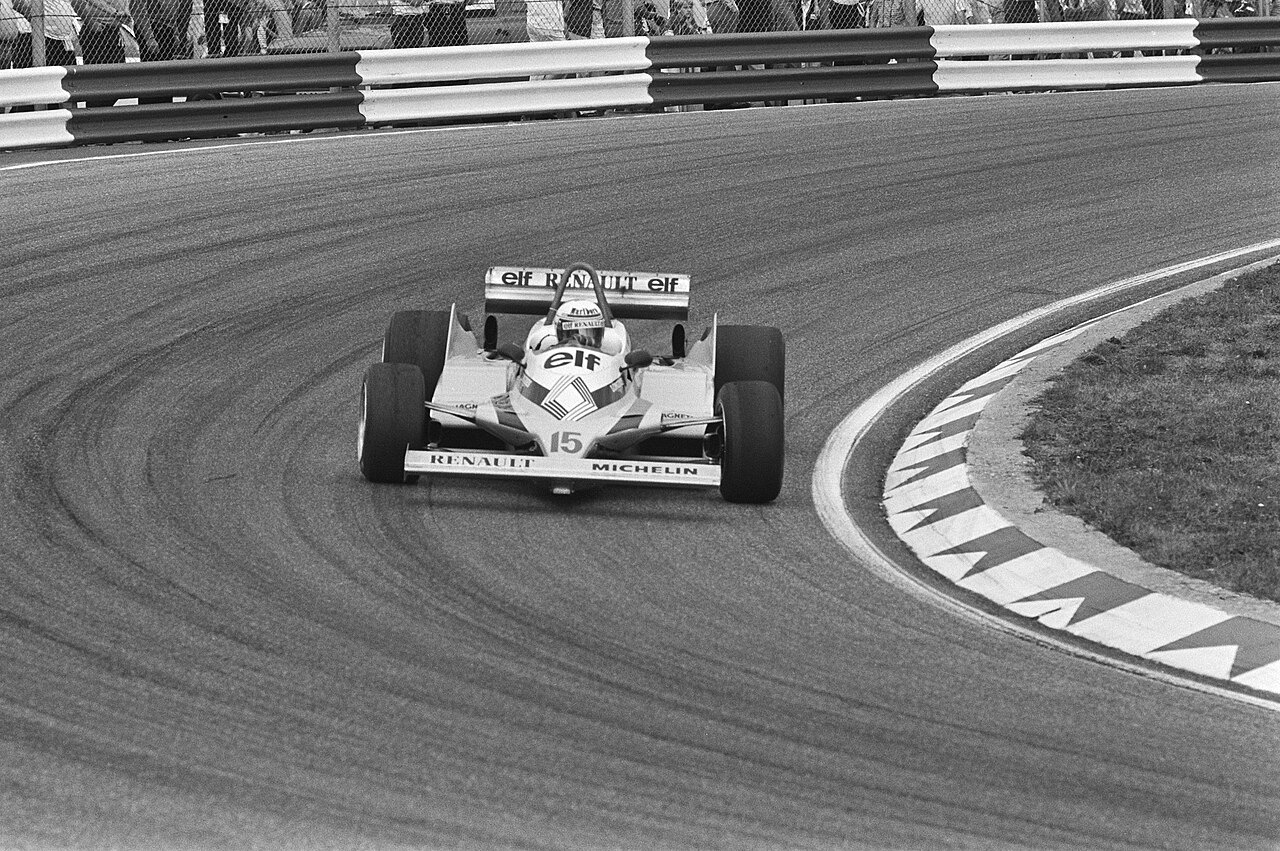
Factory history records Prost’s 1981 victories in France, the Netherlands and Italy. The period photograph used here shows the 1981 Dutch Grand Prix, giving the article a contemporary reference rather than relying solely on later restored livery. A season result still needs to be separated from individual chassis identity. The same driver could use more than one car, while a chassis could be reassigned or altered during its career.
Renault: thirty years of Formula One
What makes the programme collectible
The 2025 Renault collection sale provides a revealing example in RE30-B9. The catalogue describes a 1982 development based on a 1981 chassis, used in testing by both drivers and later restored for static display. That is valuable primary provenance for that particular object. It is not a template that can be copied wholesale onto every RE30. Component survival, competition use and restored presentation need to be assessed separately.
Renault collection sale: RE30-B9
Identification and provenance
An individual file should identify the precise RE30 designation, works number, dated logbook entries and any conversion history. Compare the nose, wings and cooling arrangements with the relevant event photographs, then investigate discrepancies through documentation. A familiar yellow-and-black scheme is useful for recognition but cannot authenticate an original tub. Record whether the car is static, operational or mechanically incomplete at the date of inspection.
Specifications and identity reference
| Reference season | 1981 |
|---|---|
| Programme | RE30 and explicitly identified B/C developments |
| Engine family | Renault turbocharged V6; dated EF1 reference for RE30B |
| Period illustration | Alain Prost, 1981 Dutch Grand Prix |
Rarity and production scope
This is one Archive programme profile for the RE30 family, with the initial 1981 identity and later derivatives distinguished. No complete chassis total is asserted. Artcurial’s Renault-consigned RE30-B9 account documents one car’s evolution and static condition; it does not establish a census or the identity of the photographed 1981 car. Later derivatives are not counted as additional road editions.
This is an Archive record. Concepts, restored heritage vehicles, works cars and competition programmes are not added to customer road-production totals. A programme profile does not establish how many physical chassis were made, and repeated exhibition appearances do not create additional vehicles.
What the photograph represents
Alain Prost in his Renault during the 1981 Dutch Grand Prix, catalogued as an RE30. Period programme illustration; the photograph does not establish the complete subsequent identity of a surviving chassis.
Related Renault heritage profiles
Frequently asked questions
Why retain the RE30B and RE30C suffixes?
They distinguish later developments and help match technical details to the correct season and chassis.
Does the RE30-B9 sale record describe the car in the period photo?
No. It is used as a documented provenance example for a different, specifically identified development chassis.
What is the production-count boundary for this profile?
This is one Archive programme profile for the RE30 family, with the initial 1981 identity and later derivatives distinguished. No complete chassis total is asserted. Artcurial’s Renault-consigned RE30-B9 account documents one car’s evolution and static condition; it does not establish a census or the identity of the photographed 1981 car. Later derivatives are not counted as additional road editions.
Sources and further reading
- Renault: thirty years of Formula One
- Renault collection sale: RE30-B9
- FIA Brazilian historical results
Research checked 17 October 2026. Linked factory announcements and heritage records support the specifically attributed claims. Photographic descriptions identify the illustrated subject. Design analysis and suggested authentication steps are editorial interpretation.
Built in limited numbers
This is one Archive programme profile for the RE30 family, with the initial 1981 identity and later derivatives distinguished. No complete chassis total is asserted. Artcurial’s Renault-consigned RE30-B9 account documents one car’s evolution and static condition; it does not establish a census or the identity of the photographed 1981 car. Later derivatives are not counted as additional road editions.
Gallery
Specifications
Factory specifications may vary by model year, market and configuration.
Identity & production
- Official model
- Renault RE30 Formula One
Sources and verification
Source citations are being prepared for this profile.