1966 Fiat Dino Spider 2000
Discover the Fiat Dino Spider 2000: 1966 introduction, Pininfarina open body, V6 architecture, scoped rarity and a credited model photograph.
The Fiat Dino Spider 2000 placed a sophisticated V6 within a compact Pininfarina open body.
History and purpose
The Fiat Dino Spider 2000 placed a sophisticated V6 within a compact Pininfarina open body. Fiat’s manufacturer history dates the Spider to 1966, correcting the source inventory’s 1967 heading. Its origin connects Fiat road-car manufacture with Ferrari’s engine homologation needs, but the resulting vehicle retains its own Fiat identity. The catalogue title therefore keeps both the maker and the complete body-and-engine designation. For numerical eligibility, the checked historical publication reports 1,583 Spiders across the original body programme. That conservative whole-body bound is used here, while the exact reconciled total for the two-litre subset remains unset and the wider Dino family is kept separate.
Design and engineering
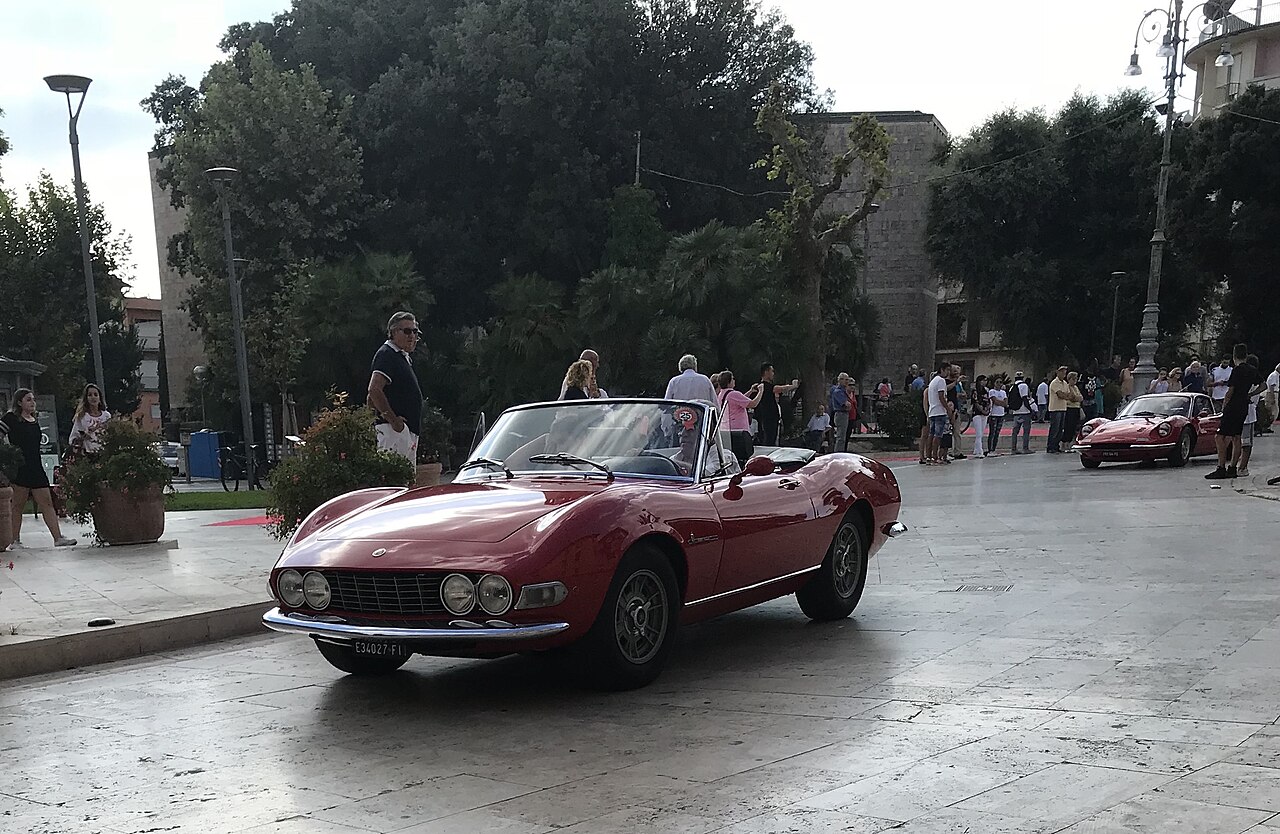
The red reference photograph shows the two-litre Spider with its roof open. Rounded front surfaces lead into a short, low passenger compartment, giving the body a light visual centre. Bright trim outlines the front opening and windscreen, while the short rear volume keeps the shape compact. The open configuration reveals proportions that a closed coupé cannot share, even though the Dino engine relationship links the programmes historically. Manufacturer material anchors the original longitudinal front-engine and five-speed layout. The photo supplies the model-specific body view, without claiming an engine number or proving the condition of unseen running gear from a distant exterior angle.
Identifying the original configuration
Dino is a name shared by several vehicles, so the maker, body and engine series belong together in the identity fields. This is a Fiat two-litre Spider, distinct from the later 2400 Spider, the Bertone-bodied Fiat Coupé and Ferrari’s own mid-engined Dino models. The photograph’s source names a 1968 Dino 2000 Spider, which is compatible with a programme introduced in 1966. It does not mean that 1968 should replace the original introduction date. Engine substitutions and later trim changes should be recorded at individual level, because a badge alone cannot prove that a particular car retains its original two-litre mechanical configuration.
Collector context and preservation
A useful collector comparison places the 2000 and 2400 Spiders beside each other. The body relationship stays visible while the engineering record explains the later engine and rear-suspension changes. Preserve chassis references, original engine identity and dated restoration material together rather than allowing the Ferrari connection to dominate every field. Roof, cabin and side-profile photographs are especially valuable because they record the open-car package directly. This approach produces a reference that is helpful beyond a search for the Dino name: readers can understand which Fiat body programme is being discussed, how the two-litre car fits its chronology and which questions remain for an individual example’s provenance file.
Reading the evidence for this profile
The original source links below identify the programme and the historical statements used in this article. The photograph has its own creator and licence record, separate from the manufacturer’s vehicle history. Keep both when transferring this profile into a collection catalogue. A manufacturing tally describes how many cars belong to a defined original programme; it does not measure how many survive, how many are publicly visible, or how many retain all their original components. Those individual questions require dated chassis and restoration evidence. The reference year likewise describes the programme’s introduction or named historic configuration, while the supplied caption states the photographed setting and any established individual identity. This lets future research expand the car’s history without blurring the scope of the record already assembled here.
Specifications and verified rarity
| Reference year | 1966 |
|---|---|
| Model / programme | Dino Spider 2000 |
| Body / role | Pininfarina-bodied two-seat V6 spider |
| Documented engineering | Front-mounted 1,987 cc 65-degree V6 |
| Architecture / transmission reference | Five-speed manual; rear-wheel drive |
| Exact manufacturing tally | Not established |
| Eligibility bound | 1583 for the documented scope or parent programme |
| Rarity scope | Original Fiat Dino Spider 2000. Eligibility uses the published 1,583-car whole Spider body programme across both engine series; exact reconciled 2000 subset tally is unset. The wider Dino family is not treated as under 7,500. |
| Inventory reference | FIA-056 — Verified |
Frequently asked questions
What is the Fiat Dino Spider 2000?
The original two-litre Fiat Dino open car, introduced in 1966 with Pininfarina bodywork. The complete Spider programme supplies the conservative rarity bound.
What engineering details are documented?
Front-mounted 1,987 cc 65-degree V6. Five-speed manual; rear-wheel drive. The specification table identifies the documented model, concept package or explicitly named donor architecture. It does not certify an unseen engine number, individual component condition or a restoration specification from the exterior photograph.
Why is 1966 used in the profile title?
This is the reference year for the original configuration, introduction or public presentation explained in the history section. A photographed example can be younger. Where the supplied inventory used a different date, its original title remains an identity alias so that the same programme is not uploaded twice.
What belongs in an individual vehicle file?
Connect the chassis identity with original configuration records, dated photographs, custodial history and restoration paperwork. Record changes to paint, trim, mechanical components and bodywork as dated events. This profile establishes the named subject and its rarity or physical archive scope; the individual file supplies the history of the particular example.
What rarity or archive scope is verified?
Original Fiat Dino Spider 2000. Eligibility uses the published 1,583-car whole Spider body programme across both engine series; exact reconciled 2000 subset tally is unset. The wider Dino family is not treated as under 7,500.
Who took the supplied photograph?
Rutger van der Maar via Wikimedia Commons, under CC BY 2.0. The original file and licence links accompany the image. Retain that credit when the photograph is uploaded, exported or reused.
Related Fiat profiles
Sources and photo credits
- Original manufacturer, museum or custodial record
- Carlo Alberto Gabellieri: historical Dino body-programme research, Auto d’Epoca, December 2005
Photograph: Rutger van der Maar via Wikimedia Commons original file, CC BY 2.0. Source-provided photograph supplied without local cropping, retouching or text removal. A source thumbnail is used where available. Source-identified 1968 Fiat Dino 2000 Spider, photographed in open configuration; 1966 is the programme introduction year.
Built in limited numbers
Original Fiat Dino Spider 2000. Eligibility uses the published 1,583-car whole Spider body programme across both engine series; exact reconciled 2000 subset tally is unset. The wider Dino family is not treated as under 7,500.
Gallery
Specifications
Factory specifications may vary by model year, market and configuration.
Identity & production
- Official model
- Dino Spider 2000