1952 Ferrari 250 S
Explore 250 S: verified history, design, rarity scope and specifications, with a credited documentary photograph.
The Ferrari 250 S has a place in the marque’s history that is much larger than its one-car programme.
History and purpose
The Ferrari 250 S has a place in the marque’s history that is much larger than its one-car programme. Ferrari records the car’s 1952 Mille Miglia victory with Giovanni Bracco and its use at Le Mans that year. The Nationales Automuseum’s exhibition description identifies the original Mille Miglia-winning 250 S as a one-off. Together, those records establish a narrowly defined subject: the original Vignale-bodied competition berlinetta, associated with chassis 0156 ET. The 250 designation here is the beginning of a historical engine and model story, not permission to apply later 250 GT specifications or production counts to this individual racing car.
Design and engineering
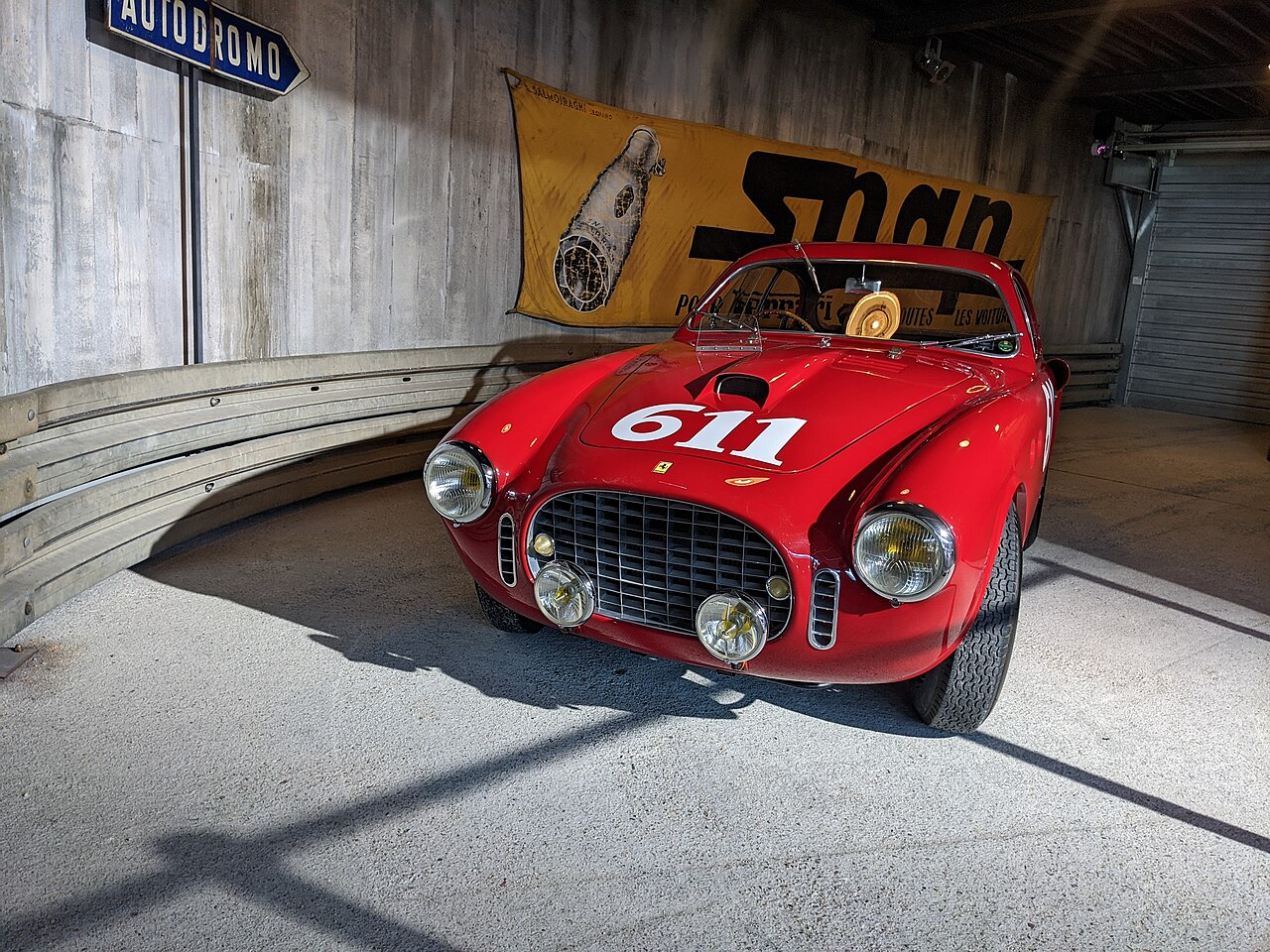
The museum photograph shows a compact red berlinetta with an oval grille, enclosed passenger compartment and small rear volume. A long bonnet and rounded front wings give the car a recognisable sports-racing stance, while its roof makes the body read differently from an open barchetta. Race numbers are visible in the modern display. They are described as display details rather than used independently to prove a particular race appearance. Ferrari’s archived model specifications establish the front-mounted V12 architecture. The image documents present appearance and museum context; it does not establish that every panel or painted marking survives unchanged from 1952.
Identifying the original configuration
A one-off competition car needs a different identity test from a modern numbered road edition. The chassis connection matters because race bodies can be repaired, altered or recreated over time. An authentic original car may have a complex configuration history, and that history should be recorded rather than hidden behind a blanket claim of untouched originality. This profile connects the model record with the museum’s identification of the original winning car. It does not turn the visible competition livery into a chassis certificate. The single-car tally belongs to the original 250 S subject, not to every vehicle later described as a 250-series sports Ferrari.
Collector context and preservation
The value of a detailed archive entry is that it allows the 250 S to be understood without borrowing the fame of a GTO, Testa Rossa or California Spider. Its closed body, early V12 development and documented race achievement are sufficient subjects for study. For a collector, records of original chassis identity, body evolution and custodial history belong beside the race results. Modern exhibition photographs add another dated layer to that record. Comparing them with period images can show which visual details remained and which changed, but a difference alone should not be labelled fraudulent. The documented chain of identity is more informative than an unsupported promise that a historic competition object has never been restored.
Reading the evidence for this profile
The original source links below identify the programme and the historical statements used in this article. The photograph has its own creator and licence record, separate from the manufacturer’s vehicle history. Keep both when transferring this profile into a collection catalogue. A manufacturing tally describes how many cars belong to a defined original programme; it does not measure how many survive, how many are publicly visible, or how many retain all their original components. Those individual questions require dated chassis and restoration evidence. The reference year likewise describes the programme’s introduction or named historic configuration, while the supplied caption states the photographed setting and any established individual identity. This lets future research expand the car’s history without blurring the scope of the record already assembled here.
Specifications and verified rarity
| Reference year | 1952 |
|---|---|
| Model / programme | 250 S |
| Body / role | One-off Vignale competition berlinetta |
| Engine architecture | Front-mounted 3.0-litre V12 |
| Transmission | Competition manual |
| Exact manufacturing tally | 1 |
| Eligibility bound | 1 for the documented scope or parent programme |
| Rarity scope | Original 1952 Ferrari 250 S, chassis 0156 ET: one individually documented competition car, not the entire 250 family. |
| Inventory reference | FER-020 — Verified |
Frequently asked questions
How many original 250 S cars are covered?
One, the original 1952 competition berlinetta associated with chassis 0156 ET.
Did the model win the Mille Miglia?
Ferrari’s model record documents Giovanni Bracco’s 1952 victory.
What does the supplied picture show?
The original model on display in the Loh collection museum context, rather than a generic later 250 GT.
Does the count include all Ferrari 250 models?
No. It applies only to the original 250 S competition subject.
What rarity or archive scope is verified?
Original 1952 Ferrari 250 S, chassis 0156 ET: one individually documented competition car, not the entire 250 family.
Who took the supplied photograph?
Thomas Vogt from Paderborn, Deutschland via Wikimedia Commons, under CC BY 2.0. The original file and licence links accompany the image. Retain that credit when the photograph is uploaded, exported or reused.
Related Ferrari profiles
Sources and photo credits
- Original manufacturer or custodial record
- Nationales Automuseum: original one-off Mille Miglia-winning car
Photograph: Thomas Vogt from Paderborn, Deutschland via Wikimedia Commons original file, CC BY 2.0. Source-provided photograph supplied without local cropping, retouching or text removal. A source thumbnail is used where available. Original Ferrari 250 S Vignale berlinetta in the Loh collection museum display. Present display livery is distinguished from untouched period condition.
Built in limited numbers
Original 1952 Ferrari 250 S, chassis 0156 ET: one individually documented competition car, not the entire 250 family.
Gallery
Specifications
Factory specifications may vary by model year, market and configuration.
Identity & production
- Official model
- 250 S