1930 Cadillac V-16 Series 452 Sport Phaeton
Explore the 1930 Cadillac V-16 Series 452 Sport Phaeton: history, design, scoped rarity, collector details, specifications and an authentic photograph with.
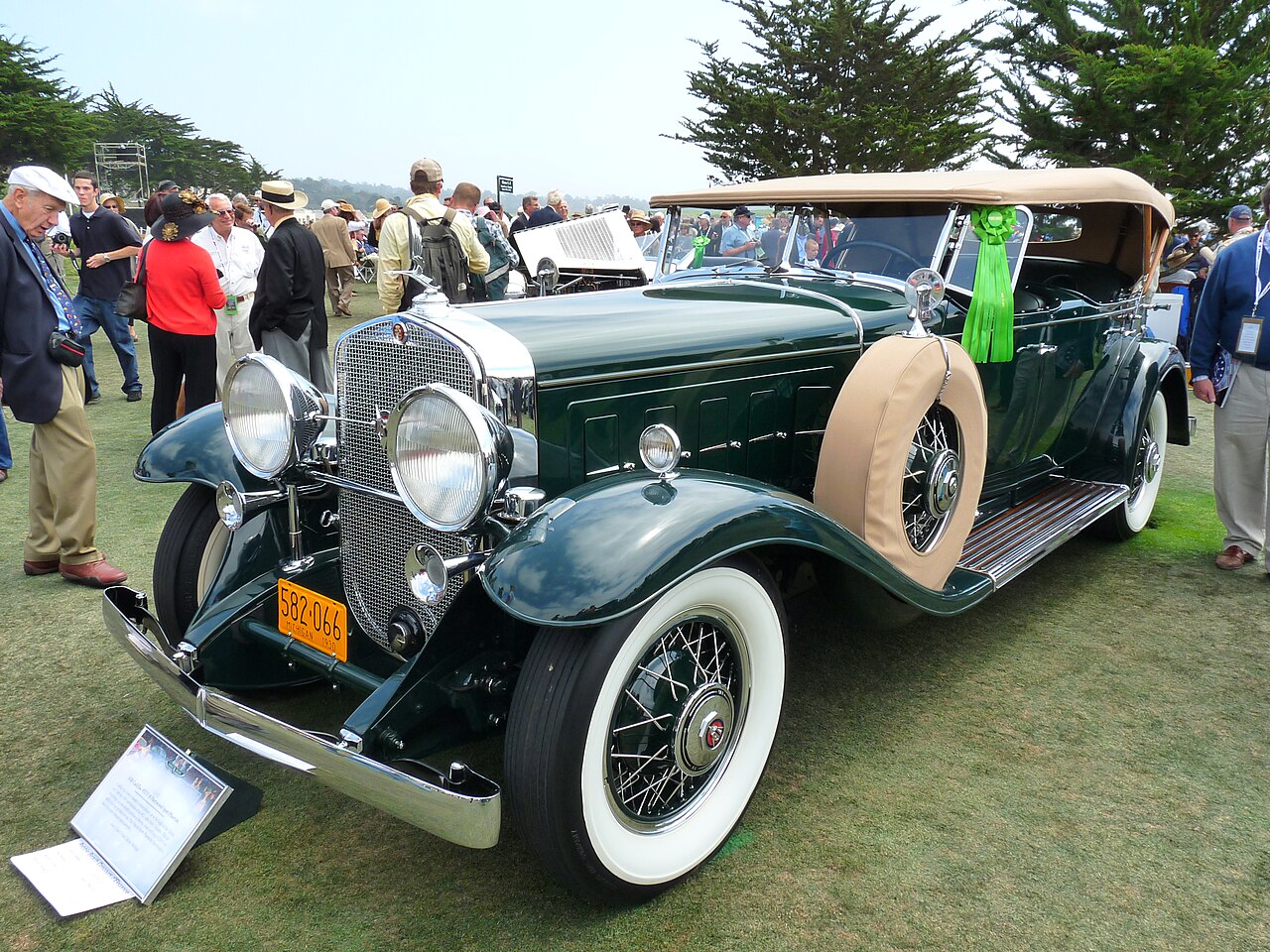
The 1930 Cadillac V-16 Series 452 Sport Phaeton spreads the early sixteen-cylinder car’s luxury across an open touring body. Its attraction is the relationship between the long mechanical front and a passenger space that remains visibly connected to the outside. The selected photograph shows the car itself, replacing a candidate image that documented only an exhibition sign.
History, identity and design
The photograph gives the Sport Phaeton a convincing sense of scale. A long green bonnet, substantial radiator and exposed lamps lead toward the open body, while a light-coloured folded or raised roof structure marks the passenger area behind them. Large wheels and a side-mounted spare create strong circular accents. The setting contains people, making the height of the car’s front end easier to read. This is useful documentary context: the Cadillac’s imposing size can be understood without an exaggerated camera effect or an invented modern studio backdrop.
A phaeton is best approached through its passenger arrangement. The body carries the open-car story across more space than a roadster, and the transition from bonnet to cabin becomes less abrupt. It is therefore a useful comparison with the other Series 452 forms in this batch. Shared mechanical ancestry creates continuity, while different coachwork produces a different visual and social experience. The early V-16 programme’s numerical ceiling remains a parent bound for those separate bodies. It cannot be added once for a phaeton, once for a roadster and again for a limousine.
The source photograph names a Fleetwood Sport Phaeton. That identification is retained without borrowing a chassis number from another well-known concours example. In a surviving coachbuilt car, changes to the passenger body, windscreen or secondary cowl can matter as much as engine work. The archival shipping research records body changes among early V-16s, which makes individual documentation particularly valuable. An impressive open-car silhouette should encourage closer investigation, not replace it.
As visual interpretation, the body’s charm lies in its combination of ceremony and exposure. Lamps, spare-wheel covers and bright trim give the front a carefully arranged presentation; the open passenger compartment softens that formality. A collector can use the photo to compare body lines, roof position and the relationship of seating to the rear wheels. Original construction and restoration history belong in a separate chassis file. The profile preserves the Sport Phaeton’s identity while resisting the temptation to attach every famous V-16 anecdote to whichever attractive car is pictured.
Specifications and production scope
| Reference year | 1930 |
|---|---|
| Subject | V-16 Series 452 Sport Phaeton |
| Engineering context | 452-cubic-inch overhead-valve V-16 |
| Design focus | Open touring coachwork on the early Sixteen |
| Rarity scope | A conservative ceiling of 3,251 within the combined early Series 452/452A V-16 engine-number programme. Exact output for this body is not established. Shared parent ceilings are non-additive, and numbered positions are not certified completed body totals. |
| Exact scoped build tally | Unset; see scoped eligibility note |
| Inventory reference | CAD-019 — Verified |
Keeping the collector record useful
A useful V-16 file separates the model story from the life of an individual vehicle. Record the body or edition designation exactly as it appears in matching documents, then keep clear front, side, rear and cabin photographs with the dates attached. Changes made during restoration deserve their own entries, including the reason for the work and the evidence used. That approach lets future readers compare the physical car with this profile without confusing a present appearance, an original factory specification and an attractive historical association.
Documentary photograph
1930 Cadillac V-16 Series 452 Sport Phaeton. Documentary model photograph; individual car provenance is certified only where separately stated in the article. The source image was checked for the pictured body or physical project and its file-specific reuse terms. The visible photograph caption links the photographer, original file and licence so the illustration can be traced independently of the article.
Frequently asked questions
Is the supplied image only a museum sign?
No. The bundled image shows the complete Sport Phaeton in a concours setting. A similarly named candidate that showed only an information board was rejected before packaging.
Does the series ceiling equal Sport Phaeton production?
No. It bounds the wider early V-16 programme. The exact Sport Phaeton build field remains unset, and related body profiles share a non-additive parent population rather than independent totals.
What production scope applies to the 1930 V-16 Series 452 Sport Phaeton?
A conservative ceiling of 3,251 within the combined early Series 452/452A V-16 engine-number programme. Exact output for this body is not established. Shared parent ceilings are non-additive, and numbered positions are not certified completed body totals.
What should a collector document on an individual example?
Keep the vehicle’s identification, body or edition evidence, dated photographs and restoration records together. This V-16 profile explains the model subject; ownership, original finish and present condition require records that match the individual car being considered.
Does this profile provide a complete original specification?
The specification table records the supported identity and engineering context for this year. An exterior photograph cannot establish every optional feature or later component change. Preserve any matching build record before adding more precise equipment claims to the V-16 Series 452 Sport Phaeton file.
Who took the photograph and how may it be reused?
The bundled image is credited to Craig Howell from San Carlos, CA, USA, under CC BY 2.0 on its individual Commons file page. Keep the visible named credit and licence link. The supplied source version has no local image edits; background signage and photographer marks remain where present.
Sources
- Cadillac Database archival reference
- Cadillac Database archival reference
- Photograph: 1930 Cadillac 452 V16 Fleetwood Sport Phaeton (3828514399).jpg
Related Cadillac profiles
Compare the body forms and clearly scoped identities in 1930 Cadillac V-16 Series 452 Convertible Coupe and 1930 Cadillac V-16 Series 452 Imperial Limousine. Each profile keeps its own year, photograph and rarity scope.
Built in limited numbers
A conservative ceiling of 3,251 within the combined early Series 452/452A V-16 engine-number programme. Exact output for this body is not established. Shared parent ceilings are non-additive, and numbered positions are not certified completed body totals.
Gallery
Specifications
Factory specifications may vary by model year, market and configuration.
Identity & production
- Official model
- V-16 Series 452 Sport Phaeton