1926 Renault 40 CV des Records
Explore the Renault 40 CV des Records: history, verified identity, specification references, rarity evidence and real credited photos.
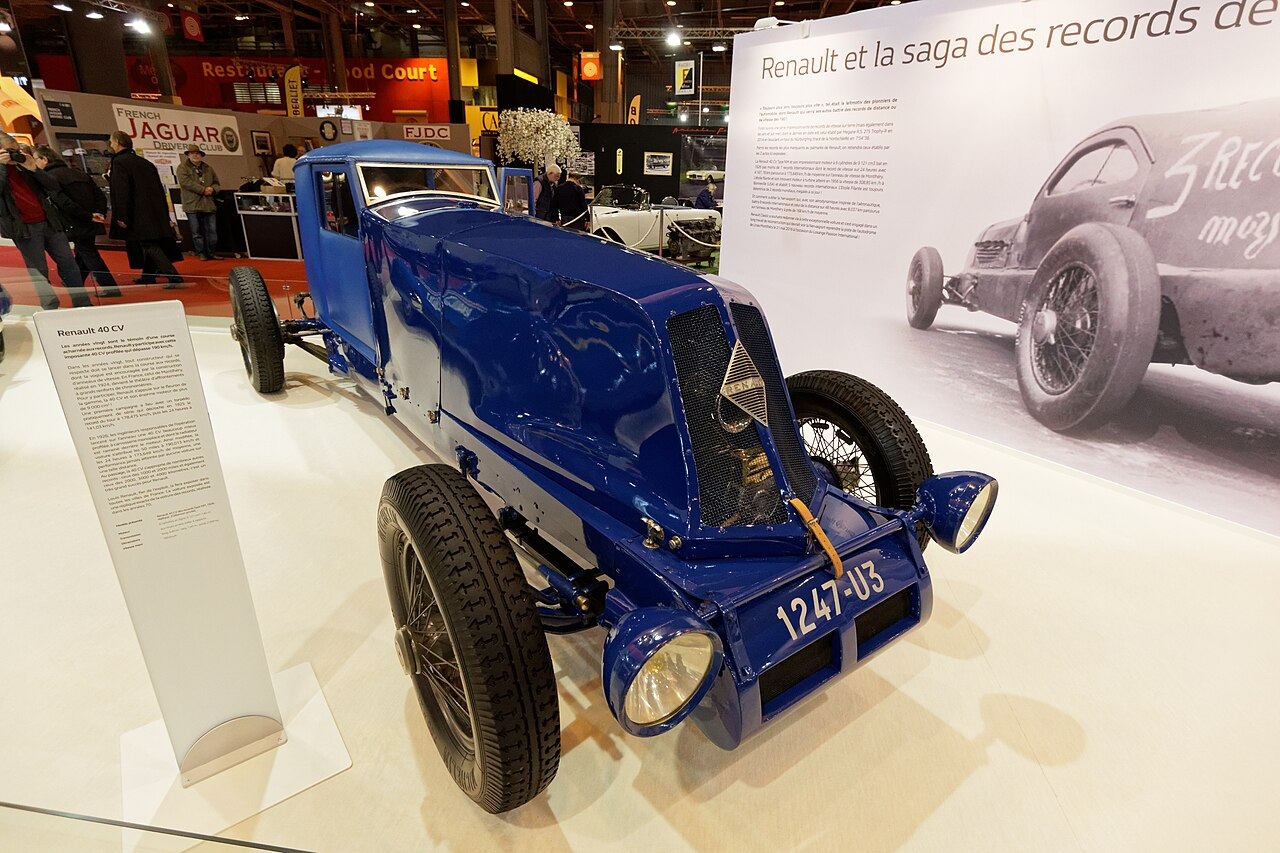
The Renault 40 CV des Records turned a luxury-car powertrain into an endurance experiment. Its narrow single-seat body and enormous straight-six make an extraordinary combination, but the most important distinction for a collector is historical: the familiar museum car is a later reconstruction of the 1926 record machine.
From flagship chassis to the Montlhéry banking
Renault’s record programme belongs to the competitive culture surrounding the new Montlhéry speed circuit. The inventory starts its story in 1925; this profile uses 1926 for the specialised single-seater documented by the factory museum. That distinction prevents earlier record attempts and the later narrow-bodied machine from becoming an invented fleet of identical vehicles. The road-going 40 CV family supplies context rather than a production total for the record car.
Renault museum: 40 CV des Records
A body built around sustained speed
The museum describes a narrowed chassis, front engine and rear-wheel drive. Its technical reference gives a 9,121 cc straight-six and 140 hp, with four forward gears. These are historical reference specifications, not a dynamometer reading of the photographed reconstruction. The tall engine installation and elongated body are useful reminders that streamlining in this period was constrained by machinery that had begun life in a very different vehicle.
Why the construction matters
Imitation leather stretched across a wooden and mesh framework offered a lightweight route to a slender body. The factory account also describes braking on the rear wheels only. For interpretation, that makes the car an endurance engineering object: body construction, cooling, tyres and servicing mattered alongside maximum power. Comparing its outline with a modern land-speed car is interesting, but does not make their safety standards or record categories equivalent.
Renault museum: 40 CV des Records
Read the record with its distance attached
Renault records a 24-hour distance of 4,167.578 kilometres at an average of 173.649 km/h, with Garfield, Plessier and Guillon sharing the driving. That average includes the endurance task rather than describing an instantaneous maximum. A display label quoting roughly 200 km/h refers to a different measure. Keeping duration, distance and speed together is essential when explaining why this ungainly-looking machine was so effective.
Renault museum: 40 CV des Records
The original design and the surviving reconstruction
Renault identifies the museum vehicle as a replica built in the 1970s. A collector file should therefore record the reconstruction’s own builder, date, components and custody separately from the 1926 achievement. Period photographs establish historical appearance; restoration records establish what exists today. Neither an exhibition appearance nor a familiar blue finish can transfer the original car’s record history to a later chassis without documentary evidence.
Specifications and identity reference
| Reference year | 1926 specialised record single-seater |
|---|---|
| Engine reference | 9,121 cc inline-six; factory reference 140 hp |
| Transmission | Four-speed gearbox plus reverse |
| Layout | Front engine; rear-wheel drive |
| Heritage exhibit | Later replica, identified by Renault as built in the 1970s |
Rarity and production scope
Renault describes the historical record design as a single model. This is an Archive programme record, not a count of all 40 CV road cars or proof that the photographed chassis ran in 1926. The later factory reconstruction has its own physical identity and is not silently added to an original-production total. The workbook’s 1925 date is retained in the audit; the article’s reference year is 1926.
This is an Archive record. Concepts, restored heritage vehicles, works cars and competition programmes are not added to customer road-production totals. A programme profile does not establish how many physical chassis were made, and repeated exhibition appearances do not create additional vehicles.
What the photograph represents
Factory reconstruction of the 1926 Renault 40 CV des Records, photographed at Rétromobile in 2016. The museum identifies its heritage car as a replica built in the 1970s; this is not a photograph of the original record chassis in 1926.
Related Renault heritage profiles
Frequently asked questions
Is the museum car the original record car?
No. Renault explicitly describes its exhibit as an exact replica made in the 1970s. Its value as a heritage reconstruction should be documented on that basis.
What does the 173.649 km/h figure mean?
It is Renault’s reported average over the 24-hour record distance, rather than a maximum-speed measurement.
What is the production-count boundary for this profile?
Renault describes the historical record design as a single model. This is an Archive programme record, not a count of all 40 CV road cars or proof that the photographed chassis ran in 1926. The later factory reconstruction has its own physical identity and is not silently added to an original-production total. The workbook’s 1925 date is retained in the audit; the article’s reference year is 1926.
Sources and further reading
Research checked 17 October 2026. Linked factory announcements and heritage records support the specifically attributed claims. Photographic descriptions identify the illustrated subject. Design analysis and suggested authentication steps are editorial interpretation.
Built in limited numbers
Renault describes the historical record design as a single model. This is an Archive programme record, not a count of all 40 CV road cars or proof that the photographed chassis ran in 1926. The later factory reconstruction has its own physical identity and is not silently added to an original-production total. The workbook’s 1925 date is retained in the audit; the article’s reference year is 1926.
Gallery
Specifications
Factory specifications may vary by model year, market and configuration.
Identity & production
- Official model
- Renault 40 CV des Records
Sources and verification
Source citations are being prepared for this profile.