
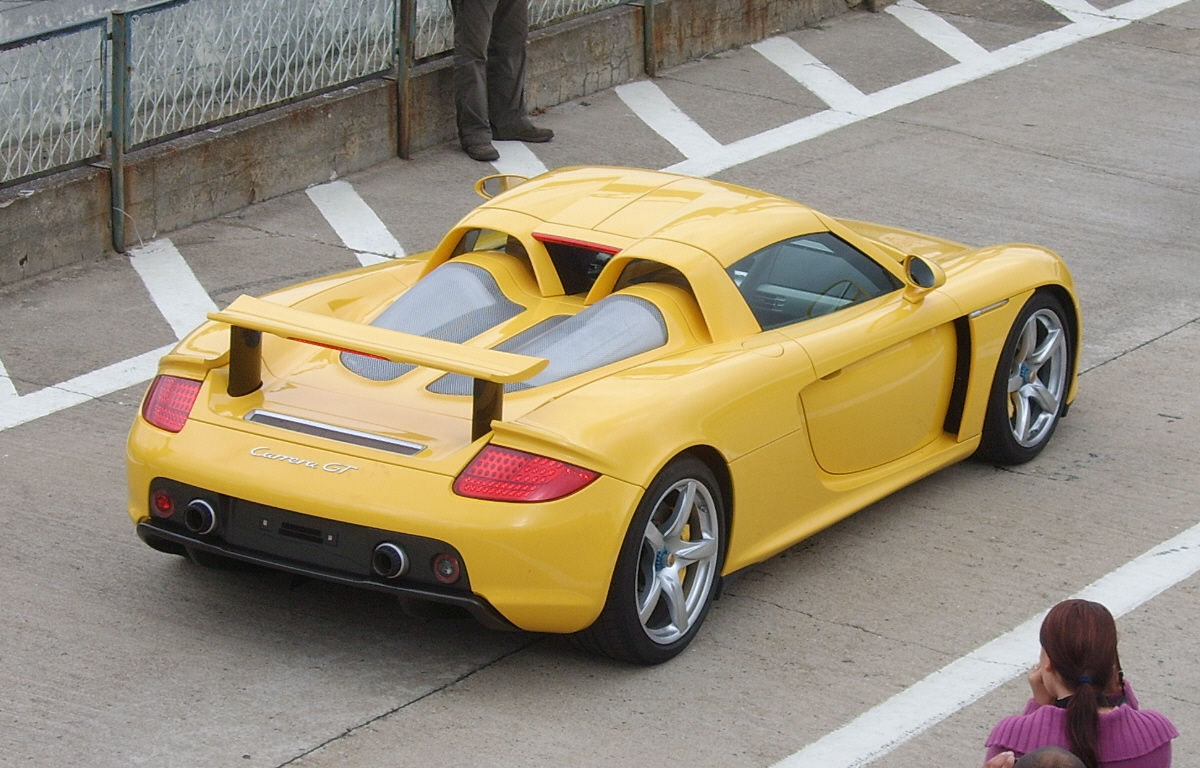
The Ferrari F40 and Porsche Carrera GT are often grouped as analog supercars. The comparison is useful, but the label hides two very different engineering stories. Ferrari unveiled the F40 in 1987 as a 40th-anniversary statement built around a twin-turbocharged V8. Porsche brought the Carrera GT from a 2000 concept into production in 2003 with a naturally aspirated V10 rooted in an un-raced endurance-racing project. One expresses the urgency of a turbo era; the other turns a motorsport engine and carbon structure into a road car. Neither needs an invented scarcity figure or a current price tag to be compelling.
The difference in production evidence is equally important. Porsche explicitly says it hand-built 1,270 Carrera GTs from autumn 2003 to early May 2006. Ferrari's F40 history documents the launch and technical story, but the manufacturer pages used here do not establish a final F40 production total. This comparison therefore gives a firm Porsche count and leaves the Ferrari count open. Read the separate Carrera GT and F40 profiles for each car's chronology.
At a glance: what can be compared
| Question | Ferrari F40 | Porsche Carrera GT |
|---|---|---|
| Public debut | 1987 anniversary unveiling | 2000 concept; 2003 production debut |
| Engine | Twin-turbocharged V8 | Naturally aspirated V10 |
| Maker-stated output | 478 CV in Ferrari's historical account | 450 kW / 612 PS in Porsche's retrospective |
| Production evidence used here | Final total not established by the cited Ferrari material | 1,270 hand-built examples, autumn 2003 to May 2006 |
| Defining idea | Anniversary-era turbo performance | Race-derived V10 and carbon structure |
These power ratings use the makers' own units. A CV or PS figure should not silently become an identical mechanical-horsepower figure. Nor does engine output alone answer which car is quicker on a given road or circuit. Period tyres, gearing, condition and the exact measurement method all matter. The table is a map of the published design choices, not a head-to-head instrumented test.
Why did Ferrari build the F40?
Ferrari's 1987 account places the F40 at the marque's fortieth anniversary and describes a 90-degree, twin-turbocharged V8 with two intercoolers and IHI turbochargers producing 478 CV. Ferrari says the car was unveiled at Maranello's Centro Civico on July 21, 1987. Its historical model entry supplies another factory point of reference for the engine specification. Those sources are more useful for understanding the machine than a bare claim that it was an expensive poster car.
The timing explains much of its identity. A 1987 supercar did not have to solve the same engineering problem as a 2003 one. Ferrari's turbocharged approach emphasizes the period's pursuit of extraordinary power from a compact V8. The F40's visual language, intake openings and dramatic rear wing belong to that whole package. Treating it as merely the Ferrari counterpart to Porsche's later V10 car erases the historical interval that makes the contrast interesting.
Ferrari's record also separates the anniversary purpose from the eventual production total. A named anniversary model can be historically specific even where the exact final number is not established by the sources linked in an article. Claims about initial plans, orders, examples built, later special variants and surviving cars describe different populations. An unsupported “one of X” badge in a listing should not be copied into a model-wide field.
How did the Carrera GT reach production?
Porsche's conceptual-forerunners history traces the car from the Paris concept in 2000 to its Geneva production premiere on March 3, 2003. Porsche says the naturally aspirated V10 produced 450 kW (612 PS) and identifies the internal type as 980. Its public production statement is unusually clear: 1,270 were hand-built in Leipzig from autumn 2003 to early May 2006. The engine was assembled at Zuffenhausen. Porsche's super sports-car history connects the V10 concept to a Le Mans programme.
The Carrera GT is therefore a specific production car, not simply a race car with number plates. Porsche describes a carbon-fibre-reinforced plastic monocoque and unit carrier, a two-piece Targa roof that stows in the luggage compartment, Porsche Ceramic Composite Brakes and a ceramic double-plate dry clutch. Its double-wishbone pushrod suspension is another sign of how closely the project considered structure and packaging. Those details give the production run context: the limited scale accompanies unusually specialized construction.
A concept-car date, launch date and production period are not interchangeable. The Paris study did not add 2000-model-year production cars to the 1,270 total. Likewise, a later anniversary feature does not create a separate Carrera GT edition. An individual car still needs a chassis record to connect it to the production series.
Turbo V8 versus naturally aspirated V10
Ferrari's two turbochargers and intercoolers are part of the F40's power story. Porsche's V10 makes its power without turbocharging. These are mechanical differences with consequences for how the engines deliver torque and how each project was packaged, but a manufacturer specification alone does not establish a universally preferred driving experience. The condition and configuration of the specific car matter too.
The Ferrari's output is quoted in CV, Porsche's in kW and PS. Converting units can help readers compare nominal peaks, provided the original rating, regional specification and source date remain attached. A claim about acceleration should be attributed to the exact maker test or independent test that produced it. This guide compares the engineering that the makers themselves document, which is enough to explain why the cars feel like products of distinct periods.
The rear-engine-versus-mid-engine shorthand also needs care. The Carrera GT is a mid-engine car. The F40's V8 is mounted behind the passenger compartment, and Ferrari's detailed configuration should guide precise descriptions. An article that reduces the comparison to engine location misses the construction, induction and historical purpose that distinguish them.
What does 1,270 tell a collector?
It establishes the size of Porsche's completed production population as reported by Porsche. It does not say that 1,270 examples are registered today, that all are original, or that all carry their initial components. Production, survival and present condition are separate questions. A seller's chassis documents, service file and inspection answer different questions from a historical model total.
For the F40, an unsupported exact total would create false precision in this particular source set. Ferrari's published launch history and model page document the anniversary context and output; this article has no direct factory statement here that pins down a final global production denominator. A future factory archive can sharpen that field without changing the well-supported engineering history. See what makes a limited-production vehicle rare for the broader distinction between announced, built, sold and surviving.
Scarcity alone cannot determine the importance of either car. Porsche's 1,270 is a documented run, but the Carrera GT's V10, structure and production path explain why readers seek it out. The F40's historical role rests on Ferrari's anniversary project and turbo technology regardless of whether an unsourced round number is repeated across listings.
How to identify an individual car
Begin with the factory designation and chassis identity. Confirm the recorded year and original configuration against the maker's records. Then review the service history, repairs and major component replacements. A photograph of an F40 does not authenticate its chassis; a Carrera GT's 1,270-unit denominator does not authenticate an advertised example. A vehicle can be real and correctly identified while still having a complicated maintenance history worth disclosing.
Look separately at documentation and visible equipment. Paint, wheels, interior pieces and badges can change. A factory record establishes how the car was built; a current inspection establishes what is present now. If a seller invokes a special racing connection or exceptionally low mileage, ask for records specific to that car. The general histories linked here do not certify an individual vehicle.
The comparison has another practical lesson: preservation depends on different systems. A twin-turbocharged 1980s Ferrari and a carbon-structured 2000s Porsche invite distinct technical checks. A qualified inspection should focus on the model and chassis at hand rather than a universal “analog supercar” checklist.
Where these cars sit in the Rarity Rides archive
The Ferrari F40 profile follows the Maranello anniversary story, while the Porsche Carrera GT profile follows the V10's route into production. For a different Porsche idea of limited production, compare the 992 Sport Classic: its 1,250-unit heritage edition is related by marque, but it is a distinct 911-based project. The modern heritage comparison explains why a revival's purpose should not be confused with an earlier supercar's engineering programme.
That chain of reading lets the cars answer different questions. The F40 shows what Ferrari's 1987 anniversary statement looked like. The Carrera GT shows what Porsche built when a racing-derived V10 met a carbon road-car architecture. The Sport Classic shows how a later maker can deliberately reference its past within a numbered edition. Calling all three “rare” is a start; naming their actual projects is the story.
Frequently asked questions
How many Porsche Carrera GTs were made?
Porsche says 1,270 were hand-built from autumn 2003 to early May 2006. That is a production figure, not a current survivor count.
How many Ferrari F40s were built?
The Ferrari pages cited here establish its launch and specifications but do not provide the final production total. An exact number requires a directly identified factory source; this guide does not infer one from a seller listing or an uncited repetition.
Was the Carrera GT's V10 actually raced at Le Mans?
Porsche says the engine had racing origins and its retrospective describes the project that led to the road car. That history should not be shortened into a claim that the production Carrera GT itself raced at Le Mans.
Are they both anniversary editions?
Ferrari's F40 is explicitly linked to its fortieth anniversary. Porsche's Carrera GT emerged from its concept and V10 programme. The two cars have different origin stories.
Which has more power?
Ferrari publishes 478 CV for the F40 in the cited history. Porsche publishes 450 kW (612 PS) for the Carrera GT. The Porsche nominal rating is higher, but peak output alone does not settle the broader comparison.
Manufacturer sources
Ferrari's F40 anniversary history and F40 model entry document its launch and technical figures. Porsche's Carrera GT retrospective documents the production run, V10 and carbon construction; its super sports-car overview provides further programme context.
How the production dates shape the comparison
The F40 appeared in the late 1980s, when Ferrari was marking its fourth decade and turbocharged engines held a prominent place in high-performance design. Porsche's Carrera GT reached production roughly sixteen years after the F40's unveiling, after a concept programme that Porsche dates to 2000. Comparing the two as though they were simultaneous competitors would obscure the intervening changes in materials, braking and chassis design. A chronological comparison makes their differences easier to understand.
Porsche's account is precise about its production window: autumn 2003 through early May 2006. The company's 1,270-unit statement is a completed-run claim in that retrospective. The F40's July 1987 unveiling is a launch event. A launch date should not be mistaken for a final build date, just as early orders in a launch story should not be mistaken for completed cars. When assembling a timeline for an individual example, use its actual factory build and delivery documents instead of applying a model's introduction date as its year.
The distinction also matters when searching. “Ferrari F40 production” may return repeated figures without the exact factory source behind them. “Porsche Carrera GT production” can be answered directly from Porsche's retrospective. A reliable comparison can be asymmetrical: cite the count where the maker states it, and explain the other car through equally strong but different factory evidence. Symmetry in a table is never a reason to insert an unsupported F40 number.
The engineering beyond the engine bay
The Carrera GT's carbon-fibre-reinforced plastic monocoque and unit carrier are not cosmetic details. They form the architecture around the V10 and contribute to the car's identity as a specialized, limited production project. Porsche's retrospective also identifies the ceramic double-plate dry clutch, carbon-based seat shells and pushrod suspension. These details explain why the project cannot be summarized by “612 PS and 1,270 made.” They define how Porsche attempted to translate a motorsport-inspired concept into a roadgoing package.
Ferrari's F40 cannot be understood solely by its 478 CV peak either. Its turbochargers and intercoolers are part of the design vocabulary Ferrari explicitly highlights in its historical account. The machine's anniversary origin ties technical and brand history together. A fair comparison does not award points for newer technology or assign nostalgia points to an older car. It asks how well each car expresses the technical and historical purpose its maker described.
Finally, model-wide specification is only a baseline. Decades of maintenance can change a car's tyre type, exhaust, body panels or mechanical condition. Porsche's later tyre update is an example of why period specification and present equipment must be distinguished. A modern tyre recommendation does not rewrite the Carrera GT's original production count or the F40's launch-era engineering.
