1956 Renault Étoile Filante
Explore the Renault Étoile Filante: history, verified identity, specification references, rarity evidence and real credited photos.
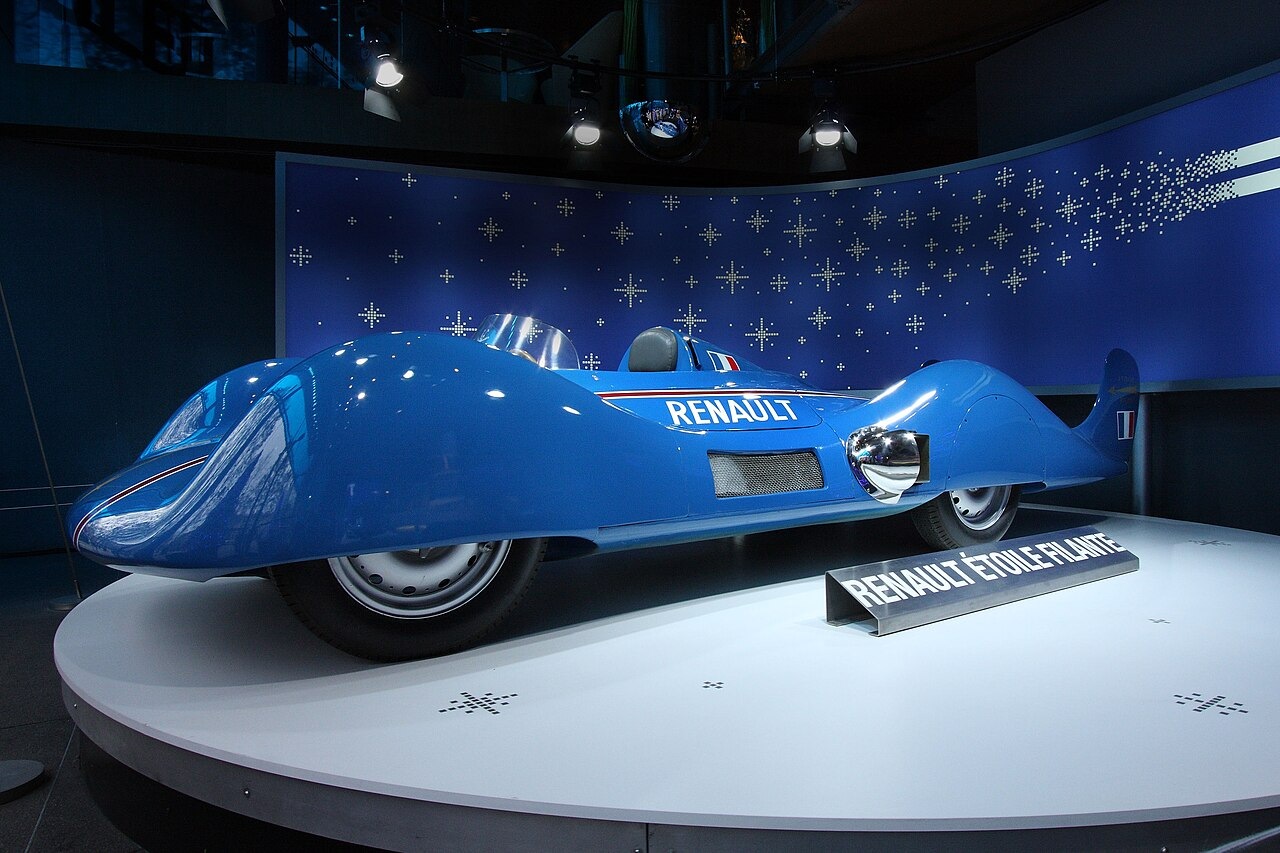
The Renault Étoile Filante took turbine technology onto the Bonneville salt in 1956. Its dramatic body makes it an obvious collector attraction, but the verified story is more precise than the usual one-off legend: Renault’s museum lists two vehicles and distinguishes the original turbine experiment from later commemorative running.
A turbine experiment on four wheels
The Étoile Filante belongs to Renault’s exploration of alternative propulsion, with a Turmo turbine at the heart of the project. The museum dates the programme to 1956. Its significance lies in a physical engineering experiment, rather than a speculative drawing or a promised production model. It is therefore retained as an Archive record, with the experimental vehicles separated from any customer road-car production statistics.
Renault museum: Étoile Filante
Packaging a different kind of engine
Renault gives a 270 hp turbine reference and describes a tubular structure with polyester bodywork. The propulsion installation sits behind the driver. These details explain why the car’s proportions differ so strongly from a conventional contemporary saloon. Turbine output is not evidence of a particular acceleration time, however; the way power reaches the driven wheels and the intended operating environment remain essential parts of any comparison.
Bonneville, September 1956
The manufacturer records four speed records on 5 September 1956, including 306.902 km/h over one kilometre and 307.707 km/h over one mile. Those distances should remain attached to their respective figures. A higher number in a photograph’s caption is not substituted for the factory’s specified record measurements. Nor does a historical announcement establish that the same category record remains unbeaten decades later.
Renault museum: Étoile Filante
The shape as a functional statement
The low body, prominent rear fins and exposed cockpit give the Étoile Filante a visual identity that remains recognisable in a static display. As design interpretation, it expresses the optimism surrounding aviation technology in the period. That reading is separate from technical verification. A photograph can establish visible form and exhibition context, while information about turbine installation or operation requires the engineering record and an inspection of the actual vehicle.
Renault museum: Étoile Filante
Preserve the propulsion history of each appearance
Renault describes a 2016 Bonneville return with electric propulsion. That anniversary appearance should not be retold as another run by an unchanged 1956 turbine installation. For a physical vehicle file, record when propulsion equipment was removed, substituted or reinstated, alongside the identity of the participating chassis. Exhibition photographs should retain their dates so that later presentations do not silently become evidence of original mechanical configuration.
Specifications and identity reference
| Programme year | 1956 |
|---|---|
| Factory quantity reference | Two vehicles |
| Original propulsion | Turmo gas turbine; factory reference 270 hp |
| Structure | Tubular frame with polyester bodywork |
| Recorded kilometre speed | 306.902 km/h, 5 September 1956 |
Rarity and production scope
The Renault museum’s technical table lists two Étoile Filante vehicles. The profile therefore rejects an exclusive one-car total. These are experimental Archive vehicles, with no road-production quantity entered. Historical turbine records, later electric anniversary running and current museum presentation are different contexts; none establishes the present mechanical state or individual identity of every surviving component.
This is an Archive record. Concepts, restored heritage vehicles, works cars and competition programmes are not added to customer road-production totals. A programme profile does not establish how many physical chassis were made, and repeated exhibition appearances do not create additional vehicles.
What the photograph represents
Renault Étoile Filante in a later display. This illustrates the 1956 turbine programme; the photograph does not establish which of the two original vehicles is shown or its current propulsion equipment. Record speeds are taken from Renault’s account, not the image caption.
Related Renault heritage profiles
Frequently asked questions
Was the Étoile Filante a single car?
Renault’s museum technical reference lists two vehicles, so this profile does not call the programme an exclusive one-off.
Was the 2016 return another turbine record attempt?
The manufacturer describes electric propulsion for that commemorative return. It should not be presented as a repeat by the original turbine configuration.
What is the production-count boundary for this profile?
The Renault museum’s technical table lists two Étoile Filante vehicles. The profile therefore rejects an exclusive one-car total. These are experimental Archive vehicles, with no road-production quantity entered. Historical turbine records, later electric anniversary running and current museum presentation are different contexts; none establishes the present mechanical state or individual identity of every surviving component.
Sources and further reading
Research checked 17 October 2026. Linked factory announcements and heritage records support the specifically attributed claims. Photographic descriptions identify the illustrated subject. Design analysis and suggested authentication steps are editorial interpretation.
Built in limited numbers
The Renault museum’s technical table lists two Étoile Filante vehicles. The profile therefore rejects an exclusive one-car total. These are experimental Archive vehicles, with no road-production quantity entered. Historical turbine records, later electric anniversary running and current museum presentation are different contexts; none establishes the present mechanical state or individual identity of every surviving component.
Gallery
Specifications
Factory specifications may vary by model year, market and configuration.
Identity & production
- Official model
- Renault Étoile Filante
Sources and verification
Source citations are being prepared for this profile.