1968 Porsche 909 Bergspyder
Explore the 909 Bergspyder: history, verified identity, specification references, rarity evidence and real credited photos.
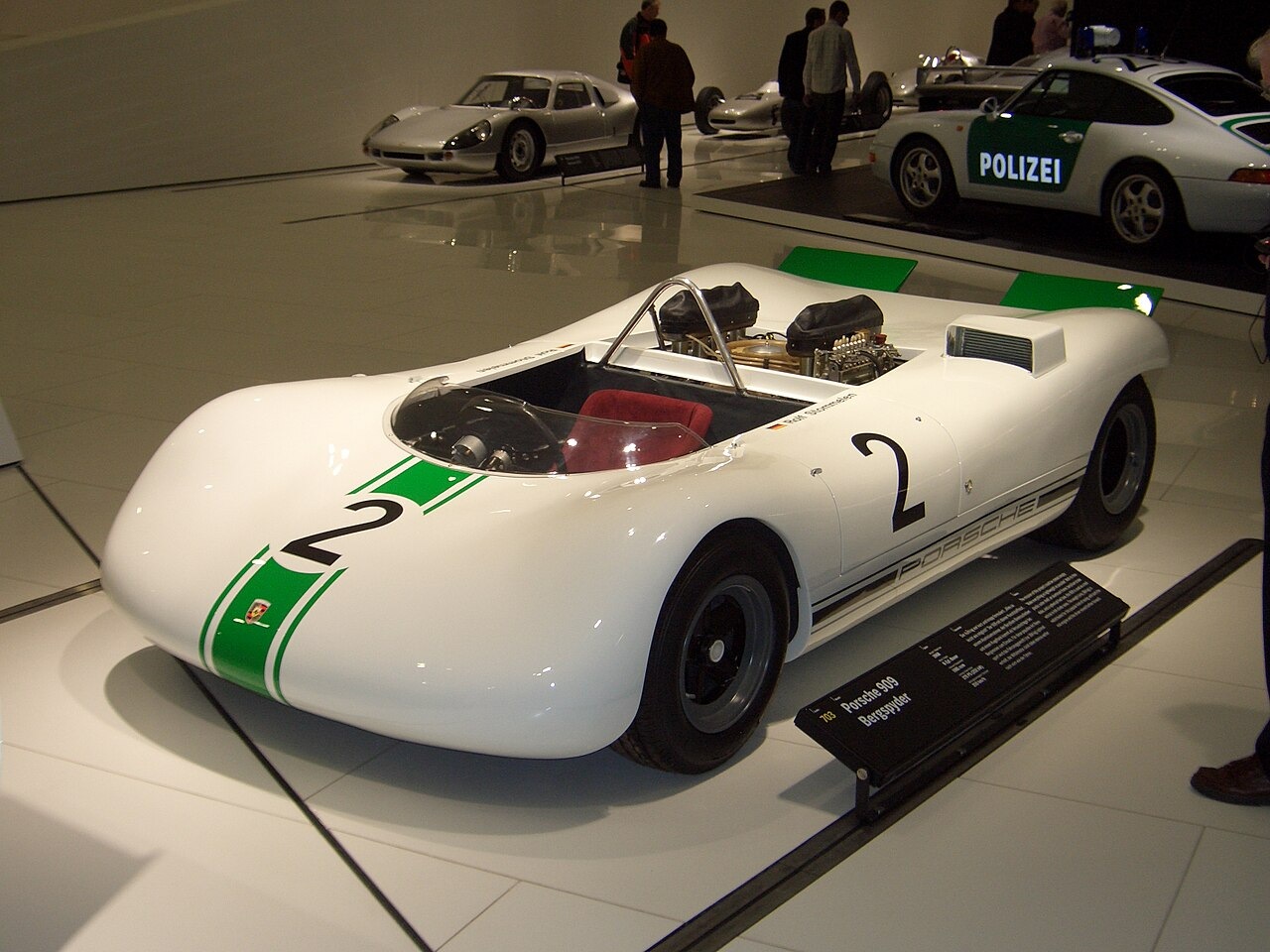
The Porsche 909 Bergspyder reduced the hill-climb prototype to an extreme lightweight experiment. Introduced in 1968, it combined a small flat-eight engine with a body and chassis package designed around short uphill competition. Porsche’s heritage account identifies two examples. Weight references vary with source and configuration, making a single unqualified figure less useful than a dated explanation of the car’s purpose and the specific exhibit being described.
A machine built for an uphill sprint
Porsche’s heritage presentation places the 909 in the European Hill Climb Championship of 1968. The short-event setting matters: design decisions that suit a brief ascent need not suit a long endurance race or everyday road use. The Bergspyder is therefore best read as a focused experimental competition object. It belongs alongside the brand’s engineering history rather than within ordinary road-car production or a generic list of open Porsche sports cars.
Porsche: Gaisberg history and two-example reference
The lightweight package and its unusual systems
The manufacturer describes an aluminium frame, thin body skin, unusual brake materials and a spherical fuel tank. These details explain how reducing mass shaped the whole vehicle. They should remain historical descriptions, not invitations to infer that the car is currently operated with every original component. A museum or demonstration configuration may preserve the appearance while using different service parts, and that difference should be recorded when known.
Why weight needs a source and configuration
Porsche’s 2019 museum programme gives 384 kg, while a later account describes an approximately 400 kg machine. Those references are close enough to communicate exceptional lightness but not identical enough to merge silently. The profile retains them as dated manufacturer descriptions. Neither is a new weighing of the photographed exhibit. Fluids, equipment and demonstration preparation are among the questions an individual technical file would need to resolve.
Porsche: Gaisberg history and two-example reference
Two examples and a very short competition career
The Gaisberg heritage account states that two 909s existed and that one was raced twice in 1968. That is a specific factory historical reference, not a count inferred from photographs or event entries. It does not authenticate the later custody of both objects. Keeping the number attached to its source preserves its usefulness while leaving construction changes, component exchanges and present condition to individual vehicle records.
Porsche Museum: 2019 lightweight specification reference
Identifying an authentic 909 reference
A caption should distinguish the 909 from the related 907 and 910 hill-climb machines, whose shapes and competition settings can invite confusion. Check the museum description, engine reference and overall body before accepting an image. A replica or scale model needs its own label. For a surviving object, dated workshop and collection records are necessary to connect the present car with a particular original chassis and period competition appearance.
Specifications and identity reference
| Reference year | 1968 |
|---|---|
| Discipline | European hill climbing |
| Engine family | Approximately 2.0-litre flat eight |
| Construction theme | Extreme lightweight prototype |
| Historical examples | Two, according to Porsche’s Gaisberg account |
| Weight references | 384 kg in 2019 source; approximately 400 kg in later account |
| Fuel-system feature | Spherical tank described |
| Count category | Factory historical reference; not road production |
Rarity and production scope
Verified 909 Bergspyder programme. Porsche’s Gaisberg account identifies two examples. Weight is configuration-sensitive and reported with its source; no road-production count or independently audited surviving-chassis total is assigned.
This is an Archive record. Concepts, restored heritage vehicles, works cars and competition programmes are not added to customer road-production totals. A programme profile does not establish how many physical chassis were made, and repeated exhibition appearances do not create additional vehicles.
What the photograph represents
Porsche 909 Bergspyder photographed in a display in 2009. Later heritage appearance, not a new weighing or certification of original mechanical configuration.
Related Porsche heritage profiles
Frequently asked questions
Was the 909 a production roadster?
No. It was an experimental hill-climb competition prototype.
Why are both 384 and approximately 400 kg mentioned?
Manufacturer accounts use different weight references; they are not presented as a new identical measurement.
What is the production-count boundary for this profile?
Verified 909 Bergspyder programme. Porsche’s Gaisberg account identifies two examples. Weight is configuration-sensitive and reported with its source; no road-production count or independently audited surviving-chassis total is assigned.
Sources and further reading
- Porsche: Gaisberg history and two-example reference
- Porsche Museum: 2019 lightweight specification reference
- Porsche Christophorus: later sphere and weight account
Research checked 17 October 2026. Linked factory, heritage and specialist-register records support the specifically attributed claims. Photographic descriptions identify the illustrated subject. Design analysis and suggested authentication steps are editorial interpretation.
Built in limited numbers
Verified 909 Bergspyder programme. Porsche’s Gaisberg account identifies two examples. Weight is configuration-sensitive and reported with its source; no road-production count or independently audited surviving-chassis total is assigned.
Gallery
Specifications
Factory specifications may vary by model year, market and configuration.
Identity & production
- Official model
- Porsche 909 Bergspyder
Sources and verification
Source citations are being prepared for this profile.