1988 Lotus Type 100T Formula One
Explore the 1988 Lotus Type 100T Formula One: programme history, design, verified rarity scope, specifications and credited photography.
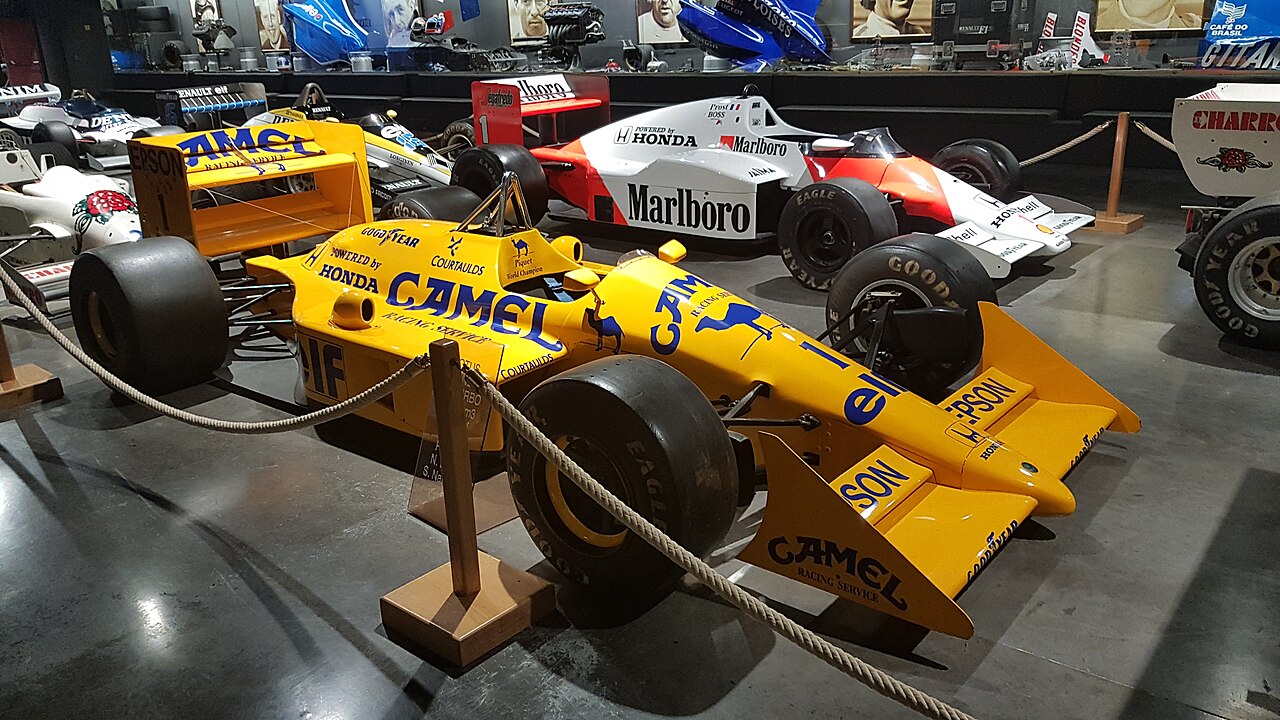
The Lotus Type 100T belongs to the final year of the team’s original turbo-powered Formula One sequence. Its own custodial record and a creator-identified museum photograph preserve the 1988 design separately from the preceding Type 99T.
History and verified programme identity
Classic Team Lotus identifies the Type 100T as the last team car penned by Gérard Ducarouge and describes it as much smaller and substantially different from its predecessor. Its public register lists five entries for the 1988 programme. Those entries are retained as a chassis-reference framework, not a census of unchanged survivors. The photograph identifies a 1988 Lotus Honda V6 Turbo at the Manoir de l’Automobile in Loéhac. The creator’s September 2022 date records a later museum appearance rather than an original Grand Prix event or a new production car.
Engineering and design
The programme’s design distinction is important even when familiar sponsor colours make neighbouring cars appear related. The custodian’s account specifically describes a smaller, different design; it does not present the Type 100T as another paint scheme on the Type 99T. The museum image shows the narrow central body, side enclosures and separate wings within the exposed-wheel layout. It cannot establish internal dimensions, engine settings or an active-suspension installation. Technical claims for the predecessor are therefore not automatically copied into this record. An individual specification should be linked to the relevant chassis and dated original preparation.
The physical car in the supplied photograph
Koreller’s photograph shows a yellow 1988 Lotus Honda V6 Turbo in the Manoir de l’Automobile collection at Loéhac in September 2022. Its low nose, open wheels and racing cockpit are visible among other exhibits. The exact model-year and Honda description are retained as the creator’s subject identification, with the later display context stated plainly.
A closer look at the design
The museum view is particularly useful for comparing the assembled car’s proportions with other late-1980s single-seaters. The tyres surround a compact body and the separate wings define its front and rear. That visual evidence supports a study of appearance but cannot explain every hidden structural or mechanical difference. The primary custodial account supplies the key distinction from the preceding Type. Reading the two together keeps the programme coherent without turning the museum display into a technical inspection. A detailed chassis history could add which body and running-gear configuration the exhibit represents. Until then, the image remains a real, accurately credited later appearance, and the five register entries remain a qualified research reference rather than a claim about current survival or originality.
Collecting and chassis evidence
A Type 100T file should connect the register identity with period race documentation and subsequent structural work. Five register rows do not establish that five untouched original cars remain. The photographed livery and painted number may help identify a configuration, but are not substitutes for the chassis chain. Museum presentation can also include later restoration decisions. Record those choices alongside dated technical evidence so the car’s current appearance does not overwrite its original competition history. The model archive explains the programme while leaving an individual exhibit’s component continuity to its own records.
Related Lotus designs and meaningful comparisons
The Type 101 provides the following normally aspirated competition comparison, while the Type 102 introduces the subsequent V12 programme. Their separate profiles make the changes in powertrain context and body development easier to follow. A consecutive Type number is a historical link, not proof of shared physical cars or a combined register count.
Reading the sources
The programme sources and the photograph answer different questions. Manufacturer and custodial records establish the original model, Type, category and published production scope. The creator’s file establishes the pictured subject, setting and image permission. An individual chassis history can then add ownership, competition entries and dated repairs without changing the scope of the original programme. Build references are not survivor counts, and a later specification does not automatically become an additional newly manufactured vehicle. Where primary evidence does not establish a complete fabrication census, that field remains unassigned.
Specifications and rarity evidence
| Programme reference year | 1988 |
|---|---|
| Model / Type | Type 100T Formula One — Type 100T |
| Body / competition role | Late turbo-era Grand Prix single-seater |
| Programme year | 1988 |
| Design attribution | Gérard Ducarouge, custodian reference |
| Register scope | Five entries |
| Photo powertrain identification | Honda V6 Turbo |
| Photo setting | Loéhac museum, September 2022 |
| Published build / register reference | 5 listed register entries |
| Independently audited completed tally | Not assigned |
| Count scope | Published reference: 5 listed register entries. Named programme or stated register scope retained separately from audited completed output and current survivor counts. |
| Original inventory status | LOT-100 — Verified |
Frequently asked questions
Is the Type 100T simply the Type 99T in another livery?
No. Classic Team Lotus explicitly describes a smaller, substantially different design. The predecessor’s active-suspension story is not automatically assigned to this car.
How is Type 100T Formula One classified?
This is a Lotus competition archive. It remains separate from Lotus road-car production. Customer cars, works entries and converted chassis need a reconciled scope before any complete fabrication tally is assigned.
Which technical details are established for the programme?
The primary record supports programme year: 1988; design attribution: Gérard Ducarouge, custodian reference; register scope: Five entries. These are programme or explicitly attributed photo references. A particular surviving car’s engine, chassis repairs and competition preparation require its own dated documentation.
Does the photographed appearance establish factory originality?
The caption records a real creator-identified Type 100T Formula One subject and its documented setting. It establishes the illustration’s scope, while original components, restoration work and individual race provenance require chassis-specific evidence. A competition number, current paint or museum display is not used as an originality certificate.
What rarity or archive scope is verified?
Published reference: 5 listed register entries. Named programme or stated register scope retained separately from audited completed output and current survivor counts.
Who photographed the supplied image?
Koreller via Wikimedia Commons, under CC BY-SA 4.0. The original file and licence are linked with the image. Retain the creator, source and licence when uploading, exporting or reusing it; local retouching and synthetic enlargement have not been performed.
Related Lotus profiles
Sources and photo credits
Photograph: Koreller via Wikimedia Commons original source, CC BY-SA 4.0. Source-provided thumbnail supplied without local cropping, retouching or synthetic enlargement.
Built in limited numbers
Published reference: 5 listed register entries. Named programme or stated register scope retained separately from audited completed output and current survivor counts.
Gallery
Specifications
Factory specifications may vary by model year, market and configuration.
Identity & production
- Official model
- Type 100T Formula One