1965 Lotus Type 35 Formula Two / Three
Explore the 1965 Lotus Type 35 Formula Two / Three: programme history, design, verified rarity scope, specifications and credited photography.
The Lotus Type 35 belongs to Formula Two and Formula Three, with category-specific power units in the custodial record. The inventory’s Tasman label is retained for recognition, while the profile uses the supported programme categories.
History and verified programme identity
Classic Team Lotus identifies the Type 35 as a 1965 Formula Two/Three design based on the Type 32. Its record lists Cosworth SCA and BRM applications for Formula Two, with 1.0-litre Cosworth MAE and Holbay R65 applications for Formula Three. It does not establish a complete fabrication tally on the accessible page. The photographed car appears at the Tasman Revival, but an event name alone does not turn its original design category into a Tasman programme. The original workbook wording remains a duplicate-check alias.
Engineering and design
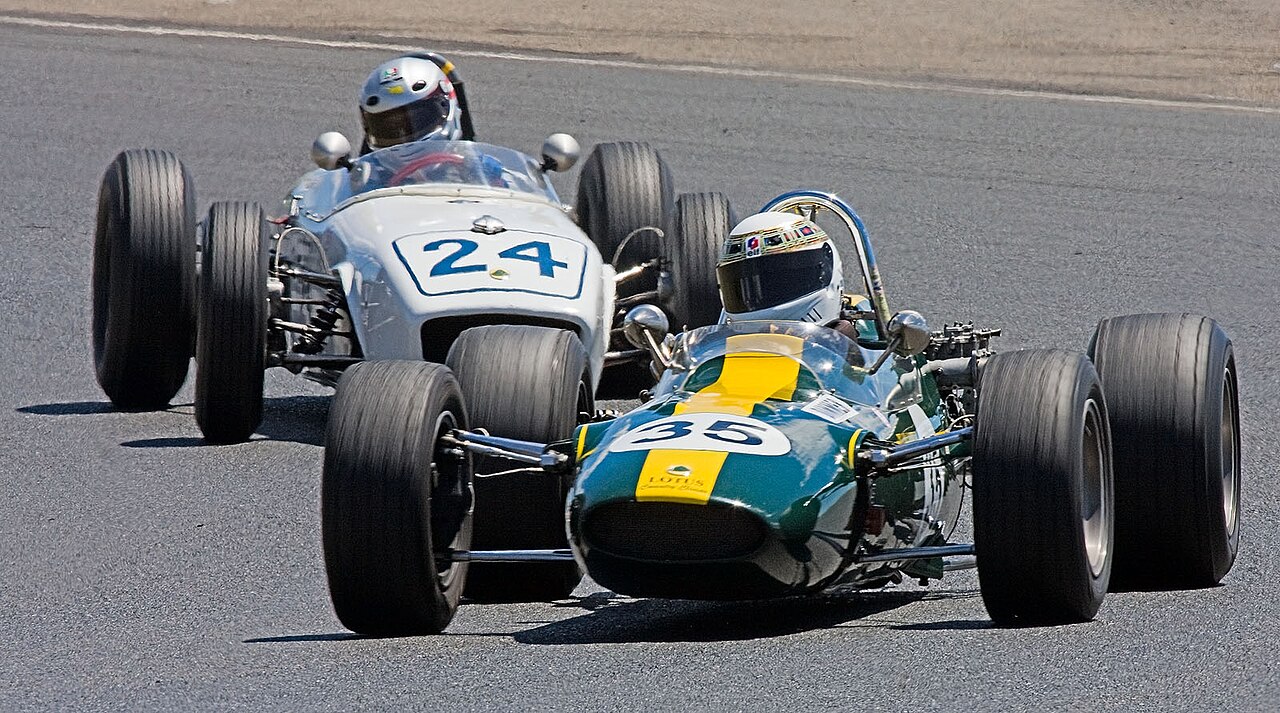
The category-specific engines make the Type 35 a useful example of one design family serving different racing requirements. A common structure can support several installations without creating one universal specification. The track photograph shows an open-wheel car with its driver low in the body and another single-seater behind it. It records a later racing appearance, while the actual current engine and suspension preparation require individual evidence. A programme description should therefore keep each engine application tied to its category instead of borrowing the specification of the nearest photographed competitor.
The physical car in the supplied photograph
The supplied photograph shows a Type 35 in a green-and-yellow livery at the Tasman Revival in Eastern Creek, Australia, in 2008. Richard Taylor’s source identifies the model, with another car following on track. The modern event context and the original programme category are kept distinct.
A closer look at the programme
The track image documents the car as an active historic racer rather than a static exhibit. That later chapter adds value when it remains dated and explicitly captioned. The original category still comes from the custodian’s Type record. This distinction also helps avoid an easy catalogue error: a current meeting title can describe the gathering without defining every entrant’s original Formula. The model, category, engine history and photographed event are related information, but they answer different questions and should not collapse into a single label. The Type 35 photograph includes another single-seater behind the foreground car. That makes the event setting readable, but the second vehicle remains background context rather than another Type 35 counted into the programme. The creator’s foreground model identification supplies the image scope. The green-and-yellow body can be compared visually with other Lotus designs, yet the original category still comes from the custodial record. This is especially useful here because the Tasman Revival name describes a modern meeting rather than the original design category of every car appearing on its track.
Collecting and chassis evidence
A Type 35 file should identify the chassis and original category before attaching engine or driver history. Later conversions and historic-racing preparation can be documented as stages of the same vehicle. The profile preserves those boundaries and leaves a whole-programme fabrication count unassigned. Correcting the broad inventory category improves the record without promoting a different workbook row or creating another car.
Related Lotus designs and meaningful comparisons
The Type 32B shows the actual Tasman derivative in this batch, while the Type 44 is a later Formula Two development connected with the Type 35. These profiles make the different categories legible without relying on paint colours or the names of modern events.
Reading the sources
The programme sources and the photograph answer different questions. Manufacturer and custodial records establish the original model, Type, category and published production scope. The creator’s file establishes the pictured subject, setting and image permission. An individual chassis history can then add ownership, competition entries and dated repairs without changing the scope of the original programme. Build references are not survivor counts, and a later specification does not automatically become an additional newly manufactured vehicle. Where primary evidence does not establish a complete fabrication census, that field remains unassigned.
Specifications and rarity evidence
| Programme reference year | 1965 |
|---|---|
| Model / Type | Type 35 Formula Two / Three — Type 35 |
| Body / competition role | Multi-category monocoque Formula-car programme |
| Programme year | 1965 |
| Primary categories | Formula Two and Formula Three |
| Design basis | Type 32 |
| F2 engine applications | Cosworth SCA and BRM |
| F3 engine applications | Cosworth MAE and Holbay R65 |
| Published build / register reference | No complete tally assigned |
| Independently audited completed tally | Not assigned |
| Count scope | Verified physical competition Type programme. Complete fabrication census unassigned; later engine, body and suspension changes are dated configurations, not automatically additional manufactured cars. |
| Original inventory status | LOT-041 — Verified |
Frequently asked questions
Does appearance at the Tasman Revival make this a Tasman-design Type?
No. The event is a later setting. The primary custodian describes the original Type 35 as Formula Two/Three, with different engines for each category.
How is Type 35 Formula Two / Three classified?
This is a Team Lotus competition Type archive. It remains separate from Lotus road-car production. Customer cars, works entries and converted chassis need a reconciled scope before any complete fabrication tally is assigned.
Which technical details are established for the programme?
The primary record supports programme year: 1965; primary categories: Formula Two and Formula Three; design basis: Type 32. These are programme or explicitly attributed photo references. A particular surviving car’s engine, chassis repairs and competition preparation require its own dated documentation.
Does the photographed appearance establish factory originality?
The caption records a real creator-identified Type 35 Formula Two / Three subject and its later setting. It establishes the illustration’s scope, while original components, restoration work and individual race provenance require chassis-specific evidence. A competition number, current paint or museum display is not used as an originality certificate.
What rarity or archive scope is verified?
Verified physical competition Type programme. Complete fabrication census unassigned; later engine, body and suspension changes are dated configurations, not automatically additional manufactured cars.
Who photographed the supplied image?
Richard Taylor from Australia via Wikimedia Commons, under CC BY 2.0. The original file and licence are linked with the image. Retain the creator, source and licence when uploading, exporting or reusing it; local retouching and synthetic enlargement have not been performed.
Related Lotus profiles
Sources and photo credits
Photograph: Richard Taylor from Australia via Wikimedia Commons original source, CC BY 2.0. Source-provided thumbnail supplied without local cropping, retouching or synthetic enlargement.
Built in limited numbers
Verified physical competition Type programme. Complete fabrication census unassigned; later engine, body and suspension changes are dated configurations, not automatically additional manufactured cars.
Gallery
Specifications
Factory specifications may vary by model year, market and configuration.
Identity & production
- Official model
- Type 35 Formula Two / Three