1965 Lotus Type 38 Indianapolis Car
Explore the 1965 Lotus Type 38 Indianapolis Car: programme history, design, verified rarity scope, specifications and credited photography.
The Lotus Type 38 carries the Indianapolis project into the 1965 winning season. Its fully stressed-skin monocoque and Ford quad-cam V8 programme belong to a distinct competition Type, with the photographed winning car identified separately.
History and verified programme identity
Classic Team Lotus describes the Type 38 as Len Terry’s fully enclosed stressed-skin monocoque fitted with a Ford quad-cam V8. Its public register contains nine entries with some repeated or unusual individual identifiers. Those entries are retained as a register reference, not simplified into an audited manufacturing census. The custodian connects the design with Jim Clark’s Indianapolis victory. The supplied creator record identifies the particular photographed car as the 1965 winner at Goodwood, adding a narrower subject description without giving every Type 38 that individual history.
Engineering and design
A full stressed-skin monocoque makes the enclosing structure central to the chassis rather than merely an outer cover. The Indianapolis role also defines the fuel, suspension and engine-packaging problem. The photograph shows the long front body and compact cockpit in a later event setting; it does not expose enough to certify the structural material or every repair. Those details require drawings and a specific car’s restoration record. The model history can explain the design approach and winning association while preserving the distinction between an original programme and one surviving exhibit.
The physical car in the supplied photograph
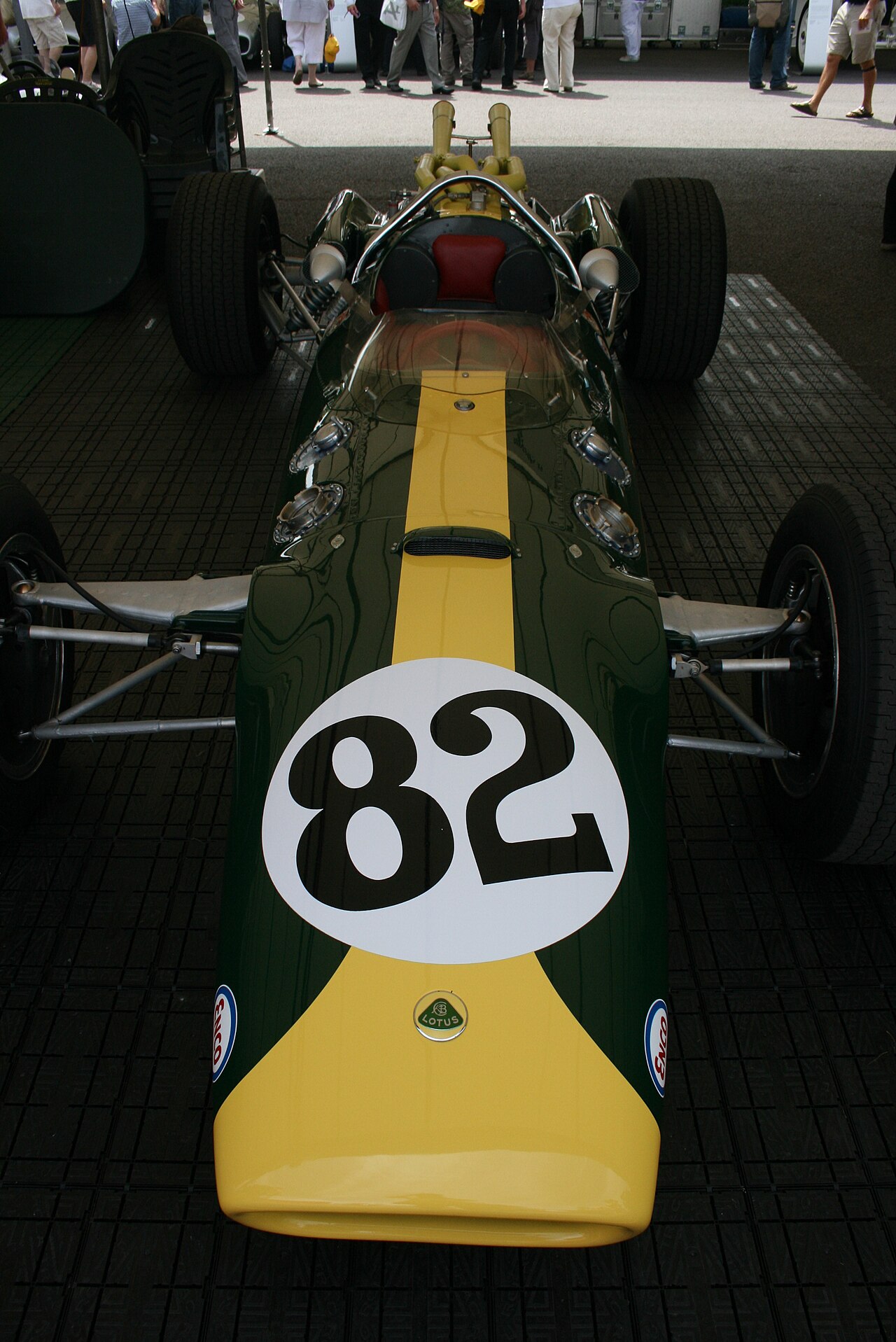
The supplied photograph shows the creator-identified 1965 Indianapolis-winning Type 38 waiting at the 2010 Goodwood Festival of Speed. Supermac1961 photographed its green body, broad yellow centre stripe and open wheels. The image date is retained separately from the race year and the programme’s introduction.
A closer look at the programme
The photograph emphasizes the long central stripe and narrow driver space. Its later Goodwood context is useful because the car appears among people and other vehicles, giving a sense of scale. The historical winner identity comes from the source record rather than from the number visible on the nose. Keeping that distinction prevents a current display marking from becoming the only basis for a race claim. The primary Type page then supplies the structural context, with each individual chassis’s repairs and later appearances preserved in its own chronology. The tall Goodwood image preserves the Type 38’s nose, cockpit and setting in one frame. A broad yellow stripe makes the central body conspicuous, while the separate wheels emphasize the single-seater layout. This is a later public appearance of the source-identified winning car, with people and surroundings providing scale. The current display number does not replace the original entrant’s record. Keeping the photo’s own date and caption allows the historical Indianapolis association to remain precise without implying that the camera captured the car during its 1965 race.
Collecting and chassis evidence
An individual winner’s provenance deserves more than a model name and current paint. Chassis records, period entries, ownership and later repairs should be reconciled with the exhibit identity. The public register’s repeated identifier notation makes a simple survivor total especially inappropriate. This profile records the Type and the creator’s narrower photo claim without using the picture as a certificate of every original component.
Related Lotus designs and meaningful comparisons
The Type 34 provides the earlier Indianapolis development, while the Type 56 illustrates a later turbine and four-wheel-drive approach. The three belong to a connected competition history, with different powertrains and structures. A later success or experiment does not replace the programme identity of an earlier car.
Reading the sources
The programme sources and the photograph answer different questions. Manufacturer and custodial records establish the original model, Type, category and published production scope. The creator’s file establishes the pictured subject, setting and image permission. An individual chassis history can then add ownership, competition entries and dated repairs without changing the scope of the original programme. Build references are not survivor counts, and a later specification does not automatically become an additional newly manufactured vehicle. Where primary evidence does not establish a complete fabrication census, that field remains unassigned.
Specifications and rarity evidence
| Programme reference year | 1965 |
|---|---|
| Model / Type | Type 38 Indianapolis Car — Type 38 |
| Body / competition role | Ford quad-cam V8 Indianapolis programme |
| Programme year | 1965 |
| Structure | Full stressed-skin monocoque |
| Engine reference | Ford quad-cam V8 |
| Designer in custodial record | Len Terry |
| Photo appearance | Goodwood Festival of Speed, 2010 |
| Published build / register reference | 9 listed register entries |
| Independently audited completed tally | Not assigned |
| Count scope | Published source reference: 9 listed register entries. Scope follows the named programme or register; independently audited completed output and survivor census remain unassigned. |
| Original inventory status | LOT-039 — Verified |
Frequently asked questions
Does the winning-car photograph mean every Type 38 won Indianapolis?
No. The programme and the specific creator-identified winner are different scopes. Individual race provenance remains chassis-specific.
How is Type 38 Indianapolis Car classified?
This is a Team Lotus competition Type archive. It remains separate from Lotus road-car production. Customer cars, works entries and converted chassis need a reconciled scope before any complete fabrication tally is assigned.
Which technical details are established for the programme?
The primary record supports programme year: 1965; structure: Full stressed-skin monocoque; engine reference: Ford quad-cam V8. These are programme or explicitly attributed photo references. A particular surviving car’s engine, chassis repairs and competition preparation require its own dated documentation.
Does the photographed appearance establish factory originality?
The caption records a real creator-identified Type 38 Indianapolis Car subject and its later setting. It establishes the illustration’s scope, while original components, restoration work and individual race provenance require chassis-specific evidence. A competition number, current paint or museum display is not used as an originality certificate.
What rarity or archive scope is verified?
Published source reference: 9 listed register entries. Scope follows the named programme or register; independently audited completed output and survivor census remain unassigned.
Who photographed the supplied image?
Supermac1961 from CHAFFORD HUNDRED, England via Wikimedia Commons, under CC BY 2.0. The original file and licence are linked with the image. Retain the creator, source and licence when uploading, exporting or reusing it; local retouching and synthetic enlargement have not been performed.
Related Lotus profiles
Sources and photo credits
Photograph: Supermac1961 from CHAFFORD HUNDRED, England via Wikimedia Commons original source, CC BY 2.0. Source-provided thumbnail supplied without local cropping, retouching or synthetic enlargement.
Built in limited numbers
Published source reference: 9 listed register entries. Scope follows the named programme or register; independently audited completed output and survivor census remain unassigned.
Gallery
Specifications
Factory specifications may vary by model year, market and configuration.
Identity & production
- Official model
- Type 38 Indianapolis Car