1961 Lotus Type 21 Formula One
Explore the 1961 Lotus Type 21 Formula One: programme history, design, verified rarity scope, specifications and credited photography.
The Lotus Type 21 refines the rear-engined Formula One design and records Team Lotus’s first championship Grand Prix victory as a works team. Its lower driving position and 1961 competition identity make it distinct from the earlier Type 18 and later hybrid developments.
History and verified programme identity
Classic Team Lotus dates the Type 21 to 1961 and describes it as a development of the Type 18. Its record emphasizes a more reclined driver, intended to lower the centre of gravity and frontal area. The custodial page lists eleven numbered register entries and identifies Innes Ireland’s United States Grand Prix victory at Watkins Glen as the first Team Lotus Grand Prix win. That works-team milestone is different from Stirling Moss’s 1960 Monaco victory in a privately entered Type 18, which was the first championship win for a Lotus car. The two achievements are kept separately worded.
Engineering and design
The driver’s position is an important part of the Type 21’s design account. Reclining the occupant changes the height and length of the space that the chassis and body must enclose. It can also influence the sight line, control placement and the relationship between the front body and cockpit. Classic Team Lotus links that change to centre of gravity and frontal area, but no numerical reduction is assigned here. The useful explanation is the design intention and its visible effect on the low body. The measured geometry of an individual restored car would require drawings and technical records for its actual configuration.
The physical car in the supplied photograph
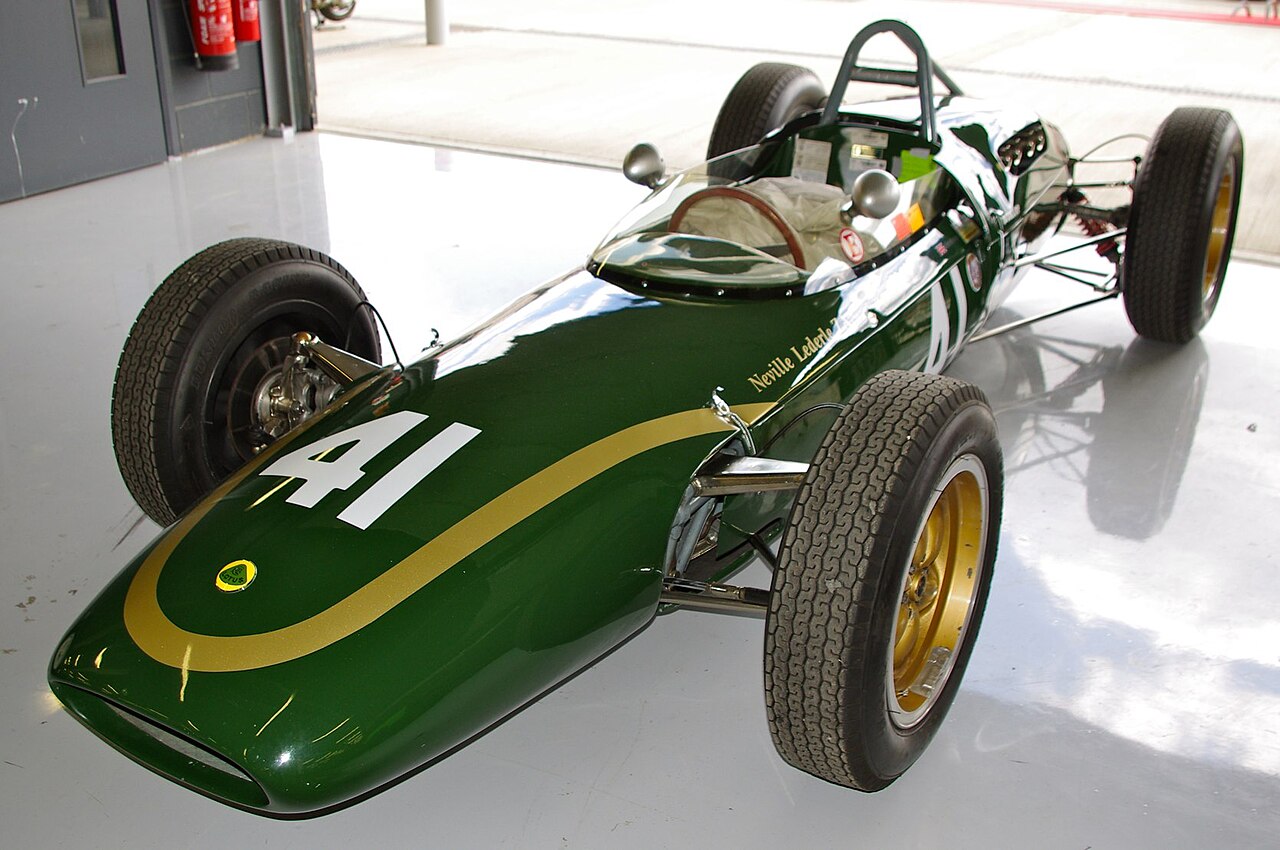
The supplied photograph shows a green Type 21 at the Silverstone Classic in 2011. The narrow yellow front stripe, small cockpit and exposed rear mechanical area are visible in the paddock. The creator identifies the Type. The event image is not assigned Ireland’s Watkins Glen chassis identity or described as a photograph of the original 1961 win. It supplies a later physical illustration of the programme.
The entrant matters when describing a milestone
The Type 21’s first-win wording becomes clearer when the entrant is retained alongside the car. A manufacturer’s design can win in a private team before its own works operation achieves the same championship milestone. Both events belong in the history, but they answer different questions. For readers new to early Formula One, the distinction helps explain why accounts of the Type 18 and Type 21 may each contain a first. The programme pages can be connected without declaring one account wrong. An individual car’s file would go further, identifying the chassis, driver and event documents for the relevant entry. The photograph here remains a later model illustration, so the historical milestone does not become an unsupported claim that the pictured car is the specific Watkins Glen winner.
Collecting and chassis evidence
A Type 21 record should distinguish the original design from Type 18/21 hybrids and subsequent rebuilds. Similar paint and a related body shape do not establish identical chassis histories. The public register helps locate original references, while an individual competition file would connect one car with its entries, engines and later ownership. Eleven listed entries are retained as a custodial register reference, not as a current survivor count. That wording gives the rarity evidence a precise scope and avoids inferring that every listed chassis survives intact or that every car with a Type 21 appearance was originally constructed in that form.
Related Lotus designs and meaningful comparisons
The Type 18 provides the design basis and the earlier Lotus-car victory. The Type 24 illustrates the next phase of Formula One customer-car development. Comparing the driver position and body proportions across the three makes the Type 21’s evolution easier to understand. It also demonstrates why the phrase first Lotus win needs a defined subject. A car manufacturer’s first winning entry and a works team’s first win can both be important historical facts, provided they are recorded with the right programme, entrant and date.
Reading the sources
The programme sources and the photograph answer different questions. Manufacturer and custodial records establish the original model, Type, category and published production scope. The creator’s file establishes the pictured subject, setting and image permission. An individual chassis history can then add ownership, competition entries and dated repairs without changing the scope of the original programme. Build references are not survivor counts, and a later specification does not automatically become an additional newly manufactured vehicle. Where primary evidence does not establish a complete fabrication census, that field remains unassigned.
Specifications and rarity evidence
| Programme reference year | 1961 |
|---|---|
| Model / Type | Type 21 Formula One — Type 21 |
| Body / competition role | Rear-engined works Formula One development |
| Custodial programme year | 1961 |
| Design relationship | Development of the Type 18 |
| Driver arrangement | More reclined position, custodial description |
| Works-team milestone | Innes Ireland, 1961 US Grand Prix |
| Photo setting | Silverstone Classic, 2011 |
| Published build / register reference | 11 listed register entries |
| Independently audited completed tally | Not assigned |
| Count scope | Published complete named programme reference: 11 listed register entries. This is a source-reported reference, not an independently audited completed tally or a surviving-car census. |
| Original inventory status | LOT-020 — Verified |
Frequently asked questions
Why distinguish the first Lotus-car win from the first Team Lotus win?
Moss won Monaco in 1960 in a privately entered Type 18. Classic Team Lotus identifies Ireland’s 1961 Watkins Glen victory in the Type 21 as the works team’s first championship Grand Prix win.
How is Type 21 Formula One classified?
This is a Team Lotus competition Type archive. It remains separate from Lotus road-car production. Customer cars, works entries and converted chassis need a reconciled scope before any complete fabrication tally is assigned.
Which technical details are established for the programme?
The primary record supports custodial programme year: 1961; design relationship: Development of the Type 18; driver arrangement: More reclined position, custodial description. These are programme or explicitly attributed photo references. A particular surviving car’s engine, chassis repairs and competition preparation require its own dated documentation.
Does the photographed appearance establish factory originality?
The caption records a real creator-identified Type 21 Formula One subject and its later setting. It establishes the illustration’s scope, while original components, restoration work and individual race provenance require chassis-specific evidence. A competition number, current paint or museum display is not used as an originality certificate.
What rarity or archive scope is verified?
Published complete named programme reference: 11 listed register entries. This is a source-reported reference, not an independently audited completed tally or a surviving-car census.
Who photographed the supplied image?
David Merrett from Daventry, England via Wikimedia Commons, under CC BY 2.0. The original file and licence are linked with the image. Retain the creator, source and licence when uploading, exporting or reusing it; local retouching and synthetic enlargement have not been performed.
Related Lotus profiles
Sources and photo credits
Photograph: David Merrett from Daventry, England via Wikimedia Commons original source, CC BY 2.0. Source-provided thumbnail supplied without local cropping, retouching or synthetic enlargement.
Built in limited numbers
Published complete named programme reference: 11 listed register entries. This is a source-reported reference, not an independently audited completed tally or a surviving-car census.
Gallery
Specifications
Factory specifications may vary by model year, market and configuration.
Identity & production
- Official model
- Type 21 Formula One