1955 Lotus Mark IX
Explore the 1955 Lotus Mark IX: programme history, design, verified rarity scope, specifications and credited photography.
The Lotus Mark IX refines the early streamlined sports-racing programme around smaller-capacity engines. Its compact body and documented 1955 competition context give it a distinct identity beside both the Mark VIII and the later Eleven.
History and verified programme identity
Classic Team Lotus describes the Mark IX as an improved Mark VIII intended principally for smaller engines and reports 23 built. The register identifies 1,098 cc and 1,460 cc Coventry-Climax applications and a 1,487 cc MG engine. Its early-years history also records the Mark IX in Team Lotus’s 1955 Le Mans appearance with Colin Chapman and Ron Flockhart. That programme-level competition context does not establish that the photographed example was the same works car. The model reference, race history and individual pictured chassis are retained as separate kinds of evidence.
Engineering and design
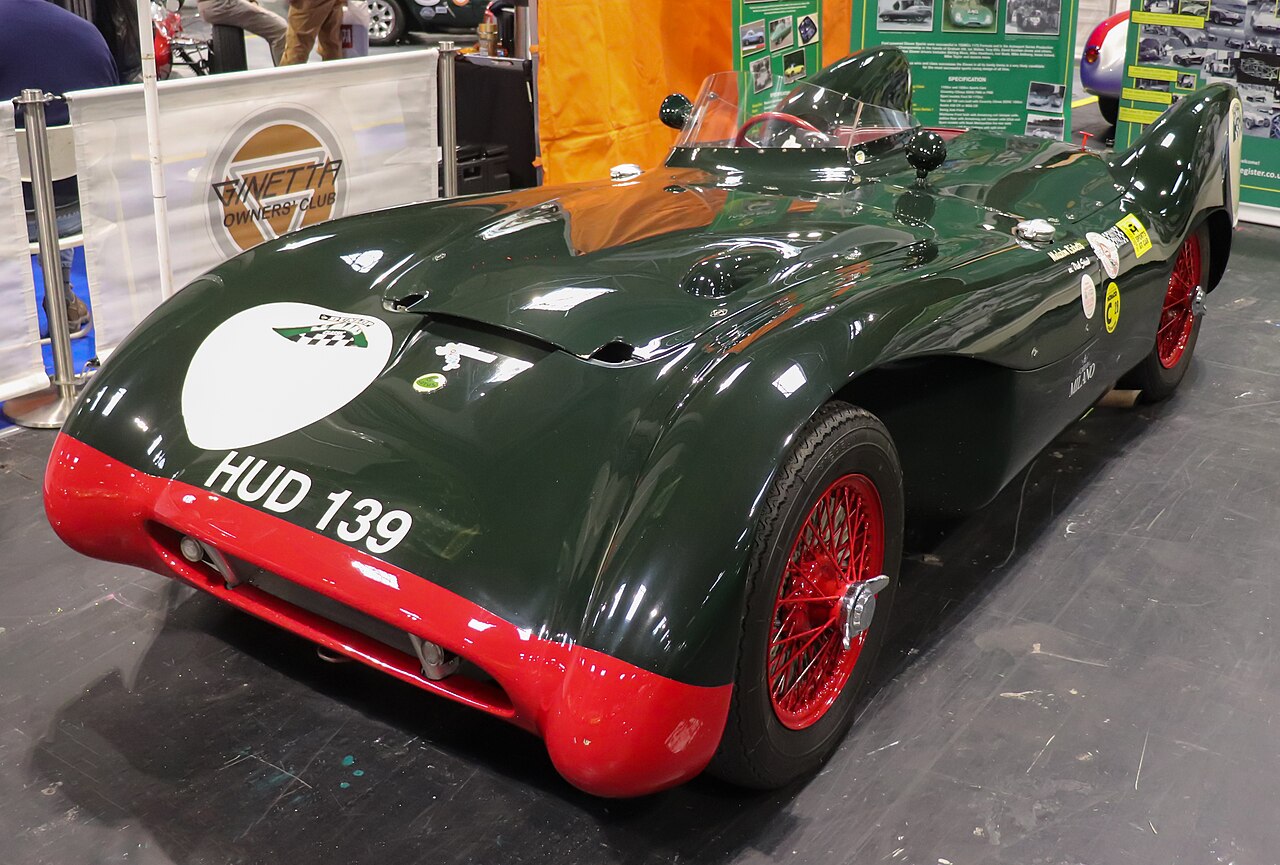
The Mark IX’s interest is the relationship between a compact power unit and a fully clothed sports-car body. Smaller engines can allow the body, cooling system and driver compartment to be organized differently, but the final arrangement depends on each installation. The photograph shows how little of the running gear is exposed compared with a cycle-winged Mark VI. That makes the outer surface read as a single shape, while the small windscreen and open cockpit keep the driver visible within it. Studying those relationships gives the car more context than an isolated horsepower figure would, particularly where several engines belonged to the same programme.
The physical car in the supplied photograph
The supplied photograph shows a green Mark IX with a red nose, registration HUD 139 and a large white competition roundel at the NEC Classic Motor Show in 2019. The file names a 1955 Mark IX. Its front opening and small glazed cockpit are visible in the indoor display. The image illustrates a later physical appearance and does not certify an original race livery or an unchanged 1955 specification.
A familiar outline with a narrower programme
The Mark IX’s relationship to the Mark VIII is explicit in the custodial history, but the later car should still be identified on its own terms. Its small-capacity intention and named engine applications give it a narrower technical context than a generic streamlined Lotus description. In the supplied exhibit, the red front opening draws attention to the nose, while the dark green upper surface and low screen lead toward the cockpit. The registration visible in the photograph can be a useful starting point for individual research, but it is not a substitute for a chassis record. A catalogue can use the model comparison to explain the family resemblance and then use the separate Type entry to preserve the particular programme. This is especially valuable where several related racers are displayed together and a casual caption might otherwise merge them.
Collecting and chassis evidence
The 23-car source reference belongs to the Mark IX programme, not to one engine option or one body colour. A researcher should therefore keep an individual chassis’s engine changes, ownership and competition entries in a separate chronology. If a car is described as having competed at Le Mans, its number and entry must be connected to period documentation before that history can be assigned to the exhibit. Restoration photographs can be equally useful, provided their dates are retained. They explain how the car reached its present appearance without turning the current body finish into a statement about every Mark IX originally constructed.
Related Lotus designs and meaningful comparisons
The Mark VIII is the natural earlier comparison because the custodial description explicitly identifies the relationship. The Eleven provides the later contrast: a successor sports-racing programme with its own body, production reference and engine choices. Looking across all three helps explain the sequence of experiments in sports-car form. It also makes the Type number an effective catalogue boundary. A superficially similar streamlined Lotus should still be identified from its record and chassis history before it is used as an illustration of the Mark IX.
Reading the sources
The programme sources and the photograph answer different questions. Manufacturer and custodial records establish the original model, Type, category and published production scope. The creator’s file establishes the pictured subject, setting and image permission. An individual chassis history can then add ownership, competition entries and dated repairs without changing the scope of the original programme. Build references are not survivor counts, and a later specification does not automatically become an additional newly manufactured vehicle. Where primary evidence does not establish a complete fabrication census, that field remains unassigned.
Specifications and rarity evidence
| Programme reference year | 1955 |
|---|---|
| Model / Type | Mark IX — Type 9 |
| Body / competition role | Small-capacity streamlined sports racer |
| Programme role | Improved Mark VIII for smaller-capacity engines |
| Climax capacities in register | 1,098 cc and 1,460 cc |
| MG application in register | 1,487 cc |
| Photographed setting | NEC Classic Motor Show, 2019 |
| Published build / register reference | 23 |
| Independently audited completed tally | Not assigned |
| Count scope | Published complete named programme reference: 23. This is a source-reported reference, not an independently audited completed tally or a surviving-car census. |
| Original inventory status | LOT-007 — Verified |
Frequently asked questions
Was every Mark IX powered by a 1,098 cc Coventry-Climax engine?
No. Classic Team Lotus lists more than one Coventry-Climax capacity and an MG application. Programme engine options are not assigned automatically to the pictured car.
How is Mark IX classified?
This is a Team Lotus competition Type archive. It remains separate from Lotus road-car production. Customer cars, works entries and converted chassis need a reconciled scope before any complete fabrication tally is assigned.
Which technical details are established for the programme?
The primary record supports programme role: Improved Mark VIII for smaller-capacity engines; climax capacities in register: 1,098 cc and 1,460 cc; mg application in register: 1,487 cc. These are programme or explicitly attributed photo references. A particular surviving car’s engine, chassis repairs and competition preparation require its own dated documentation.
Does the photographed appearance establish factory originality?
The caption records a real creator-identified Mark IX subject and its later setting. It establishes the illustration’s scope, while original components, restoration work and individual race provenance require chassis-specific evidence. A competition number, current paint or museum display is not used as an originality certificate.
What rarity or archive scope is verified?
Published complete named programme reference: 23. This is a source-reported reference, not an independently audited completed tally or a surviving-car census.
Who photographed the supplied image?
Vauxford via Wikimedia Commons, under CC BY-SA 4.0. The original file and licence are linked with the image. Retain the creator, source and licence when uploading, exporting or reusing it; local retouching and synthetic enlargement have not been performed.
Related Lotus profiles
Sources and photo credits
- Primary manufacturer or custodial programme record
- Classic Team Lotus: early-years programme context
Photograph: Vauxford via Wikimedia Commons original source, CC BY-SA 4.0. Source-provided thumbnail supplied without local cropping, retouching or synthetic enlargement.
Built in limited numbers
Published complete named programme reference: 23. This is a source-reported reference, not an independently audited completed tally or a surviving-car census.
Gallery
Specifications
Factory specifications may vary by model year, market and configuration.
Identity & production
- Official model
- Mark IX