1954 Lotus Mark VIII
Explore the 1954 Lotus Mark VIII: programme history, design, verified rarity scope, specifications and credited photography.
The 1954 Lotus Mark VIII gave the early Lotus sports racer an enveloping aerodynamic body. It marks an important change from exposed-wheel club cars toward a form designed for faster international sports-car competition.
History and verified programme identity
Classic Team Lotus identifies the Mark VIII as the first aerodynamic sports-racing Lotus and reports seven built. Its programme record lists MG, Connaught and Coventry-Climax power units, rather than one engine fitted universally to every car. The team’s early-years history connects the streamlined bodies with Frank Costin and places the model within the 1954 establishment of Team Lotus. Those sources define a small competition programme. They do not make the number seven a survivor count or establish the present mechanical configuration of every chassis carrying a Mark VIII identity.
Engineering and design
An enveloping body changes more than appearance. With the wheels and frame covered, the designer can organize the front, cabin and tail as a continuous surface. The visible long nose and extended rear body give the Mark VIII a different visual rhythm from the Mark VI’s separate wings. At the same time, body shape has to coexist with engine access, cooling and the driver’s view. These competing tasks make the sports racer useful to study as a complete package. Its form suggests an aerodynamic intention, but an exhibition photograph cannot establish a drag coefficient or prove the performance of the body at speed. No unsupported aerodynamic measurement is assigned here.
The physical car in the supplied photograph
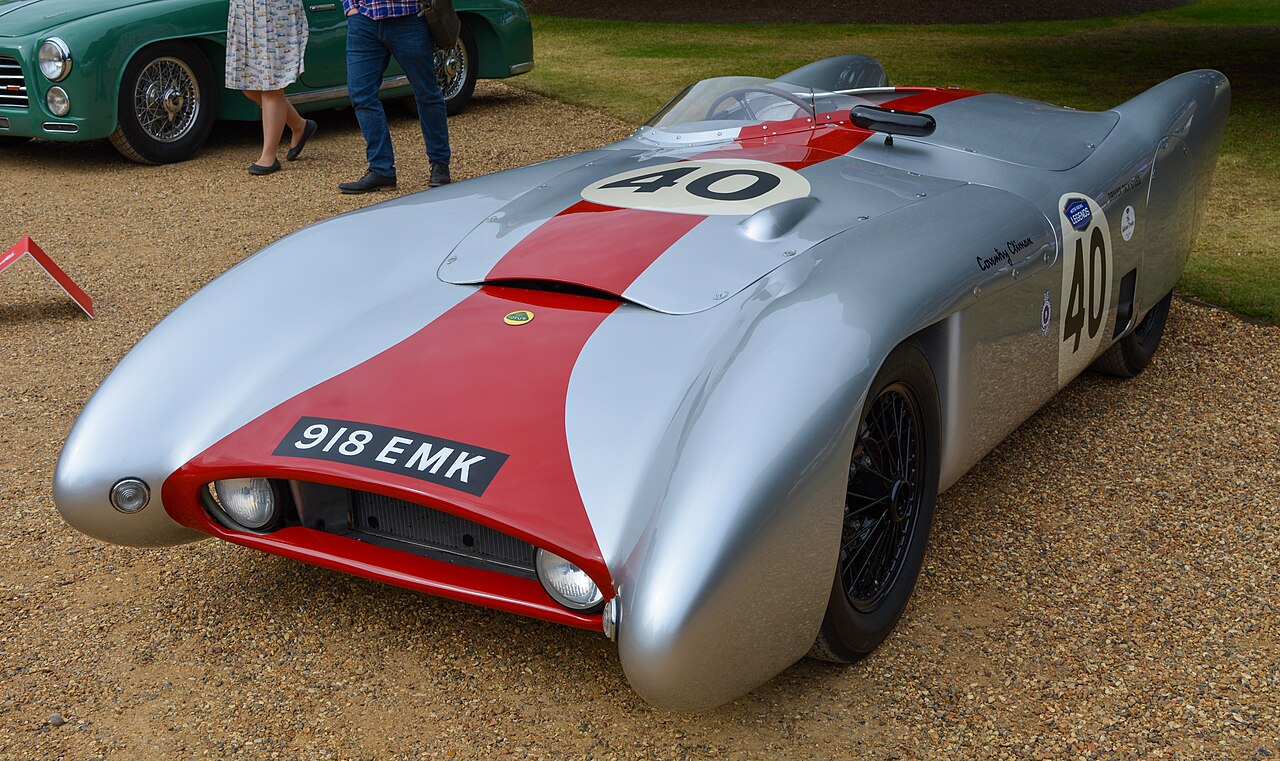
The supplied photograph shows a silver Mark VIII with a red central stripe and competition number 20 at Hampton Court in 2019. The source names the vehicle as a 1954 Mark VIII. Its covered wheels, broad shoulders and raised tail surfaces are clearly visible. The modern display appearance illustrates the model’s form while retaining the actual setting, rather than presenting the photograph as a 1954 race scene.
The body becomes a continuous surface
The Hampton Court view makes the Mark VIII’s enclosed-wheel form particularly legible. The silver body extends across the front wheels and continues into a long rear volume, while the central red stripe emphasizes the car’s length. These visual relationships help explain the transition away from separate cycle wings. They also show why a nose close-up alone would be an incomplete illustration: the tail and cockpit are part of the same aerodynamic proposal. The display setting gives the viewer time to read the surfaces, although it cannot reproduce airflow or certify the original panel shape. An individual restoration history would be needed for that narrower question. The photograph and the primary programme account work best together, with the former documenting a real later object and the latter explaining what made the original Type different from the cars that preceded it.
Collecting and chassis evidence
A Mark VIII collection file should distinguish the original chassis, its successive engines and its body history. A small racing programme can contain substantial variation even when its body shape remains recognizable. Event photographs, chassis records and period preparation documents answer different questions, and none should silently replace another. The custodial seven-car statement is useful for the programme’s rarity; the photograph is useful for the physical appearance of one later example. Individual claims about a particular driver, race entry or original engine would require a chassis-specific link to the primary record before being added to this profile.
Related Lotus designs and meaningful comparisons
The Mark IX develops the small-capacity sports-racing idea, while the Eleven gives the streamlined Lotus family a later, more widely produced form. The Mark VIII remains distinct because it documents an earlier step in that body and chassis exploration. A comparison of their noses, cockpit openings and rear surfaces is more informative than grouping them under an undifferentiated description of a rare Lotus racer. Their separate Type numbers also prevent a restoration, replacement body or later model from being counted as another Mark VIII merely because the cars look related.
Reading the sources
The programme sources and the photograph answer different questions. Manufacturer and custodial records establish the original model, Type, category and published production scope. The creator’s file establishes the pictured subject, setting and image permission. An individual chassis history can then add ownership, competition entries and dated repairs without changing the scope of the original programme. Build references are not survivor counts, and a later specification does not automatically become an additional newly manufactured vehicle. Where primary evidence does not establish a complete fabrication census, that field remains unassigned.
Specifications and rarity evidence
| Programme reference year | 1954 |
|---|---|
| Model / Type | Mark VIII — Type 8 |
| Body / competition role | Aerodynamic front-engined sports racer |
| Programme role | First aerodynamic sports-racing Lotus, custodial description |
| Engine families | MG, Connaught and Coventry-Climax |
| Period reference | 1954 |
| Photographed setting | Hampton Court, 2019 |
| Published build / register reference | 7 |
| Independently audited completed tally | Not assigned |
| Count scope | Published complete named programme reference: 7. This is a source-reported reference, not an independently audited completed tally or a surviving-car census. |
| Original inventory status | LOT-006 — Verified |
Frequently asked questions
Is the seven-car reference a count of surviving Mark VIIIs?
No. Classic Team Lotus reports seven built for the original programme. This profile does not assign a surviving-car census.
How is Mark VIII classified?
This is a Team Lotus competition Type archive. It remains separate from Lotus road-car production. Customer cars, works entries and converted chassis need a reconciled scope before any complete fabrication tally is assigned.
Which technical details are established for the programme?
The primary record supports programme role: First aerodynamic sports-racing Lotus, custodial description; engine families: MG, Connaught and Coventry-Climax; period reference: 1954. These are programme or explicitly attributed photo references. A particular surviving car’s engine, chassis repairs and competition preparation require its own dated documentation.
Does the photographed appearance establish factory originality?
The caption records a real creator-identified Mark VIII subject and its later setting. It establishes the illustration’s scope, while original components, restoration work and individual race provenance require chassis-specific evidence. A competition number, current paint or museum display is not used as an originality certificate.
What rarity or archive scope is verified?
Published complete named programme reference: 7. This is a source-reported reference, not an independently audited completed tally or a surviving-car census.
Who photographed the supplied image?
Chelsea Jay via Wikimedia Commons, under CC BY-SA 4.0. The original file and licence are linked with the image. Retain the creator, source and licence when uploading, exporting or reusing it; local retouching and synthetic enlargement have not been performed.
Related Lotus profiles
Sources and photo credits
- Primary manufacturer or custodial programme record
- Classic Team Lotus: early-years programme context
Photograph: Chelsea Jay via Wikimedia Commons original source, CC BY-SA 4.0. Source-provided thumbnail supplied without local cropping, retouching or synthetic enlargement.
Built in limited numbers
Published complete named programme reference: 7. This is a source-reported reference, not an independently audited completed tally or a surviving-car census.
Gallery
Specifications
Factory specifications may vary by model year, market and configuration.
Identity & production
- Official model
- Mark VIII