1939 Lincoln Continental Prototype for Edsel Ford
Explore 1939 Lincoln Continental Prototype for Edsel Ford: sourced history, rarity, design and credited photography.
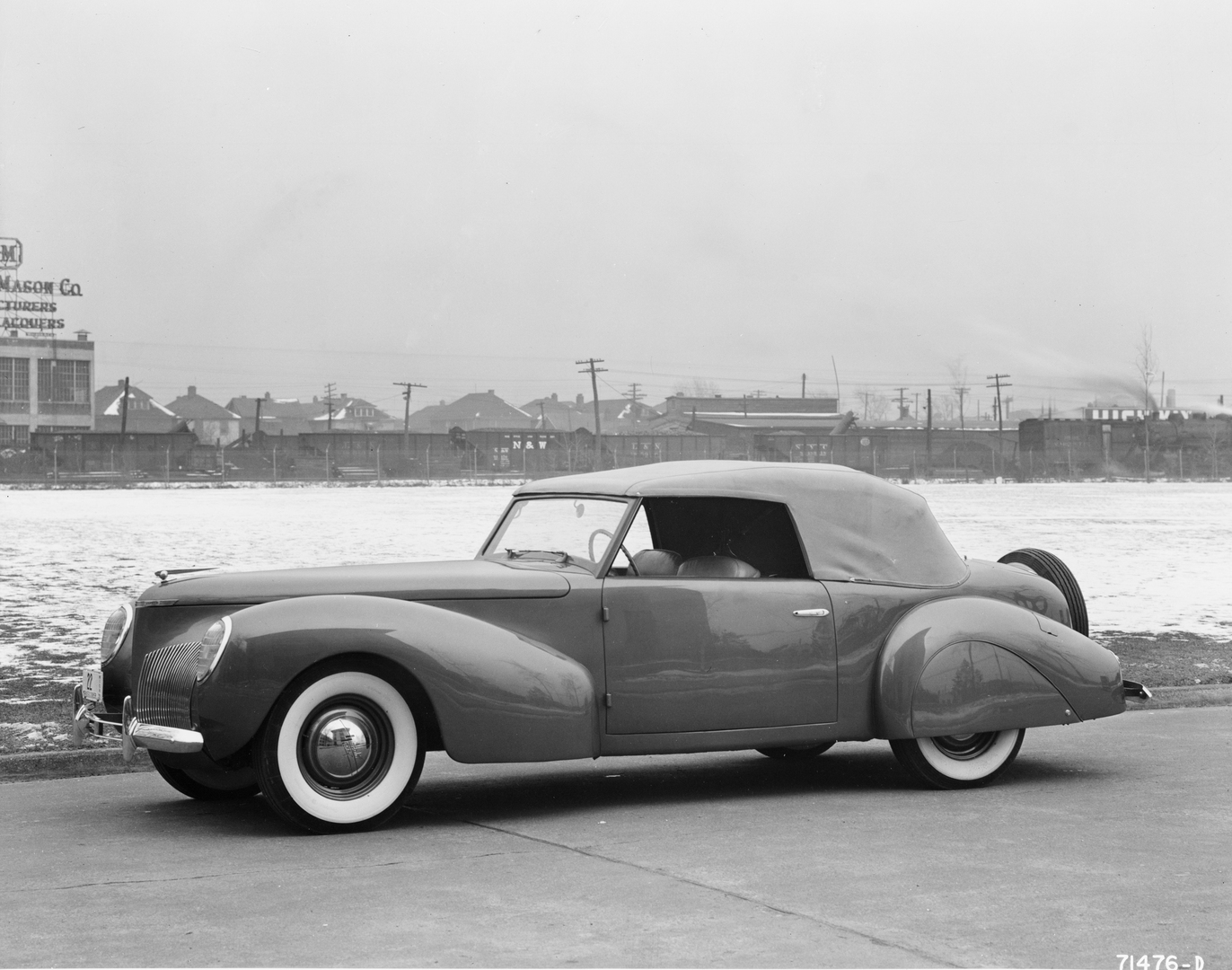
Before Continental became a production name, Edsel Ford’s personal prototype established its distinctive proportions. This archive follows that original 1939 car through a period photograph, rather than presenting a later production cabriolet as the prototype.
History and verified identity
The Henry Ford identifies the prototype as a collaboration between Edsel Ford and E. T. Bob Gregorie, inspired by Ford’s European trip. Its photographic record dates the subject to February 1939 and states that the original prototype was subsequently destroyed. Ford Heritage Vault supplies the matching Continental Cabriolet Special concept photograph, reference negative 71476-D. The record is therefore a documented historic physical car represented by an original-period image, not a surviving museum automobile.
Reading the credited photograph
The Ford archival photograph shows the personal prototype in side profile with its soft top raised. The long front section, small passenger compartment and curved rear fender dominate the image. The body sits against an industrial outdoor background, making the uninterrupted flank easy to read. The image belongs to the original design record; neither the background nor the roof position establishes a later ownership or restoration story.
Why this Lincoln belongs in the archive
The prototype’s appeal is the clarity of its design decision. A restrained body can make proportion carry more of the visual identity than ornament. Looking at the roof, hood and rear quarter together explains that quality better than listing decorative details in isolation. Its relationship to later production cars is a design lineage, not evidence that every subsequent Continental reproduced the personal car exactly. Keeping the original prototype separate lets the production history develop without overwriting the first physical experiment.
The physical concept and its design brief
Continental Prototype for Edsel Ford is useful as a full-size design record because it allows the passenger compartment, exterior surfaces and display presentation to be examined together. A drawing can communicate an intention, but the physical article also shows how that intention was expressed at scale. Its archive status rests on that documented identity. Complete fabrication output remains separate: the existence of one known image or auction entry does not prove that only one design model, prototype or display article was made.
When studying Continental Prototype for Edsel Ford, keep three layers together without merging them: the original programme statement, the physical object identified by the sources, and the dated photograph supplied here. A proposed powertrain or future feature belongs to the first layer unless a specific build record establishes its installation. The photographed body belongs to the latter two. This distinction lets the article discuss an ambitious concept while retaining an honest account of the evidence for the actual display.
What a later appearance can establish
A later exhibition or studio photograph can extend the appearance record for Continental Prototype for Edsel Ford without becoming a new production programme. The caption should retain the photograph’s own setting and date wherever those are documented. It can show a visible shape or cabin detail, but an exhibition view does not establish road registration, durability or the current operation of hidden hardware. The most informative archive adds new dated evidence to the same named programme rather than creating another vehicle merely because it appears in another year.
A useful comparison for this vehicle
The prototype should be compared with a production Continental as a design starting point, rather than judged as an incomplete version of a later car. A personal commission can have a different purpose from a body intended for repeat manufacture, and its photograph can preserve decisions that become less obvious in the production lineage. Look first at the relative lengths of the hood, cabin and rear quarter, then at the amount of trim used to articulate those surfaces. The period image also has documentary value of its own because the physical prototype no longer survives. Its negative reference connects the appearance to a particular original source, allowing a future researcher to distinguish another view of the same car from an unrelated production cabriolet.
Reading the evidence for this profile
The original source links below identify the programme and the historical statements used in this article. The photograph has its own creator and licence record, separate from the manufacturer’s vehicle history. Keep both when transferring this profile into a collection catalogue. A manufacturing tally describes how many cars belong to a defined original programme; it does not measure how many survive, how many are publicly visible, or how many retain all their original components. Those individual questions require dated chassis and restoration evidence. The reference year likewise describes the programme’s introduction or named historic configuration, while the supplied caption states the photographed setting and any established individual identity. This lets future research expand the car’s history without blurring the scope of the record already assembled here.
Specifications and verified rarity
| Reference year | 1939 |
|---|---|
| Model / programme | Continental Prototype for Edsel Ford |
| Body / role | Documented original personal-car prototype |
| Evidence form | Original-period photograph of the physical prototype |
| Custodial source | The Henry Ford photographic collection |
| Exact manufacturing tally | Not established |
| Rarity evidence | Documented physical archive scope; fabrication census unassigned |
| Rarity scope | Documented physical Continental Prototype for Edsel Ford archive programme. Complete fabrication census unassigned; a photographed example is not proof of a one-car programme. |
| Inventory reference | LNC-025 — Verified |
Frequently asked questions
Does the original prototype survive?
The Henry Ford’s photographic record says that it was destroyed.
What does the reference year identify?
1939 is the documented programme or archival reference used for this profile. The original workbook year is retained separately when corrected.
Does the photograph authenticate every mechanical component?
It documents the visible named subject. Hidden hardware and individual originality require a build or inspection record.
Is the number of surviving examples established?
No survivor census is assigned. Original programme references, fabrication output and surviving-car counts are kept separate.
What rarity or archive scope is verified?
Documented physical Continental Prototype for Edsel Ford archive programme. Complete fabrication census unassigned; a photographed example is not proof of a one-car programme.
Who took the supplied photograph?
Ford Motor Company / Ford Heritage Vault (individual photographer not identified) via Ford Heritage Vault, under Manufacturer editorial-use permission. The original file and licence links accompany the image. Retain that credit when the photograph is uploaded, exported or reused.
Related Lincoln profiles
Sources and photo credits
Photograph: Ford Motor Company / Ford Heritage Vault (individual photographer not identified) via Ford Heritage Vault source, Manufacturer editorial-use permission. Source-provided photograph supplied without local cropping, retouching or text removal. A source thumbnail is used where available. The Ford archival photograph shows the personal prototype in side profile with its soft top raised.
Built in limited numbers
Documented physical Continental Prototype for Edsel Ford archive programme. Complete fabrication census unassigned; a photographed example is not proof of a one-car programme.
Gallery
Specifications
Factory specifications may vary by model year, market and configuration.
Identity & production
- Official model
- Continental Prototype for Edsel Ford