2022 Lincoln Model L100 Concept
Discover the 2022 Lincoln Model L100 Concept: its centennial history, physical show-car design, verified archive scope and credited Ford photography.
The 2022 Lincoln Model L100 Concept explores a grand touring future built around the passenger experience. Its physical show-car identity, dramatic opening body and unusual cabin deserve a record separate from ordinary Lincoln production models.
A centennial concept with a historic reference
Lincoln introduced the Model L100 at the 2022 Pebble Beach Concours d’Elegance. The manufacturer connected its name to the 1922 Model L and presented the concept during its centennial celebrations. That anniversary belongs to Lincoln’s relationship with Ford and its Model L heritage; it should not be interpreted as a claim that the Lincoln company was first founded in 1922. The L100 is a design programme with a real physical exhibition object, rather than a new numbered retail edition.
Its historic reference is most interesting when read through proportion. A large luxury car can express generosity through the amount of space given to its occupants, the length of its body and the ceremony of entering it. Those qualities can persist even when the mechanical layout, controls and materials change. The L100 therefore makes a useful comparison with an earlier formal Lincoln without requiring the two cars to share a chassis, engine or passenger arrangement.
The physical car in the supplied photograph
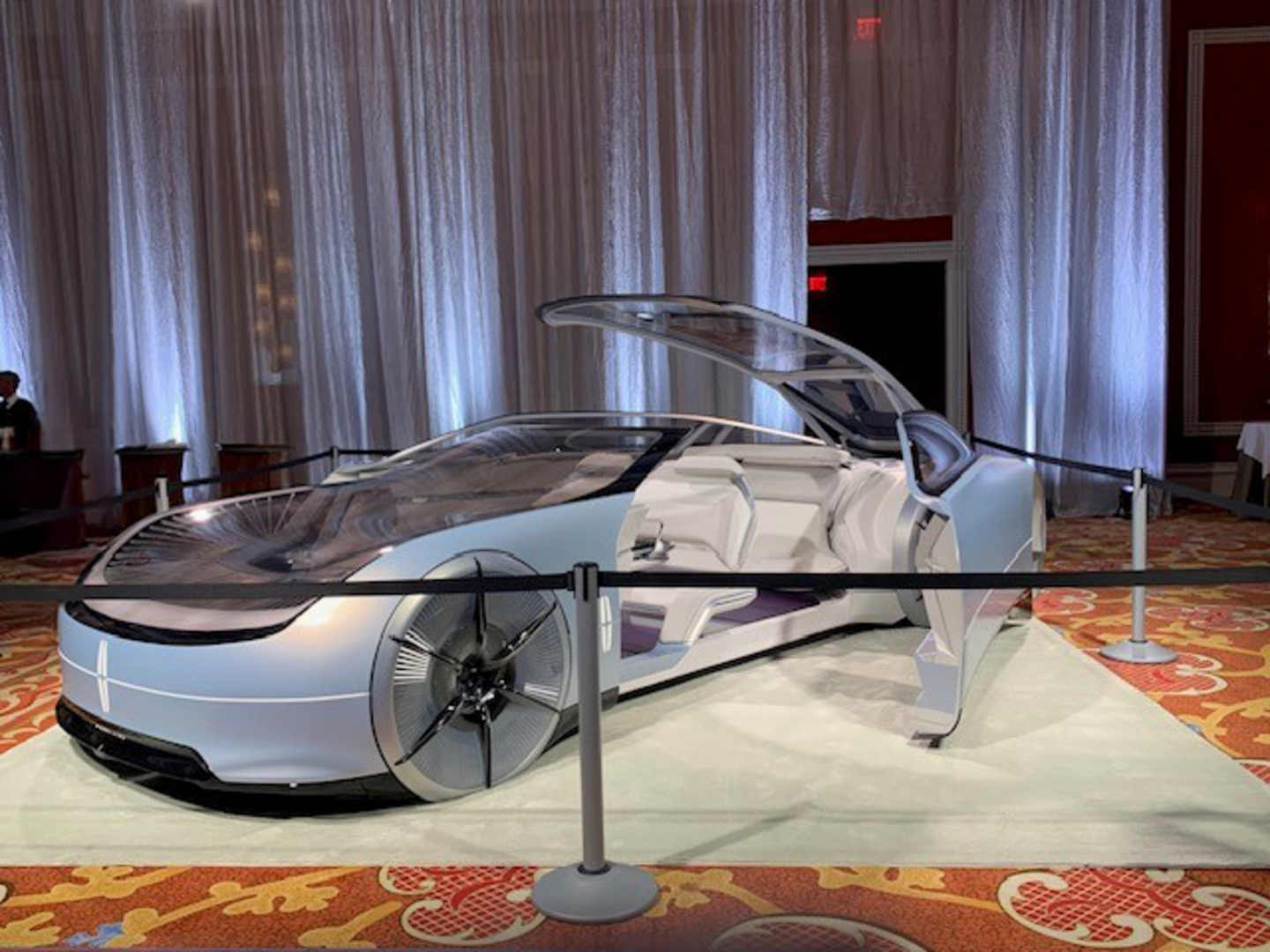
The Ford Heritage Vault photograph shows the L100 indoors behind display barriers. Its roof and a large body opening are raised, exposing the pale seating and central cabin. A broad, low nose leads into a glazed upper surface; the large wheels and long flank make the scale of the passenger compartment especially clear. Curtains, carpet, people and barriers provide the setting of a photographed physical exhibit. The archive image is distinct from the computer renderings used elsewhere in the launch campaign.
An exhibition photograph is valuable because it records how the body occupies an actual room. Reflections, perspective and the relationship between the seats and surrounding panels can be studied together. The open configuration also explains why a single closed-body view would tell only part of the story. It records the visible design object, while leaving the complete fabrication count and its present operating condition to separate custodial or engineering documentation.
Opening the cabin as part of the design
Lincoln described a lifting glass roof and reverse-hinged doors as part of the concept’s welcome sequence. Rather than treating access as a small aperture cut into the side, the design makes the opening of the upper body central to the experience. In the archive photograph, that arrangement allows the pale interior to be read as an extended space. The roof, door and seat relationship is a defining part of the programme’s appearance.
A mechanism like this changes how a viewer approaches a car. The first impression is the whole body opening around the cabin, followed by the seating and the surfaces occupants would touch. It also invites practical questions about clearance, weather protection and the route into the passenger area. Those questions help explain the design problem; this archive does not assign production engineering solutions that were never documented for the displayed example.
A passenger-first proposal for controls and materials
The manufacturer envisioned autonomous travel and an interactive central console with a jewel-inspired controller. It also described a social seating arrangement and an animal-free interior incorporating recycled suede. These details belong to the concept proposal. They are not evidence of approved autonomous operation, a retail battery specification or a certified driving range. No power, battery-capacity or acceleration figure is assigned to this profile.
The controller matters visually because it changes the centre of attention within the cabin. In a conventional luxury car, the steering wheel often organizes the dashboard and identifies the driver’s place immediately. A passenger-oriented console suggests a different hierarchy: shared surfaces and social interaction can become more prominent. That is a design interpretation of the proposal, rather than a statement that the physical car can perform every function described in the launch material.
Why the Model L100 belongs in a concept archive
The Model L100 can be catalogued through its programme name, introduction year, physical archive photograph and manufacturer’s design description. Its significance comes from that combination. A contemporary concept may never receive a customer production allocation, yet still represent an important phase in a manufacturer’s thinking about proportion, access and luxury. Preserving its identity allows later vehicles to be compared with the original proposal without retroactively changing the concept’s specification.
For a collector or researcher, the useful distinction is between a complete original programme and a single photographed example. A photograph confirms an object in a particular configuration; it does not supply a census of every styling model, display body or engineering derivative associated with the programme. This profile consequently leaves the fabrication total unassigned. That careful scope keeps the L100 searchable as a physical Lincoln concept while allowing future primary evidence to refine its history.
Reading the evidence for this profile
The original source links below identify the programme and the historical statements used in this article. The photograph has its own creator and licence record, separate from the manufacturer’s vehicle history. Keep both when transferring this profile into a collection catalogue. A manufacturing tally describes how many cars belong to a defined original programme; it does not measure how many survive, how many are publicly visible, or how many retain all their original components. Those individual questions require dated chassis and restoration evidence. The reference year likewise describes the programme’s introduction or named historic configuration, while the supplied caption states the photographed setting and any established individual identity. This lets future research expand the car’s history without blurring the scope of the record already assembled here.
Specifications and verified rarity
| Reference year | 2022 |
|---|---|
| Model / programme | Model L100 Concept |
| Body / role | Full-scale physical luxury concept |
| Introduction | 2022 Pebble Beach Concours d’Elegance |
| Historical reference | 1922 Lincoln Model L |
| Propulsion description | Battery-electric future proposal; installed specification unassigned |
| Access design | Lifting glass roof and reverse-hinged doors |
| Control proposal | Interactive centre console with jewel-inspired controller |
| Certified range / output | Not established for the physical display car |
| Exact manufacturing tally | Not established |
| Rarity evidence | Documented physical archive scope; fabrication census unassigned |
| Rarity scope | Documented physical Model L100 Concept programme. Complete fabrication census unassigned; a photographed example does not establish a one-car manufacturing total. Concept proposals are distinguished from installed, tested or production-certified equipment. |
| Inventory reference | LNC-212 — Verified |
Frequently asked questions
Was the Model L100 a production Lincoln?
It was introduced as a concept. This profile records the physical design programme, with no retail production allocation assigned.
Does the archive photo show a real car or a rendering?
It shows the physical Model L100 displayed indoors with its opening body raised; the supplied file comes from Ford Heritage Vault.
Was autonomous driving certified?
The manufacturer envisioned autonomous travel. Certification or demonstrated autonomous capability of the displayed car is not established here.
Does L100 mean 100 cars were manufactured?
No. The programme name and centennial reference do not establish a manufacturing tally.
What rarity or archive scope is verified?
Documented physical Model L100 Concept programme. Complete fabrication census unassigned; a photographed example does not establish a one-car manufacturing total. Concept proposals are distinguished from installed, tested or production-certified equipment.
Who took the supplied photograph?
Ford Motor Company / Lincoln; individual photographer not identified by the archive record via Ford Heritage Vault, under Manufacturer editorial-use permission. The original file and licence links accompany the image. Retain that credit when the photograph is uploaded, exported or reused.
Related Lincoln profiles
Sources and photo credits
- Lincoln manufacturer launch release, August 2022
- Lincoln concept programme descriptions
- Ford Heritage Vault: physical Model L100 photo and editorial permission
Photograph: Ford Motor Company / Lincoln; individual photographer not identified by the archive record via Ford Heritage Vault source, Manufacturer editorial-use permission. Original source photograph supplied without local cropping, retouching or synthetic enlargement. Physical 2022 Lincoln Model L100 Concept displayed indoors with its lifting roof and body opening raised, in a Ford Heritage Vault archive photograph.
Built in limited numbers
Documented physical Model L100 Concept programme. Complete fabrication census unassigned; a photographed example does not establish a one-car manufacturing total. Concept proposals are distinguished from installed, tested or production-certified equipment.
Gallery
Specifications
Factory specifications may vary by model year, market and configuration.
Identity & production
- Official model
- Model L100 Concept