
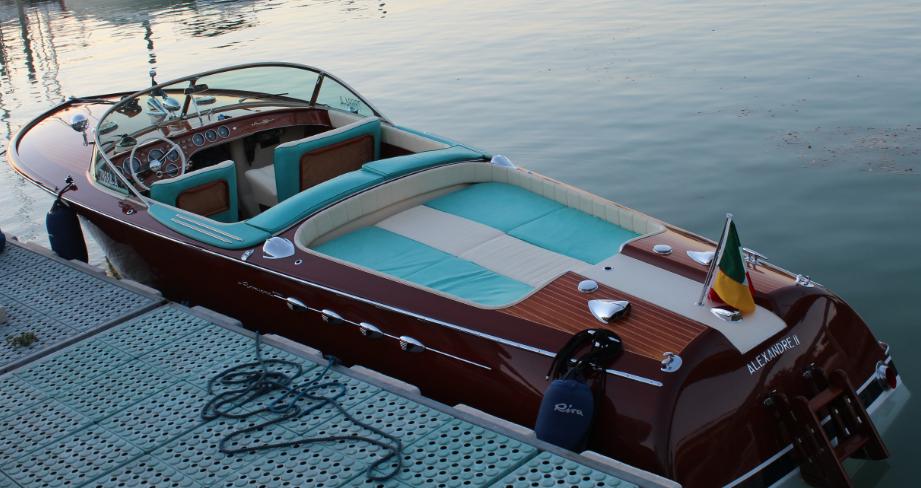
A Riva Ariston, an Aquarama Super and a Ferrari 32 tell three chapters of the same yard's story, but their production figures must not be merged. Riva's 2022 heritage release says 1,012 Aristons were built over 26 years after the model's 1950 launch. A Ferretti Group Aquarama Super feature says 203 Supers were made within the wider Aquarama family. A Ferretti Group listing says nine examples of the Ferrari 32 Special were built. It does not give a total for every Ferrari 32 version.
All three illustrate Rarity Rides' interest in documented runs below 7,500, but they are not equivalent kinds of edition. The Ariston is a long-running wooden model; the Aquarama Super is a named variant of a larger family; the Ferrari 32 Special is a later evolution of a Riva/Ferrari engineering collaboration. The manufacturer sources support these distinctions. Our Ariston, Aquarama Super and Ferrari 32 profiles carry the deeper individual histories.
Start with Riva's chronology
Riva's official company history traces the Sarnico yard from Pietro Riva's nineteenth-century beginnings through Ernesto Riva's introduction of internal-combustion engines and Carlo Riva's modern runabout era. The Ariston arrived in 1950, before the Aquarama's 1962 creation. Riva subsequently entered fibreglass production while continuing to build wooden runabouts. This overlapping chronology matters: a boat cannot be assigned to a simplistic “wood ended when fibreglass began” timeline.
The Ferrari 32 belongs to a later performance chapter. Riva Classiche's 2023 exhibition announcement calls it a collaboration between Riva's shipyard and Ferrari's engineering department. It names twin Vulcano 400 V8 engines and a historical 100 km/h top speed. The connection is manufacturer-described, not an inference from a red hull or a badge. It should not be retold as though it were an Aquarama or a Ferrari road car placed on water.
Riva presented the Ariston and Aquarama as distinct heritage boats. In 2023 it displayed a Ferrari 32 alongside several Aquarama examples. Museum or exhibition placement helps explain cultural importance; it does not authenticate an unrelated boat offered privately. An owner's hull record remains essential.
The Ariston: a limited total across a long life
The 1,012 Ariston figure is a model production count published by Riva. The same release says the run lasted 26 years. This makes the Ariston numerically bounded, though its story is unlike a modern one-year limited edition. Its design, powertrain and trim may have changed over a long production period. A single undated specification copied from a sale advertisement should not be applied to all 1,012 hulls.
Its 1950 launch puts it near the beginning of Carlo Riva's postwar reputation, before the Aquarama became the yard's best-known wooden icon. A thoughtful comparison gives the Ariston its own identity instead of calling it a precursor only. A model can be important for the experience it offered during its era and for its sustained production, not merely because a later model became more famous.
An individual Ariston should be identified through a hull number, factory correspondence, invoice or archive extract. Year-correct technical material can then be matched to that boat. The present engine, deck equipment and timber condition may differ from delivery. Riva's 1,012 total provides model context, while a survey and restoration dossier describe the specific surviving example. See the Ariston collector guide for a fuller documentation checklist.
The Aquarama Super: a variant within a family
Ferretti Group identifies 203 Supers out of more than 750 Aquaramas in the family. These are different denominators. A sentence such as “203 Aquaramas were built” drops the word that defines the variant and misstates the maker's account. Riva's official history places the Aquarama's origin in 1962 and says the last Aquarama Special, number 784, was built in 1996. That latter detail is about a Special, not a Super production total or Super end date.
The Super's place in the wooden-runabout tradition is distinct from the Ariston's earlier long run. Its collectible appeal includes Riva's design and woodworking legacy, but that does not mean every visible plank, fitting or engine in an extant boat is original. Restorations can be extensive. A factory identification and detailed scope of work are needed to tell the history of a particular hull.
Ferretti's feature discusses one restored 1966 Super with twin overhauled Crusader engines, combined 640 hp and a 45-knot statement. Those are facts about the showcased boat as described in the article; they are not a universal specification for all 203 Supers. A model comparison should avoid putting “640 hp” into a blanket table without noting its single-hull source. The Aquarama Super profile deliberately makes that limitation prominent.
The Ferrari 32: collaboration and variant precision
Riva Classiche frames the Ferrari 32 as an engineering collaboration and describes two Vulcano 400 V8s capable of a historical 100 km/h speed. This tells us about the model's purpose and performance identity. The Ferretti Group preowned page for a specific 1994 Special says that the Special evolved an earlier version with propulsion-layout improvements and a stern platform. Its nine-unit figure is expressly Special-specific.
A common search error is to call every Ferrari 32 “one of nine.” The evidence cited here does not support that. A first-version boat may be a Ferrari 32 without belonging to the nine Specials. A later-added stern platform does not automatically transform a hull's factory designation. Confirm the individual boat's identity from the original record before repeating the nine-unit phrase in an advertisement, caption or production field.
The Ferretti listing is manufacturer-group material, but it is a used-boat listing for one example. Dimensions, current equipment and engine particulars there may describe that hull rather than every Ferrari 32. Even where its specifications resemble the model generally, a universal claim requires a source defining the whole version. Riva's 2023 retrospective supports the collaboration and its named historical speed; a hull survey supports present condition.
Comparing the three counts accurately
A useful table would say: Ariston — 1,012 model units, maker's heritage statement; Aquarama Super — 203 of the Super variant, Ferretti publication; Ferrari 32 Special — nine of the Special variant, Ferretti listing. It should leave the overall Ferrari 32 total as unverified in the cited manufacturer material. The Aquarama-family “more than 750” is context, not the Super denominator. The last Special's number 784 is a historical identifier, not a Super count.
These numbers answer “how many were originally made?” only within their source's scope. They do not answer “how many remain?” A boat can be restored, re-engined, laid up, privately sold or absent from public registries. Surviving examples may be more or less original, and a current market listing does not make a fleet census. Avoid “only X left” unless a dated and defined registry supports it.
Nor can nine, 203 and 1,012 be used as a simple league table for significance. The Ferrari 32 Special's small run is notable, but a historically documented Ariston can illuminate decades of wooden Riva production. A Super is a specific Aquarama variant whose identity must be traced. Each has a different reason to merit research.
Three approaches to craftsmanship
The Ariston and Aquarama Super belong to Riva's wooden-runabout tradition. Their appeal is inseparable from shaped timber, finish and maintenance culture. A present boat's surface can be beautiful, yet inspection beneath the finish remains essential. Describe original structure, replacement timber and restoration work rather than declaring a glossy boat “untouched.” A specialist wooden-boat survey should address construction and current condition.
The Ferrari 32 expresses a different idea: performance, collaboration and later production methods within Riva's evolving range. Do not use an Aquarama's wood construction or historic propulsion details to fill a Ferrari 32 specification sheet. Family resemblance and shared yard provenance are not the same as technical identity. Their comparison is strongest when it shows how the maker's priorities changed, not when it tries to prove all Rivas are the same kind of object.
Riva's official history helps place the transitions. It documents fibreglass models arriving in 1969 and wooden runabouts continuing afterward. The precise construction of a specific boat, however, must come from its own technical documentation. A broad historical transition does not permit a writer to infer every material in every hull from a decade label.
An owner-documentation checklist
Begin with hull identifiers, the original build or delivery record, and subsequent ownership documents. Match the physical markings to paperwork. For a Super, confirm the precise variant rather than only the Aquarama family. For a Ferrari 32, distinguish first version from Special. For an Ariston, establish the build year so any specifications are drawn from the correct stage of its long run.
Then build a restoration chronology. Who carried out work, when, and to what scope? Which structure, machinery and finishes were retained, repaired or replaced? Photographs taken before and during work often show information hidden by a finished deck. Engine serials and invoices can distinguish original equipment from a period-correct or modern replacement.
Finally, obtain a current survey and, if appropriate, a sea trial under recorded conditions. A manufacturer's historical 100 km/h Ferrari 32 statement and the restored 1966 Super's reported 45 knots do not promise current speed for a different boat. Load, propellers, machinery and condition vary. Model history gives context; current inspection answers the buyer's practical questions.
Photographs and attribution
An image credited under its applicable licence may illustrate a model, but the photographer's attribution does not certify the hull's variant. If an image record says “Aquarama” without specifying Super, do not caption the boat as a Super merely to fit an article. Likewise, a red Riva is not automatically a Ferrari 32 Special. A precise caption needs a source linking the depicted boat to that identity.
Image rights and model evidence should occupy separate fields. The visible credit names the photographer, source and licence; the editorial caption says what the picture actually shows. If a boat's hull number is documented, that identification can add value to a historical comparison. If not, a broader caption is honest. Do not crop away identifiers and then claim certainty from appearance alone.
The question of “original” in a wooden boat
Originality can refer to the hull's identity, structure, engines, finish or fittings, and those elements can have different histories. An Ariston with preserved documentation and renewed planking remains the same recorded hull, but “all-original timber” would not describe it. An Aquarama Super may retain its factory model designation despite later engine work; the present performance should be measured, not inferred from the showcased 1966 boat. The restoration narrative should list what was repaired and replaced.
A dated sequence of photographs is especially useful for woodwork, since a finished surface conceals much of the structure. Ask whether a workshop retained removed parts and recorded materials and methods. A buyer can value a faithful restoration without mistaking it for untouched construction. Terms like “concours,” “museum quality” and “matching numbers” need explicit supporting criteria if they are used in a sale description.
The Ferrari 32 raises related but different questions. A Special's configuration should be checked against factory documentation, particularly because the manufacturer-group listing describes changes from the first version. Replacing machinery or modifying a stern does not automatically change the original variant designation. Its collaborative provenance should be tied to the model's maker record, and the individual boat's identity should be tied to its own file.
A chronological route through the archive
Start with the Ariston to understand Riva's 1950 launch and sustained wooden-runabout production. Move to the Aquarama Super for a later, specifically counted Aquarama-family variant. Then read the Ferrari 32 as a different performance and collaboration story. The sequence shows change over time without pretending one model directly evolved into the next.
The Wallypower 118 offers a separate boat-design comparison: Wally dates its launch to 2003 and describes a vertical bow, glass superstructure and opening bulwarks. It is not a Riva and the manufacturer pages cited in that profile do not provide a verified production total. We link it for design contrast, not to claim it meets a numeric production threshold. Rarity Rides can explain a historically interesting reference without incorrectly assigning it a count.
An evidence card for each boat
A concise card for the Ariston would say “model: Ariston; launched: 1950; maker-stated production: 1,012 over 26 years; individual hull year: verify from archive.” The Aquarama Super card would say “variant: Super; maker-group count: 203; family total: more than 750; shown 1966 boat's 640 hp and 45 knots: hull-specific.” The Ferrari 32 card would say “model collaboration: Riva/Ferrari engineering; Special subvariant: nine according to the manufacturer-group listing; entire Ferrari 32 run: unverified in cited material.”
These cards are more useful than a single unqualified “production” column. They expose the exact question answered by each source and keep a reader from transferring an example-specific speed into a model-wide specification. They also provide a clear editorial update path if factory documents emerge later.
How these histories remain useful after restoration
A restoration can change engines, upholstery, timber, paint and deck fittings. The original maker record is still a stable historical reference, while the current boat needs fresh documentation. Owners should retain before-and-after images, parts lists, invoices and survey reports so a future profile can tell both stories. A documented replacement is more informative than a vague declaration that the boat is perfect.
The Aquarama Super's 203 figure and the Ariston's 1,012 are manufacturer-published totals; they should not be revised because a boat changes hands or is restored. The Ferrari 32 Special's nine describes the subvariant. If a newly authenticated first-version Ferrari 32 appears, it does not change that Special count. Keeping population and membership separate makes the archive resilient as individual boats are studied in greater detail.
Frequently asked questions
Did Riva build 1,012 Aristons?
Yes, Riva's 2022 heritage statement says 1,012 were built across a 26-year run after the 1950 launch. It is a model total, not a survivor count or a specification for every year.
Were there 203 Aquarama Supers or 203 Aquaramas overall?
The Ferretti Group publication says 203 Supers within a broader Aquarama family of more than 750. The variant word matters. Riva's later Aquarama Special is another distinction.
Were only nine Riva Ferrari 32s made?
The cited Ferretti Group listing says nine Ferrari 32 Specials were made. It does not establish nine for the entire Ferrari 32 line. The overall model count remains unverified in the manufacturer material used here.
Were all Aquarama Supers 640 hp and 45 knots?
The Ferretti story assigns those numbers to a showcased, restored 1966 example. It does not say every Super had identical engines or achieved that speed. Check the records and current machinery of the specific hull.
How can a buyer tell which Riva variant a boat is?
Match the hull identifiers to a factory or archival record, then examine year-specific configuration and restoration history. Photographs, badges and seller descriptions can guide the inquiry but should not replace the original documentation.
Sources and next reading
The core manufacturer references are Riva's Ariston heritage announcement, Riva's history, Ferretti Group's Aquarama Super feature, Riva Classiche's Ferrari 32 exhibit and the Ferretti Group Special listing. Each is used for the specific claim it actually supports. The limited-production evidence guide explains the broader count method.
