2015 Hyundai N 2025 Vision Gran Turismo Concept
Hyundai N 2025 Vision Gran Turismo: 2015 history, the full-scale Frankfurt display, virtual-specification boundaries and credited photography.
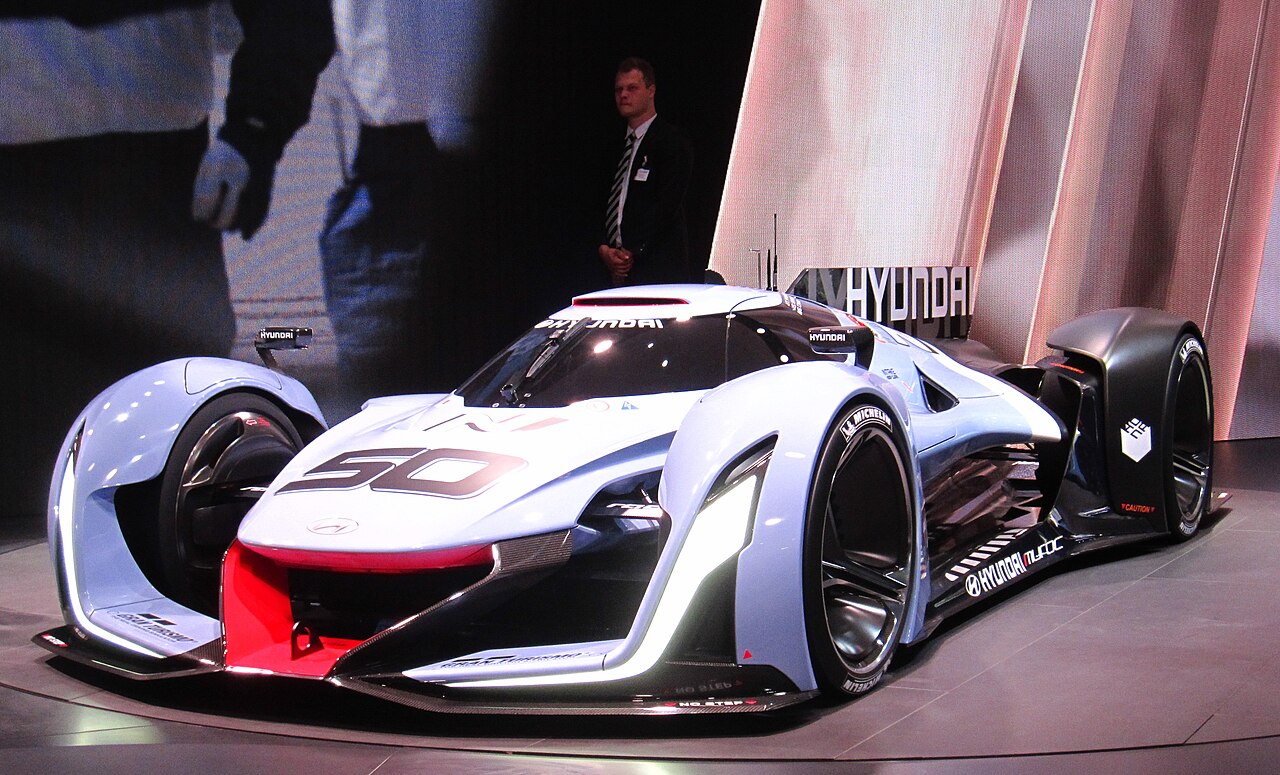
The 2015 Hyundai N 2025 Vision Gran Turismo Concept connects a virtual performance-car vision with a real full-scale display. This archive profile covers the physical show object, with the game’s powertrain and performance ambitions kept separate from installed hardware claims.
Origins and the correct historical identity
Gran Turismo’s original September 2015 announcement states that Hyundai revealed the N 2025 Vision Gran Turismo and a full-scale model ahead of the Frankfurt show. The project belongs to the Vision Gran Turismo programme and presents a futuristic performance concept. The number 2025 is part of its name, not its debut year. Published virtual drivetrain ratings do not establish the output of the physical display model photographed at Frankfurt.
Design: what makes N 2025 Vision Gran Turismo Concept distinctive
The physical car uses an extremely low, competition-like form to make the performance vision visible. The cockpit and body volumes are organised around a dramatic racing silhouette rather than the accommodation priorities of a conventional road coupe. An editorial reading can consider how the full-scale model translates a screen-based design into an object with real reflections, scale and presence. That translation is the central attraction for an archive concerned with physical automotive artefacts.
Engineering and the concept brief
A virtual vehicle can be given an elaborate powertrain description and precise performance figures within a simulation. A physical model of the same design does not automatically contain that operating system. The specification table therefore identifies the display role and leaves installed propulsion unconfirmed. The virtual fuel-cell and energy-buffer proposal can be discussed as the project’s imagined architecture, but its power rating is not imported into fields that readers could mistake for a tested full-scale machine.
Why this Hyundai belongs in the design archive
The concept belongs in a collection because the full-scale object marks a meeting point between automotive design and interactive media. It allows a manufacturer’s virtual performance vision to be judged in a motor-show environment. The archive should preserve both that context and the distinction between the model and the playable vehicle. Its value does not depend on treating an in-game lap time as a real competition result or claiming the display was a completed running race car.
Recognising and documenting the physical subject
The supplied photograph shows the physical N 2025 Vision Gran Turismo concept at the Frankfurt exhibition in September 2015. It is neither a screenshot nor a photograph of a small toy. The original source and caption keep that distinction explicit. A future gallery might add cockpit and display-label views, while an engineering update would require direct evidence of the full-scale object’s construction or operation. The title uses 2015 so the programme can be located correctly in a chronological collection.
A full-scale model as an automotive artefact
A full-scale design model allows people to judge proportions in the same space as a real car. Reflections, wheel placement, window height and the relationship between occupant space and body volume become visible in ways that a small model cannot reproduce. That physical presence is enough to make this programme an archive subject. It does not, by itself, establish a functioning road vehicle, a tested drivetrain or a finished homologation project. Those are separate milestones with their own evidence.
The most useful technical record distinguishes the design brief from what the displayed object demonstrably contained. Proposed performance can explain the designers’ ambitions, but it should remain labelled as a proposal. A material description may refer to a planned chassis or to an actual model-construction method; the two should be recorded separately when the source permits. This approach preserves the significance of the physical creation and the people who made it, while keeping the specification fields dependable for future research.
Collector significance and future research
The value of a concept archive lies in preserving the relationship between an idea, the people who developed it and the object that made it visible. A strong collection record keeps the original name, reference year, credited photographs and source links attached to that relationship. If new photographs or factory documents emerge, they can add a show appearance, a construction detail or a later change without replacing the original identity. This is particularly useful for a car whose published pictures may span several exhibitions and whose name may have acquired different spellings.
The complete fabrication tally remains unknown here. Exhibition appearances do not provide a count: the same object can travel, and a programme may also produce models or development articles that are not visible publicly. The concept belongs in this archive because its physical identity is supported, rather than because a single surviving photograph implies that only one was made. A future tally should identify which objects it covers and the document establishing that scope. Until then, this profile provides the historical and photographic foundation for further documentation.
Reading the evidence for this profile
The original source links below identify the programme and the historical statements used in this article. The photograph has its own creator and licence record, separate from the manufacturer’s vehicle history. Keep both when transferring this profile into a collection catalogue. A manufacturing tally describes how many cars belong to a defined original programme; it does not measure how many survive, how many are publicly visible, or how many retain all their original components. Those individual questions require dated chassis and restoration evidence. The reference year likewise describes the programme’s introduction or named historic configuration, while the supplied caption states the photographed setting and any established individual identity. This lets future research expand the car’s history without blurring the scope of the record already assembled here.
Specifications and verified rarity
| Reference year | 2015 |
|---|---|
| Model / programme | N 2025 Vision Gran Turismo Concept |
| Body / role | Full-scale Vision Gran Turismo display model |
| Programme debut | Frankfurt, September 2015 |
| Physical role | Full-scale Vision Gran Turismo display |
| Installed propulsion / output | Unconfirmed for physical object |
| Virtual architecture | Separate performance-design proposal; not installed-hardware evidence |
| Exact manufacturing tally | Not established |
| Rarity evidence | Physical concept archive scope; tally unknown |
| Rarity scope | Verified physical full-scale Vision Gran Turismo display; complete fabrication tally unconfirmed. Included as Concept / Archive, without an invented one-car count or retail-production ceiling. |
| Inventory reference | HYU-120 — Verified |
Frequently asked questions
Did a full-scale physical model exist?
Gran Turismo’s original announcement explicitly identifies a full-scale model.
Does 2025 identify the debut year?
It is part of the concept name; the unveiling was in 2015.
Are virtual power figures assigned to the display?
No installed-output claim is derived from the virtual specification.
Is the photo a game screenshot?
It records the physical Frankfurt display object.
What rarity or archive scope is verified?
Verified physical full-scale Vision Gran Turismo display; complete fabrication tally unconfirmed. Included as Concept / Archive, without an invented one-car count or retail-production ceiling.
Who took the supplied photograph?
Rutger van der Maar via Wikimedia Commons, under CC BY 2.0. The original file and licence links accompany the image. Retain that credit when the photograph is uploaded, exported or reused.
Related Hyundai concept profiles
Sources and photo credits
Photograph: Rutger van der Maar via Wikimedia Commons original file, CC BY 2.0. Source-provided photograph supplied without local cropping, retouching or text removal. A source thumbnail is used where available. Physical Hyundai N 2025 Vision Gran Turismo display at Frankfurt in September 2015; this is a full-scale object, not a screenshot or scale toy.
Built in limited numbers
Verified physical full-scale Vision Gran Turismo display; complete fabrication tally unconfirmed. Included as Concept / Archive, without an invented one-car count or retail-production ceiling.
Gallery
Specifications
Factory specifications may vary by model year, market and configuration.
Identity & production
- Official model
- N 2025 Vision Gran Turismo Concept