2010 Ford Focus RS500
Explore 2010 Ford Focus RS500: history, specifications, rarity evidence and credited photography.
Ford introduced the Focus RS500 in 2010 as the final special edition of its second-generation Focus RS.
History and purpose
Ford introduced the Focus RS500 in 2010 as the final special edition of its second-generation Focus RS. The manufacturer’s original announcement established 500 individually numbered customer cars across 20 European markets. It also acknowledged a small, separately numbered group of internal pre-production vehicles. This profile keeps both statements visible: 500 is the complete named customer edition, while the overall fabrication tally remains unconfirmed. The UK’s allocation is part of that programme, not an extra national edition. The inventory’s repeated RS500 row is consolidated into this record. Ford’s 350 PS five-cylinder specification defines the model’s performance upgrade without changing that scope.
Design and engineering
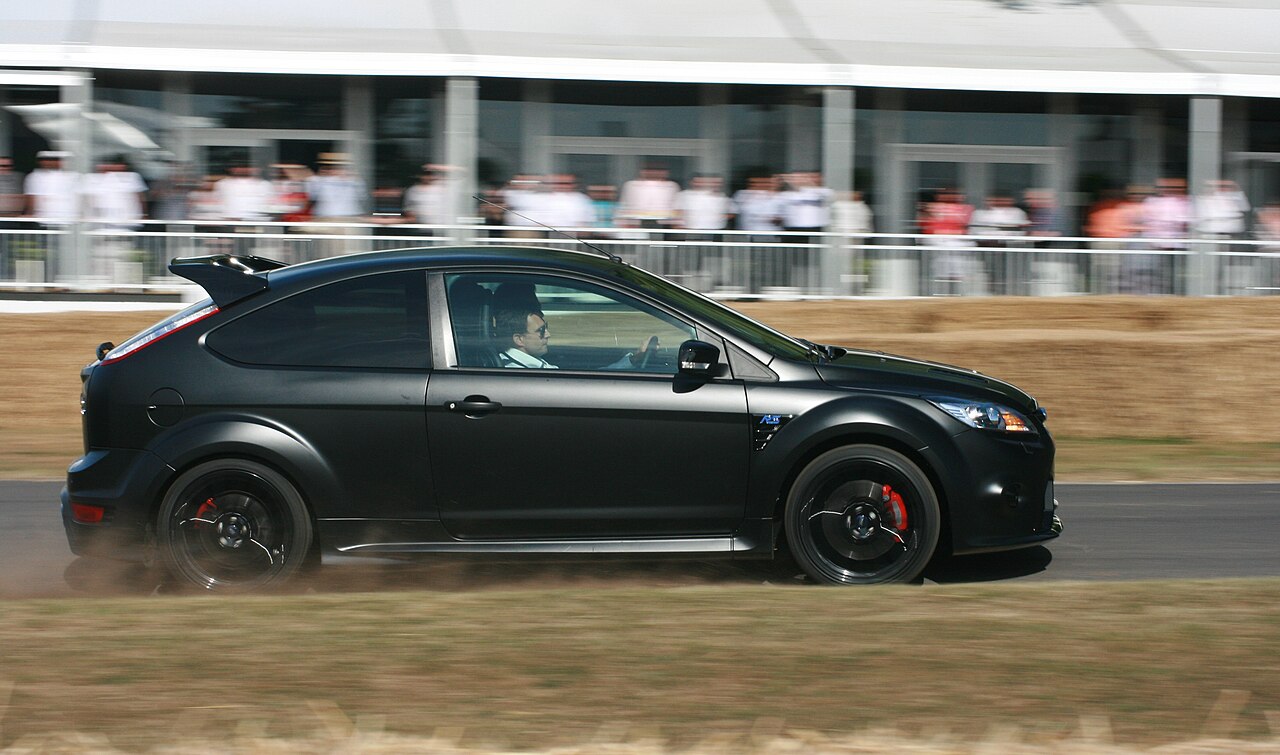
The supplied side photograph shows the RS500’s matt-black finish, dark wheels and familiar three-door Focus RS body. Ford described the special surface as a foil finish, so it should not be recorded casually as ordinary matt paint. The mechanical upgrade brought 460 Nm of torque alongside the higher power rating. The underlying front-wheel-drive architecture retained the RS programme’s RevoKnuckle suspension approach. That combination is more informative than a badge-only account: the edition paired a deliberate visual treatment with an engine upgrade, while remaining recognisably related to the standard RS. The photograph documents those visible relationships without certifying unseen tuning or component originality.
Identifying the original configuration
A real RS500 file needs its numbered console plaque and factory records as well as exterior photographs. A matt-black wrap can be applied to another Focus RS, so colour alone is insufficient authentication. The supplied source identifies an RS500, and its visible body and finish agree with the manufacturer’s description. No numbered identity is assigned to this photographed car. Keep customer numbering separate from the pre-production numbering Ford described. Likewise, distinguish the Focus RS500 from the earlier Sierra RS500 Cosworth: their shared designation belongs to Ford’s performance history, but their bodies, engines and original programmes are separate.
Collector context and preservation
The RS500 suits a collection that explains how a factory can mark the end of a model’s run with a clearly defined package. Preserve its surface-finish history, because replacement foil or later paint can materially change its presentation. Document the plaque, service history, engine work and wheel specification without treating one attractive photograph as a complete inspection. A profile can then connect the complete customer programme with the individual car’s later life. The 500-car limit does not describe survival, and it does not erase the manufacturer’s separately acknowledged development vehicles. Those distinctions keep rarity evidence precise as more examples are documented.
Reading the evidence for this profile
The original source links below identify the programme and the historical statements used in this article. The photograph has its own creator and licence record, separate from the manufacturer’s vehicle history. Keep both when transferring this profile into a collection catalogue. A manufacturing tally describes how many cars belong to a defined original programme; it does not measure how many survive, how many are publicly visible, or how many retain all their original components. Those individual questions require dated chassis and restoration evidence. The reference year likewise describes the programme’s introduction or named historic configuration, while the supplied caption states the photographed setting and any established individual identity. This lets future research expand the car’s history without blurring the scope of the record already assembled here.
Specifications and verified rarity
| Reference year | 2010 |
|---|---|
| Model / programme | Focus RS500 |
| Body / role | Three-door performance hatchback |
| Documented engine | Turbocharged 2.5-litre inline five, rated 350 PS and 460 Nm |
| Architecture / transmission | Front-wheel drive; six-speed manual; RevoKnuckle front suspension |
| Exact manufacturing tally | Not established |
| Eligibility bound | 500 for the documented scope or parent programme |
| Rarity scope | Complete original 500-customer-car Focus RS500 edition across all 20 allocated European markets. The UK allocation is included, not a separate programme. A small separately numbered pre-production group is acknowledged by Ford; complete fabrication tally unknown. FRD-304 is consolidated here. |
| Inventory reference | FRD-303 — Verified |
Frequently asked questions
What is the Ford Focus RS500?
The complete numbered 2010 Focus RS500 customer edition, not a national allocation, the standard Focus RS or the earlier Sierra RS500; duplicate inventory row FRD-304 is merged.
What engineering defines this Ford?
Turbocharged 2.5-litre inline five, rated 350 PS and 460 Nm. Front-wheel drive; six-speed manual; RevoKnuckle front suspension. These are the documented programme or preserved-concept specifications. Connect an individual vehicle’s installed components to its own dated records before assigning a factory configuration to that particular example.
Why is 2010 the reference year?
It identifies the introduction or original historical configuration described in this article. The photograph can show a later example or a later display of the original subject. The source inventory’s original heading remains an identity alias wherever the date or model name has been corrected.
How should an individual Focus RS500 be documented?
Start with the chassis identity and connect it to dated construction, registration or custodial records. Keep exterior, interior, engine and underbody photographs together. Record changes to finish, equipment and mechanical specification as separate events, so the physical car’s history can grow without changing the definition of the original programme.
What rarity or archive scope is verified?
Complete original 500-customer-car Focus RS500 edition across all 20 allocated European markets. The UK allocation is included, not a separate programme. A small separately numbered pre-production group is acknowledged by Ford; complete fabrication tally unknown. FRD-304 is consolidated here.
Who took the supplied photograph?
Supermac1961 from CHAFFORD HUNDRED, England via Wikimedia Commons, under CC BY 2.0. The original file and licence links accompany the image. Retain that credit when the photograph is uploaded, exported or reused.
Related Ford profiles
Sources and photo credits
Photograph: Supermac1961 from CHAFFORD HUNDRED, England via Wikimedia Commons original file, CC BY 2.0. Source-provided photograph supplied without local cropping, retouching or text removal. A source thumbnail is used where available. Ford Focus RS500 photographed from the side with its matt-black surface and dark wheels; no individual numbered plaque identity assigned.
Built in limited numbers
Complete original 500-customer-car Focus RS500 edition across all 20 allocated European markets. The UK allocation is included, not a separate programme. A small separately numbered pre-production group is acknowledged by Ford; complete fabrication tally unknown. FRD-304 is consolidated here.
Gallery
Specifications
Factory specifications may vary by model year, market and configuration.
Identity & production
- Official model
- Focus RS500