1995 Ford GT90 Concept
Explore 1995 Ford GT90 Concept: sourced history, design, specifications, rarity evidence and a real photograph with creator credits.
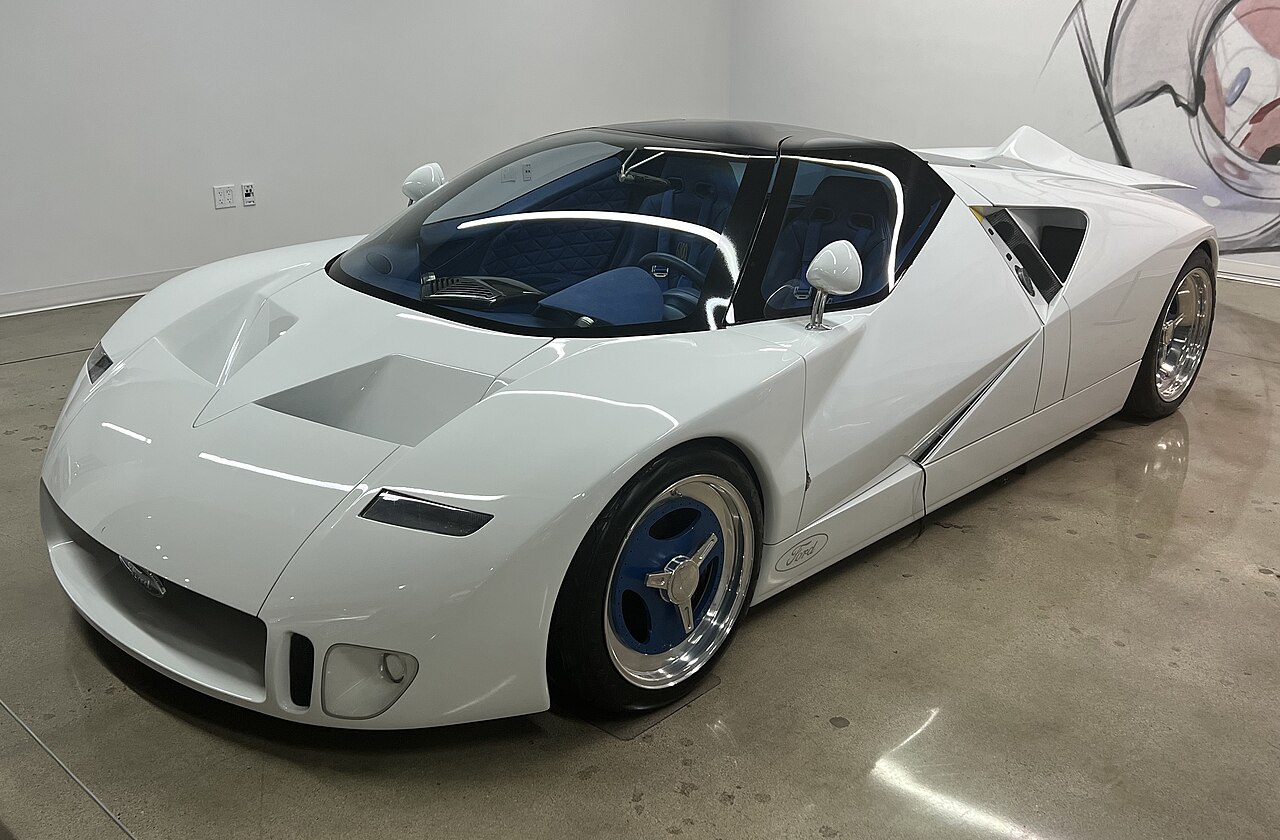
The Ford GT90 concept presented an experimental supercar and a new approach to Ford surface design in 1995.
History and purpose
The Ford GT90 concept presented an experimental supercar and a new approach to Ford surface design in 1995. The Petersen Automotive Museum’s original object account anchors the physical subject, its quad-turbocharged V12 architecture and its New Edge design role. That record corrects the inventory’s 1992 heading. The profile is an archive entry for a real concept rather than a claim that a retail edition reached manufacture. Its fabrication-total field remains unknown. Museum performance figures are presentation specifications, not independently verified road-test results, so this article concentrates on the documented engineering package and the visible design that made the concept recognisable.
Design and engineering
The museum photograph shows a white body broken into sharp planes and intersecting curves around a dark glass passenger cell. The nose is very low, the side opening deep and the rear body visually substantial. Bright wheel surfaces repeat the smooth geometry while the cabin supplies a strong dark contrast. The institutional record documents carbon-fibre body panels and a modified XJ220-derived aluminium structure. Those details explain the experimental package without treating every dramatic styling feature as a production-ready component. The image is a clear view of the full-size museum subject, rather than a scale model, rendering or later car with a similar colour scheme.
Identifying the original configuration
Use 1995 GT90 Concept as the canonical identity and retain the original 1992 inventory heading as a duplicate alias. The name should remain distinct from the original GT40, the 2002 GT40 concept and the later production Ford GT. Those related subjects can explain Ford’s design history, but they are separate physical programmes. The supplied photograph and museum object account match the preserved GT90. Exact prototype counts, unobserved component condition and demonstrated performance require their own evidence. The profile therefore records the documented concept architecture without converting promotional or museum presentation figures into claims about independently measured production-car capability.
Collector context and preservation
The GT90 is particularly effective beside the 021C because the two late-1990s concepts communicate almost opposite visual ambitions. One uses a low, angular supercar package and the other a friendly upright compact body. Preserve the GT90’s whole outline, passenger glazing, wheel design and side openings in dated archive photography. Close-ups can then reveal how the geometric surfaces meet. A concept file should also retain original presentation documents and subsequent custodial history. This allows the object to be discussed as an engineering and design experiment even when its proposed performance was never demonstrated under production-car testing conditions or followed by a retail manufacturing series.
Reading the evidence for this profile
The original source links below identify the programme and the historical statements used in this article. The photograph has its own creator and licence record, separate from the manufacturer’s vehicle history. Keep both when transferring this profile into a collection catalogue. A manufacturing tally describes how many cars belong to a defined original programme; it does not measure how many survive, how many are publicly visible, or how many retain all their original components. Those individual questions require dated chassis and restoration evidence. The reference year likewise describes the programme’s introduction or named historic configuration, while the supplied caption states the photographed setting and any established individual identity. This lets future research expand the car’s history without blurring the scope of the record already assembled here.
Specifications and verified rarity
| Reference year | 1995 |
|---|---|
| Model / programme | GT90 Concept |
| Body / role | New Edge experimental supercar |
| Documented engine | Quad-turbocharged 5.9-litre V12 in the museum specification |
| Architecture / transmission | Modified Jaguar XJ220-derived aluminium monocoque; carbon-fibre body panels |
| Exact manufacturing tally | Not established |
| Eligibility bound | Physical concept archive scope; tally unknown |
| Rarity scope | Verified physical 1995 GT90 concept shown in museum custody. The inventory’s 1992 heading is corrected to 1995. Concept archive scope, with exact fabrication total unknown and no retail production claim. |
| Inventory reference | FRD-229 — Verified |
Frequently asked questions
What is the Ford GT90 Concept?
The original 1995 Ford GT90 physical concept, a New Edge design and V12 engineering experiment; the inventory’s 1992 year is corrected.
What engineering defines this Ford?
Quad-turbocharged 5.9-litre V12 in the museum specification. Modified Jaguar XJ220-derived aluminium monocoque; carbon-fibre body panels. These are the documented programme or preserved-concept specifications. Connect an individual vehicle’s installed components to its own dated records before assigning a factory configuration to that particular example.
Why is 1995 the reference year?
It identifies the introduction or original historical configuration described in this article. The photograph can show a later example or a later display of the original subject. The source inventory’s original heading remains an identity alias wherever the date or model name has been corrected.
How should an individual GT90 Concept be documented?
Start with the chassis identity and connect it to dated construction, registration or custodial records. Keep exterior, interior, engine and underbody photographs together. Record changes to finish, equipment and mechanical specification as separate events, so the physical car’s history can grow without changing the definition of the original programme.
What rarity or archive scope is verified?
Verified physical 1995 GT90 concept shown in museum custody. The inventory’s 1992 heading is corrected to 1995. Concept archive scope, with exact fabrication total unknown and no retail production claim.
Who took the supplied photograph?
TaurusEmerald via Wikimedia Commons, under CC BY-SA 4.0. The original file and licence links accompany the image. Retain that credit when the photograph is uploaded, exported or reused.
Related Ford profiles
Sources and photo credits
Photograph: TaurusEmerald via Wikimedia Commons original file, CC BY-SA 4.0. Source-provided photograph supplied without local cropping, retouching or text removal. A source thumbnail is used where available. Original 1995 Ford GT90 at the Petersen Automotive Museum; documentary photograph of the full-size concept.
Built in limited numbers
Verified physical 1995 GT90 concept shown in museum custody. The inventory’s 1992 heading is corrected to 1995. Concept archive scope, with exact fabrication total unknown and no retail production claim.
Gallery
Specifications
Factory specifications may vary by model year, market and configuration.
Identity & production
- Official model
- GT90 Concept