2023 Ferrari SF90 XX Spider
Explore the Ferrari SF90 XX Spider: open hybrid architecture, dedicated XX bodywork, its published 599-car programme limit and a credited photo.
The Ferrari SF90 XX Spider was unveiled alongside the SF90 XX Stradale in June 2023, bringing an open body to a road-going XX special-series programme.
History and purpose
The Ferrari SF90 XX Spider was unveiled alongside the SF90 XX Stradale in June 2023, bringing an open body to a road-going XX special-series programme. Ferrari’s original release specifies separate global limits of 599 Spider and 799 Stradale cars. This profile uses the Spider’s published programme limit as the rarity ceiling and leaves the completed manufacturing total unset. The distinction is necessary because an announced finite run and a reconciled build total answer different questions. The model’s identity and programme scope are established without presenting all future or continuing deliveries as already completed.
Design and engineering
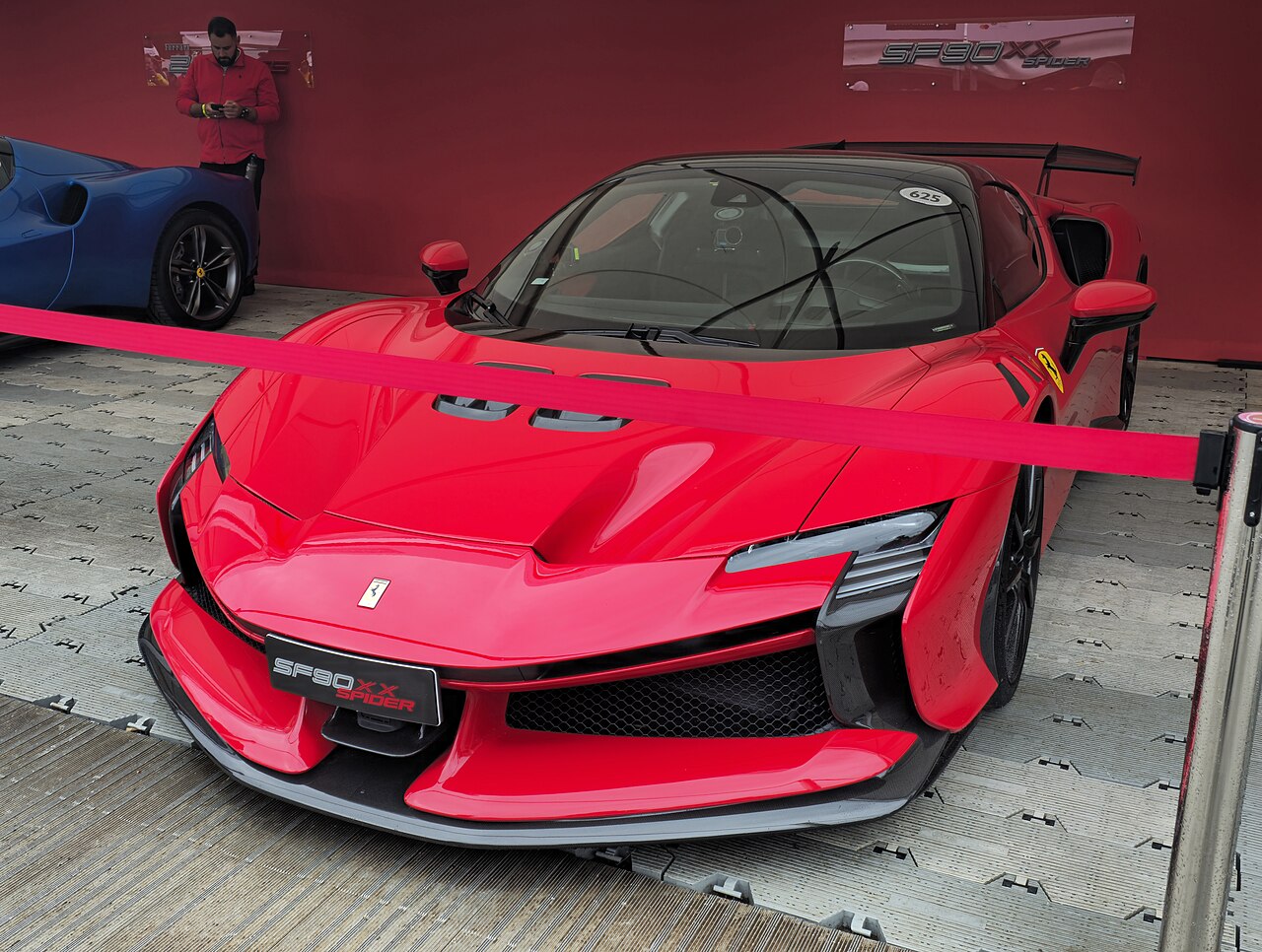
The supplied red display car has a broad fixed rear wing, a strongly sculpted front and dark airflow openings around the nose. Its upper cabin treatment identifies the retractable-roof derivative even when photographed with the top in its closed position. Ferrari’s technical archive describes a V8 plug-in hybrid powertrain with three electric motors and an eight-speed dual-clutch transmission. The visual and technical records therefore tell connected parts of the story: the body presents a highly focused road-car theme, while the hybrid system adds a different kind of complexity beneath it. The car belongs to a dedicated special series rather than a styling package alone.
Identifying the original configuration
SF90 XX Spider must be separated from the ordinary SF90 Spider and the closed XX Stradale. Their bodies and programme scopes differ, even though they share parts of the wider model name. The image source identifies the XX Spider, and the visible body corresponds to the roofed display state of that derivative. The 599 figure is a whole-model published limit, not a country allocation. It is not labelled as an exact completed manufacturing tally. For an individual car, chassis specification, roof configuration and factory equipment records supply the final identity check beyond the exterior photograph.
Collector context and preservation
Collectors can compare the Spider with the XX Stradale to study the relationship between an extreme road-series aerodynamic brief and two cabin arrangements. An individual file should include roof-open and roof-closed photographs, hybrid-system servicing and the original chassis specification. This creates a fuller record than a plaque or launch number by itself. The published series limit remains part of the programme history, while actual completion evidence can be added later without rewriting an invented total. The Spider’s interest comes from the combination of hybrid architecture, focused XX bodywork and an open-car package within one clearly named road model.
Reading the evidence for this profile
The original source links below identify the programme and the historical statements used in this article. The photograph has its own creator and licence record, separate from the manufacturer’s vehicle history. Keep both when transferring this profile into a collection catalogue. A manufacturing tally describes how many cars belong to a defined original programme; it does not measure how many survive, how many are publicly visible, or how many retain all their original components. Those individual questions require dated chassis and restoration evidence. The reference year likewise describes the programme’s introduction or named historic configuration, while the supplied caption states the photographed setting and any established individual identity. This lets future research expand the car’s history without blurring the scope of the record already assembled here.
Specifications and verified rarity
| Reference year | 2023 |
|---|---|
| Model / programme | SF90 XX Spider |
| Body / role | Limited-series retractable-roof plug-in hybrid |
| Engine architecture | Mid-rear twin-turbo V8 with three electric motors; plug-in hybrid |
| Transmission / platform reference | Eight-speed dual-clutch transmission |
| Exact manufacturing tally | Not established |
| Eligibility bound | 599 for the documented scope or parent programme |
| Rarity scope | Published complete SF90 XX Spider programme limit: 599 cars, distinct from 799 SF90 XX Stradale slots. Completed manufacturing total independently unconfirmed; not a regional allocation. |
| Inventory reference | FER-230 — Verified |
Frequently asked questions
What is the SF90 XX Spider?
The retractable-roof road-going SF90 XX derivative. Ferrari publishes a global Spider limit of 599; this is kept separate from an independently verified completed build tally.
What engine and transmission does it use?
Mid-rear twin-turbo V8 with three electric motors; plug-in hybrid. Eight-speed dual-clutch transmission. These entries describe the documented vehicle or explicitly named donor architecture. They should be read alongside the body and programme scope, rather than transferred to every Ferrari carrying a similar badge.
Why is 2023 the reference year?
The title follows the documented introduction, public presentation or custodial model-year record explained in the history section. An individual delivery can occur later. Original workbook titles remain identity aliases when research corrects their year.
How should an individual example be identified?
Start with its chassis record and original configuration, then compare dated photographs, factory or commission paperwork and the service history. Model-level specifications explain the design, while the individual file establishes the identity and condition of the particular car.
What rarity or archive scope is verified?
Published complete SF90 XX Spider programme limit: 599 cars, distinct from 799 SF90 XX Stradale slots. Completed manufacturing total independently unconfirmed; not a regional allocation.
Who took the supplied photograph?
Calreyn88 via Wikimedia Commons, under CC BY-SA 4.0. The original file and licence links accompany the image. Retain that credit when the photograph is uploaded, exported or reused.
Related Ferrari profiles
Sources and photo credits
- Original manufacturer, commission or custodial record
- Ferrari original release: distinct global Spider and Stradale limits
Photograph: Calreyn88 via Wikimedia Commons original file, CC BY-SA 4.0. Source-provided photograph supplied without local cropping, retouching or text removal. A source thumbnail is used where available. Ferrari SF90 XX Spider photographed with its retractable roof closed; the exact Spider derivative is identified by the image source.
Built in limited numbers
Published complete SF90 XX Spider programme limit: 599 cars, distinct from 799 SF90 XX Stradale slots. Completed manufacturing total independently unconfirmed; not a regional allocation.
Gallery
Specifications
Factory specifications may vary by model year, market and configuration.
Identity & production
- Official model
- SF90 XX Spider