1995 Ferrari F50
Explore F50: verified history, design, rarity scope and specifications, with a credited documentary photograph.
The Ferrari F50 introduced in 1995 gave the limited halo road-car programme a naturally aspirated V12 identity.
History and purpose
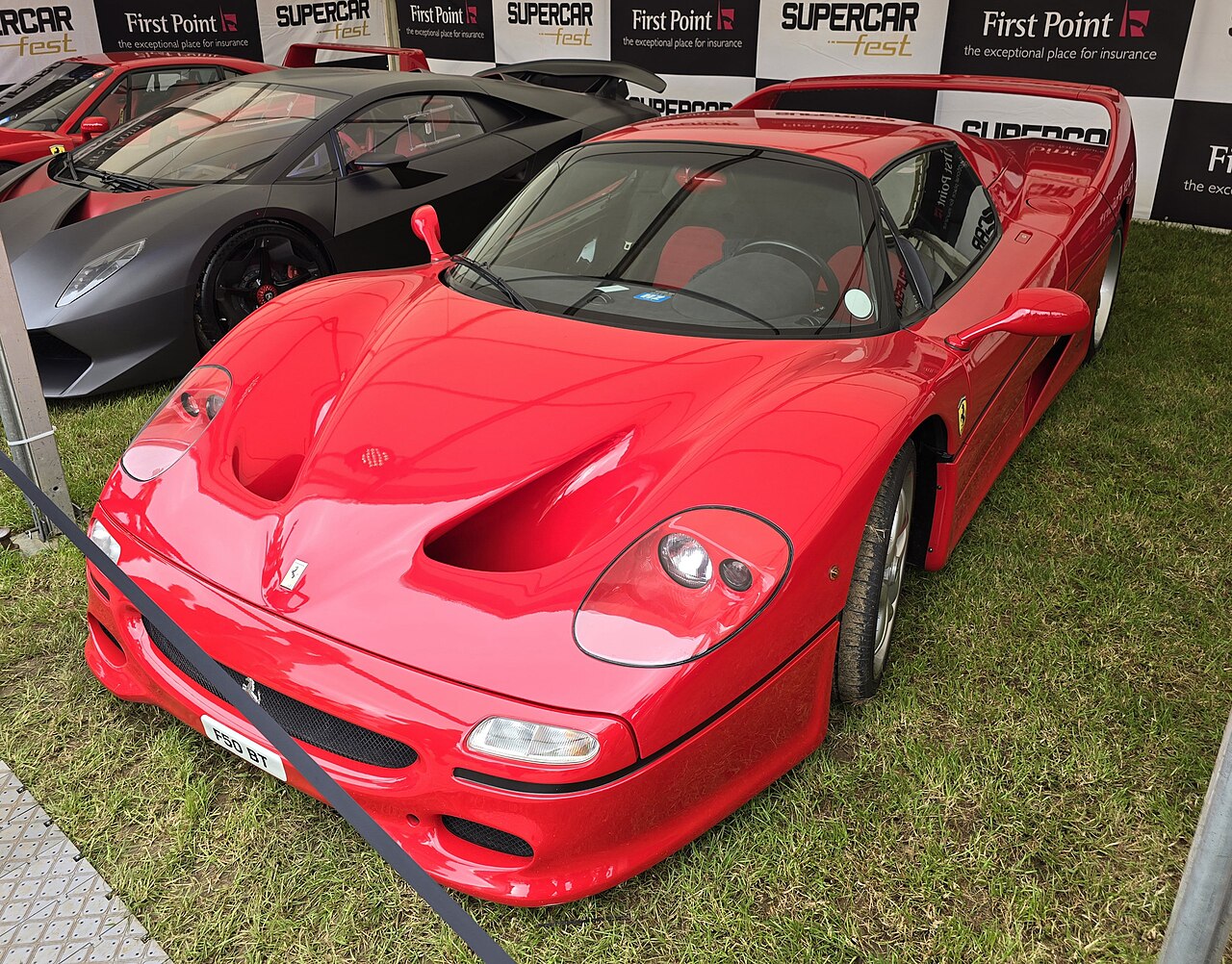
The Ferrari F50 introduced in 1995 gave the limited halo road-car programme a naturally aspirated V12 identity. Ferrari’s model history records the Geneva presentation, and its later F50 Legacy Tour press material states the 349-car road-production scope. That complete original tally is used here. The separately developed F50 GT is not counted as a standard road F50, and a track-car photograph is not substituted for the named road model. The supplied image identifies a 1996 F50, an example built within the programme whose introduction gives the profile its 1995 reference year.
Design and engineering
The photograph shows the road F50 with its low nose, open-looking passenger space and substantial rear wing. The relationship between cabin opening and rear body gives the car a different visual character from the fixed-roof GTO. Ferrari’s record describes a removable hardtop and a rear-mid V12 within a carbon-fibre structural design. Those factory facts supply the engineering context; the exterior image does not expose the chassis construction or prove the originality of the engine fitted today. Manufacturer performance specifications would also need to be labelled as period claims rather than passed off as a present independent test of the photographed survivor.
Identifying the original configuration
F50 road cars and the F50 GT development project have similar names but different scopes. The 349-car tally belongs to the original road programme, and the body in this profile matches that subject. An individual survivor’s factory identification, original engine and gearbox records, roof equipment and restoration history should remain attached to its own chassis. A modern display photograph can document body form and presentation date, but it cannot certify matching numbers. Keeping those evidence levels distinct protects the rarity statement from expanding to every related prototype or track object bearing F50 in its description.
Collector context and preservation
For collectors, the F50 can be studied through the relationship between its structural concept and its open-road-car presentation. The factory’s rear-mid V12 architecture and removable roof explain more than a generic comparison of horsepower figures. The visible body also makes an informative counterpart to the GTO: both are limited Ferrari road programmes, yet their proportions and engine strategies differ. A complete individual file should preserve original delivery specifications, roof and accessory records, component identity and a dated service history. The full 349-car scope establishes production rarity; the quality of the survivor’s documentation establishes its own historical clarity. The two should be presented together without allowing either to substitute for the other.
Reading the evidence for this profile
The original source links below identify the programme and the historical statements used in this article. The photograph has its own creator and licence record, separate from the manufacturer’s vehicle history. Keep both when transferring this profile into a collection catalogue. A manufacturing tally describes how many cars belong to a defined original programme; it does not measure how many survive, how many are publicly visible, or how many retain all their original components. Those individual questions require dated chassis and restoration evidence. The reference year likewise describes the programme’s introduction or named historic configuration, while the supplied caption states the photographed setting and any established individual identity. This lets future research expand the car’s history without blurring the scope of the record already assembled here.
Specifications and verified rarity
| Reference year | 1995 |
|---|---|
| Model / programme | F50 |
| Body / role | Limited V12 sports car with removable hardtop |
| Engine architecture | Longitudinal rear-mid-mounted naturally aspirated 4.7-litre V12 |
| Transmission | Six-speed manual |
| Exact manufacturing tally | 349 |
| Eligibility bound | 349 for the documented scope or parent programme |
| Rarity scope | Complete original 349-car F50 road-production programme. The F50 GT racing development project is excluded. |
| Inventory reference | FER-137 — Verified |
Frequently asked questions
How many original road F50s were built?
Ferrari’s Legacy Tour material records 349.
When was the model introduced?
Ferrari places the F50 presentation at Geneva in 1995.
Does the count include the F50 GT?
No. That track-development project is separately scoped.
Does the exterior image prove matching numbers?
No. Component originality requires chassis-specific factory and service documentation.
What rarity or archive scope is verified?
Complete original 349-car F50 road-production programme. The F50 GT racing development project is excluded.
Who took the supplied photograph?
Calreyn88 via Wikimedia Commons, under CC BY-SA 4.0. The original file and licence links accompany the image. Retain that credit when the photograph is uploaded, exported or reused.
Related Ferrari profiles
Sources and photo credits
Photograph: Calreyn88 via Wikimedia Commons original file, CC BY-SA 4.0. Source-provided photograph supplied without local cropping, retouching or text removal. A source thumbnail is used where available. Source-described 1996 Ferrari F50 road car. The F50 GT development body is excluded from the image and production scope.
Built in limited numbers
Complete original 349-car F50 road-production programme. The F50 GT racing development project is excluded.
Gallery
Specifications
Factory specifications may vary by model year, market and configuration.
Identity & production
- Official model
- F50