1989 Ferrari Mythos by Pininfarina
Explore Mythos by Pininfarina: verified history, design, rarity scope and specifications, with a credited documentary photograph.
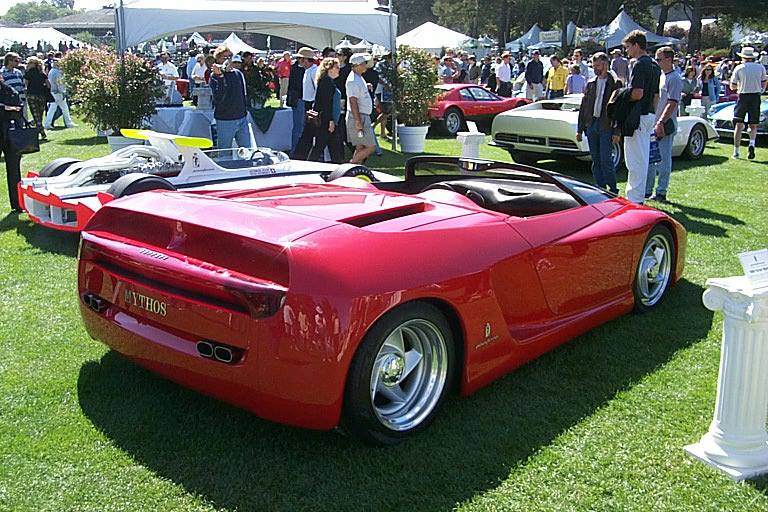
The Mythos belongs to Pininfarina’s documented 1989 design history.
History and purpose
The Mythos belongs to Pininfarina’s documented 1989 design history. The coachbuilder’s own heritage record places the project at the Tokyo show and records its subsequent Car Design Award recognition. This profile treats it as the original physical concept project, with its Ferrari relationship retained in the archive. It is not presented as a factory-numbered Ferrari road edition. The inventory’s one-off wording is also handled carefully: the cited primary heritage material does not establish an exact complete fabrication tally, so the production-total field remains blank. The authentic named concept is sufficient for a clearly labelled archive scope without inventing a number.
Design and engineering
The supplied photograph shows the red open concept from the rear quarter. Broad rear shoulders, a low passenger opening and the shaped upper rear body give the car a particularly sculptural presence. Its volumes can be examined directly without assuming that every curve was validated for production manufacture or road use. The rear-heavy visual emphasis is an observation about the photographed design, rather than a measured weight distribution. Likewise, a known Ferrari relationship should not be used to fill a specification table with unverified donor-car details. This article limits mechanical claims to the documented concept context and concentrates on the visible design and primary heritage evidence.
Identifying the original configuration
A coachbuilder concept needs its creator and project identity stated alongside the associated marque. Calling Mythos simply a Ferrari special edition would conceal Pininfarina’s role and imply a production programme the sources do not establish. Reports of other commissions or later copies would need their own physical and documentary evidence before being added to a fabrication total. The photograph shows a real exhibited concept, but it does not assign a chassis number or prove that every object described as Mythos is the original show car. Archive identity, exact manufacturing tally and the provenance of an individual photographed object remain related but separate questions.
Collector context and preservation
The collecting interest is design history: an original physical concept can preserve an argument about form even without a retail price list or a numbered production run. The Mythos image invites comparison with other open Ferraris through the treatment of the cabin opening and rear deck. Such a comparison should remain visual unless matching technical evidence is available. A strong concept file would retain original show photographs, project documentation and any later custodial record, while clearly distinguishing the concept from derivatives or replicas. The credited modern image supplies a tangible reference, and Pininfarina’s heritage account supplies authorship and debut context. Leaving the fabrication total unknown makes that record more dependable, not less useful to a serious archive.
Reading the evidence for this profile
The original source links below identify the programme and the historical statements used in this article. The photograph has its own creator and licence record, separate from the manufacturer’s vehicle history. Keep both when transferring this profile into a collection catalogue. A manufacturing tally describes how many cars belong to a defined original programme; it does not measure how many survive, how many are publicly visible, or how many retain all their original components. Those individual questions require dated chassis and restoration evidence. The reference year likewise describes the programme’s introduction or named historic configuration, while the supplied caption states the photographed setting and any established individual identity. This lets future research expand the car’s history without blurring the scope of the record already assembled here.
Specifications and verified rarity
| Reference year | 1989 |
|---|---|
| Model / programme | Mythos by Pininfarina |
| Body / role | Ferrari-based open design concept |
| Engine architecture | Ferrari-based concept; detailed drivetrain tally not independently established here |
| Transmission | Concept drivetrain details not used for rarity eligibility |
| Exact manufacturing tally | Not established |
| Eligibility bound | Physical concept archive scope; tally unknown |
| Rarity scope | Documented original 1989 Pininfarina Mythos physical concept project. Exact fabrication tally is not established; an unknown total is not converted into a one-car claim. |
| Inventory reference | FER-129 — Verified |
Frequently asked questions
Who created the Mythos project?
Pininfarina, whose own heritage archive documents the original concept.
Where was it presented?
The coachbuilder records the 1989 Tokyo show context.
Is a one-car fabrication total verified?
No exact complete tally is established by the cited primary heritage material.
Is this a numbered Ferrari road edition?
No. It is clearly classified as a Ferrari-based Pininfarina concept archive subject.
What rarity or archive scope is verified?
Documented original 1989 Pininfarina Mythos physical concept project. Exact fabrication tally is not established; an unknown total is not converted into a one-car claim.
Who took the supplied photograph?
Craig Howell via Wikimedia Commons, under CC BY 2.0. The original file and licence links accompany the image. Retain that credit when the photograph is uploaded, exported or reused.
Related Ferrari profiles
Sources and photo credits
Photograph: Craig Howell via Wikimedia Commons original file, CC BY 2.0. Source-provided photograph supplied without local cropping, retouching or text removal. A source thumbnail is used where available. Documented Pininfarina Mythos concept in a modern exhibition photograph. The image is not used to assert an exact one-car fabrication total.
Built in limited numbers
Documented original 1989 Pininfarina Mythos physical concept project. Exact fabrication tally is not established; an unknown total is not converted into a one-car claim.
Gallery
Specifications
Factory specifications may vary by model year, market and configuration.
Identity & production
- Official model
- Mythos by Pininfarina