1984 Ferrari Testarossa Monospecchio
Explore Testarossa Monospecchio: verified history, design, rarity scope and specifications, with a credited documentary photograph.
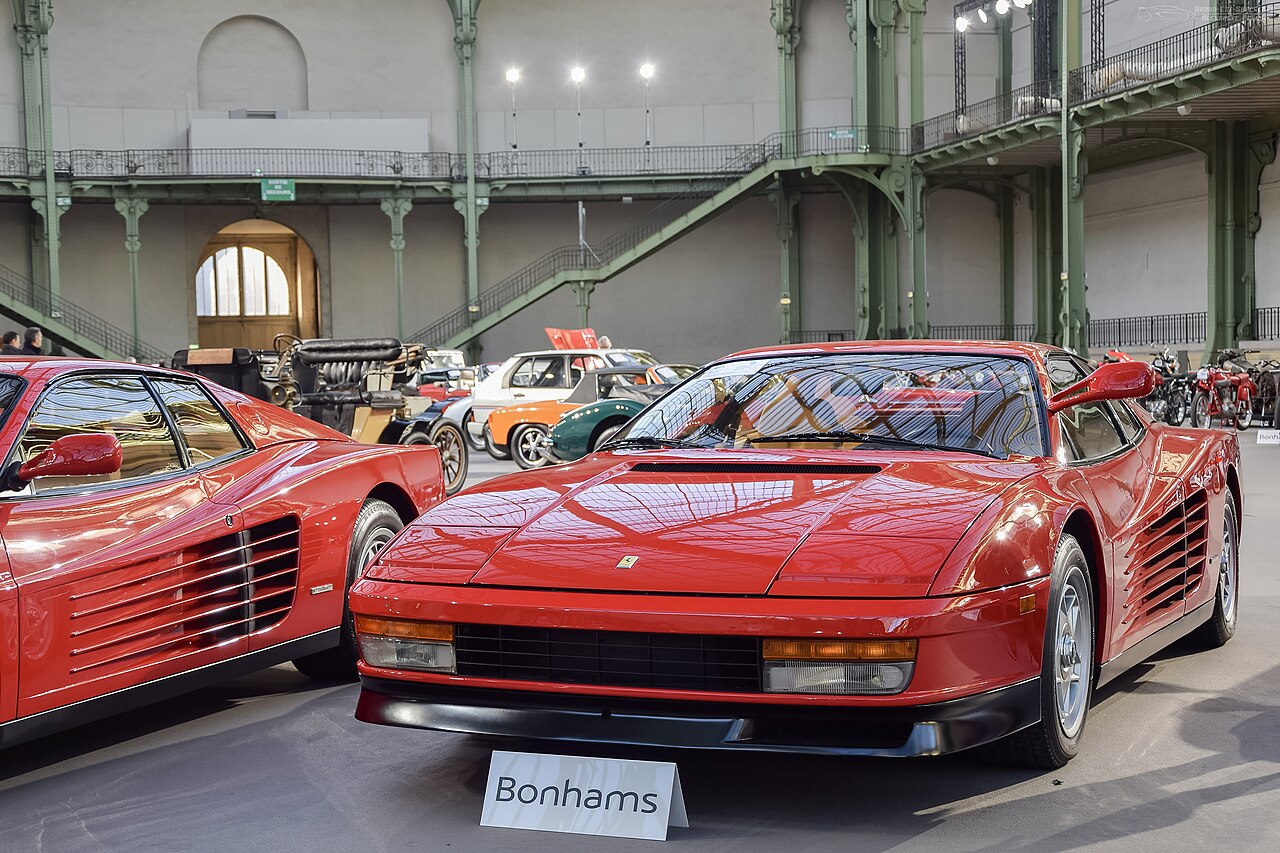
The original Ferrari Testarossa appeared at the 1984 Paris show with a visual identity that remains closely associated with its name.
History and purpose
The original Ferrari Testarossa appeared at the 1984 Paris show with a visual identity that remains closely associated with its name. This profile follows the early Monospecchio configuration, recognised by the high-mounted single exterior mirror. Ferrari’s model history supplies the wider Testarossa architecture and a complete parent-programme tally of 7,177. That count is not the Monospecchio subset total. The exact early single-mirror manufacturing number is left unverified, while the entire parent programme remains within the 7,500-car threshold. The supplied image source identifies an early 1985 Monospecchio car, chassis 57535, providing a specific photographed example of the named configuration.
Design and engineering
The photograph places the single-mirror car in a modern auction display. Its broad rear body and horizontal side strakes are central to the Testarossa’s design. Ferrari’s history connects the side cooling arrangement with the model’s rear-mid flat-twelve architecture. The single elevated mirror adds an asymmetric detail that distinguishes the early appearance from later two-mirror cars. The picture records a visible configuration and a source-identified chassis; it does not prove that the mirror or every adjacent panel remains untouched from delivery. Factory documents and a restoration chronology should establish whether a particular survivor retains or has recovered its original early specification.
Identifying the original configuration
Monospecchio describes a configuration, not the complete Testarossa run and not a numbered special edition announced as a separate total. It should not be confused with Monodado, which refers to a different wheel-fixing feature. A source may use both descriptions for the same car, but one does not automatically prove the other. This profile keeps the mirror configuration as its collecting boundary. Later 512 TR and F512 M models are excluded from the parent count. An early-style mirror fitted to a later car would need its actual manufacturing and modification history recorded before being represented as an original Monospecchio example.
Collector context and preservation
For collectors, the early mirror arrangement can be discussed as a specific stage in the Testarossa’s visible development. It changes the way the cabin and body are read, but it does not justify transferring a precise subset count from an unsourced internet summary. The factory’s complete parent tally and the image’s chassis reference provide an honest foundation. A useful individual file would retain delivery photographs, chassis and engine identity, wheel specification and records of mirror or body changes. That level of detail is more informative than calling every early-looking car a rare edition. The page remains searchable under the familiar Monospecchio name while making clear which facts describe the parent model and which describe the particular early configuration.
Reading the evidence for this profile
The original source links below identify the programme and the historical statements used in this article. The photograph has its own creator and licence record, separate from the manufacturer’s vehicle history. Keep both when transferring this profile into a collection catalogue. A manufacturing tally describes how many cars belong to a defined original programme; it does not measure how many survive, how many are publicly visible, or how many retain all their original components. Those individual questions require dated chassis and restoration evidence. The reference year likewise describes the programme’s introduction or named historic configuration, while the supplied caption states the photographed setting and any established individual identity. This lets future research expand the car’s history without blurring the scope of the record already assembled here.
Specifications and verified rarity
| Reference year | 1984 |
|---|---|
| Model / programme | Testarossa Monospecchio |
| Body / role | Early single-mirror flat-twelve berlinetta |
| Engine architecture | Longitudinal rear-mid-mounted 4.9-litre flat twelve |
| Transmission | Five-speed manual |
| Exact manufacturing tally | Not established |
| Eligibility bound | 7177 for the documented scope or parent programme |
| Rarity scope | Original high single-mirror Testarossa configuration within the complete 7,177-car Testarossa parent programme. Exact Monospecchio manufacturing tally unverified; later 512 TR and F512 M excluded. |
| Inventory reference | FER-119 — Verified |
Frequently asked questions
Does 7,177 mean 7,177 Monospecchio cars?
No. It is Ferrari’s complete original Testarossa parent tally.
Is the exact single-mirror subset total established?
No exact manufacturing tally is asserted for that configuration.
Which car appears in the picture?
The source identifies the 1985 Monospecchio chassis 57535.
Are Monospecchio and Monodado the same feature?
No. One describes the single mirror; the other describes a wheel-fixing configuration.
What rarity or archive scope is verified?
Original high single-mirror Testarossa configuration within the complete 7,177-car Testarossa parent programme. Exact Monospecchio manufacturing tally unverified; later 512 TR and F512 M excluded.
Who took the supplied photograph?
Alexandre Prevot from Nancy, France via Wikimedia Commons, under CC BY-SA 2.0. The original file and licence links accompany the image. Retain that credit when the photograph is uploaded, exported or reused.
Related Ferrari profiles
Sources and photo credits
Photograph: Alexandre Prevot from Nancy, France via Wikimedia Commons original file, CC BY-SA 2.0. Source-provided photograph supplied without local cropping, retouching or text removal. A source thumbnail is used where available. Early Ferrari Testarossa Monospecchio, source-identified as 1985 chassis 57535, in a modern auction display; the parent count is not the single-mirror subset tally.
Built in limited numbers
Original high single-mirror Testarossa configuration within the complete 7,177-car Testarossa parent programme. Exact Monospecchio manufacturing tally unverified; later 512 TR and F512 M excluded.
Gallery
Specifications
Factory specifications may vary by model year, market and configuration.
Identity & production
- Official model
- Testarossa Monospecchio