1964 Ferrari 275 GTB Short Nose
Explore 275 GTB Short Nose: verified history, design, rarity scope and specifications, with a credited documentary photograph.
The original Ferrari 275 GTB appeared in 1964 with the body configuration now commonly called short nose.
History and purpose
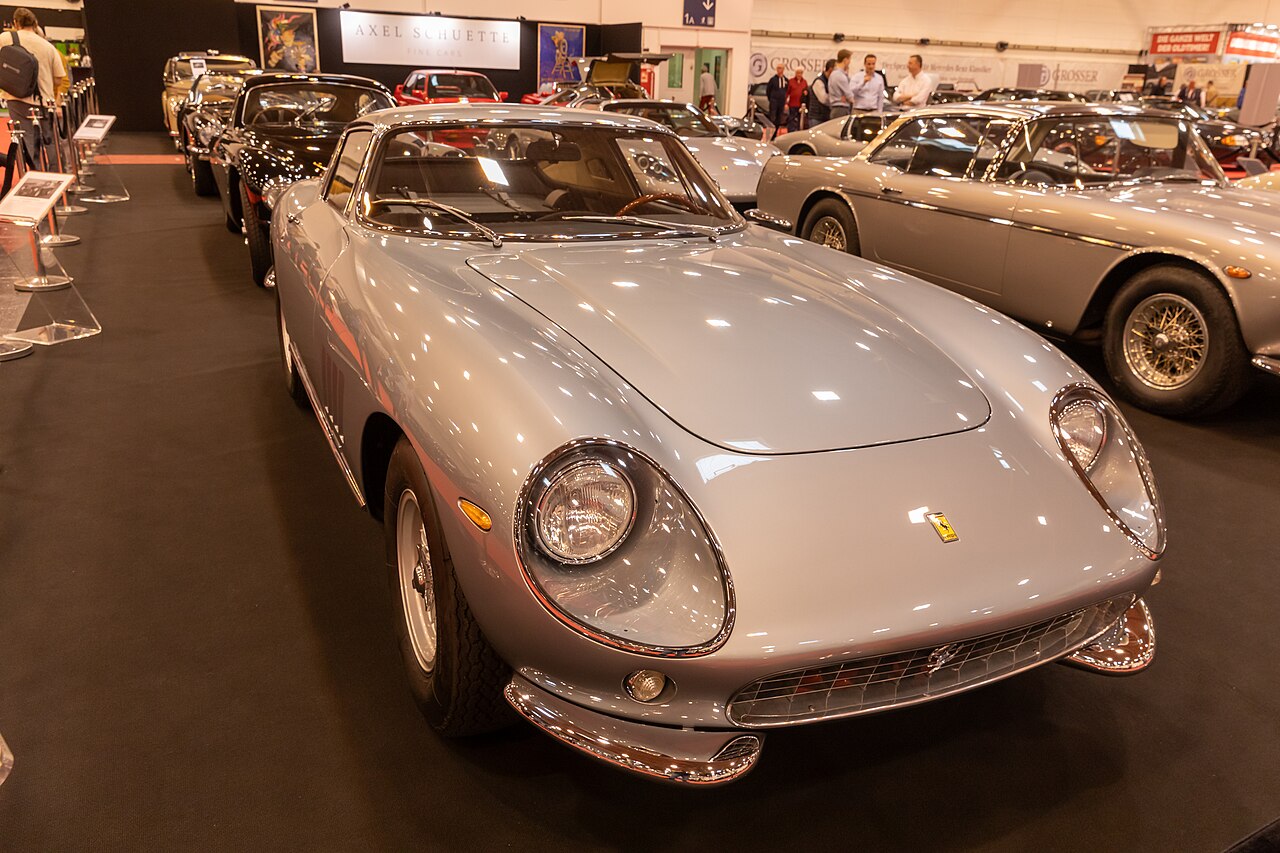
The original Ferrari 275 GTB appeared in 1964 with the body configuration now commonly called short nose. Ferrari’s model history documents the introduction and the later long-nose revision. The short-nose title therefore identifies the earlier two-cam road configuration, rather than a separate officially numbered edition. Its mechanical arrangement paired the front V12 with a rear transaxle and independent rear suspension. The supplied photo identifies chassis 07037, a later-built original short-nose car also described in Fiskens’ own vehicle record. The introduction year and the photographed car’s build year are kept separate, so the title does not imply that all short-nose examples were completed in 1964.
Design and engineering
The relatively compact front overhang gives the car a different visual balance from the long-nose GTB. The photograph shows a rounded nose, a tight passenger compartment and a smooth rear volume. Rather than judging the distinction from the model name alone, compare the relationship between the front wheel, grille and bonnet edge. This is a useful design exercise, but it is not a substitute for chassis documentation. A restored body can change its appearance, and an engine family can be shared by cars with different original specifications. The photograph provides an identified survivor as a reference; the factory history explains the architecture and the sequence of revisions.
Identifying the original configuration
Short-nose GTB and long-nose GTB remain separate inventory identities here. Neither is merged with the four-cam GTB/4 or with a competition GTB/C. The entire original road GTB programme was approximately 450 cars, with registry estimates reaching 456, so an authentic short-nose subset qualifies without relying on a disputed exact subdivision. That upper bound is not presented as the short-nose tally. The production-total field stays blank. This distinction allows later chassis-register research to refine the subset without requiring the model’s rarity argument to be rebuilt or an earlier uncertain number to remain embedded in SEO text as fact.
Collector context and preservation
An individual short-nose file should connect its chassis, body material, engine and driveline specification through delivery records and restoration history. The presence of a convincing rounded nose does not establish every one of those facts. The pictured car gives a concrete object to compare with the long-nose profile, and the dealer’s original description supports its short-nose identity. Its significance can be discussed through proportion and technical layout without assigning unverified handling impressions. For collectors, the most useful comparison preserves both continuity and change: this is recognisably a 275 GTB, but its original body configuration belongs to a particular stage of the model’s development and deserves a clear title of its own.
Reading the evidence for this profile
The original source links below identify the programme and the historical statements used in this article. The photograph has its own creator and licence record, separate from the manufacturer’s vehicle history. Keep both when transferring this profile into a collection catalogue. A manufacturing tally describes how many cars belong to a defined original programme; it does not measure how many survive, how many are publicly visible, or how many retain all their original components. Those individual questions require dated chassis and restoration evidence. The reference year likewise describes the programme’s introduction or named historic configuration, while the supplied caption states the photographed setting and any established individual identity. This lets future research expand the car’s history without blurring the scope of the record already assembled here.
Specifications and verified rarity
| Reference year | 1964 |
|---|---|
| Model / programme | 275 GTB Short Nose |
| Body / role | Two-cam V12 grand touring berlinetta |
| Engine architecture | Front-mounted 3.3-litre two-cam V12 |
| Transmission | Five-speed rear transaxle |
| Exact manufacturing tally | Not established |
| Eligibility bound | 456 for the documented scope or parent programme |
| Rarity scope | Original short-nose two-cam 275 GTB road cars within the approximately 450-car parent programme; conservative registry ceiling 456. Exact subset tally unverified. |
| Inventory reference | FER-077 — Verified |
Frequently asked questions
What does short nose identify?
The original body configuration of the two-cam 275 GTB introduced in 1964.
Is it the GTB/C competition model?
No. The road-going short-nose GTB and original competition cars are separate scopes.
Which chassis is pictured?
The source identifies 07037, also documented as a short-nose GTB by Fiskens.
Is 456 the short-nose total?
No. It is a conservative registry ceiling for the complete parent GTB programme.
What rarity or archive scope is verified?
Original short-nose two-cam 275 GTB road cars within the approximately 450-car parent programme; conservative registry ceiling 456. Exact subset tally unverified.
Who took the supplied photograph?
Matti Blume via Wikimedia Commons, under CC BY-SA 4.0. The original file and licence links accompany the image. Retain that credit when the photograph is uploaded, exported or reused.
Related Ferrari profiles
Sources and photo credits
- Original manufacturer or custodial record
- Original vehicle description: short-nose chassis 07037
- Chassis-register parent programme research
Photograph: Matti Blume via Wikimedia Commons original file, CC BY-SA 4.0. Source-provided photograph supplied without local cropping, retouching or text removal. A source thumbnail is used where available. Original short-nose Ferrari 275 GTB, source-identified as chassis 07037, at Techno-Classica Essen in 2024.
Built in limited numbers
Original short-nose two-cam 275 GTB road cars within the approximately 450-car parent programme; conservative registry ceiling 456. Exact subset tally unverified.
Gallery
Specifications
Factory specifications may vary by model year, market and configuration.
Identity & production
- Official model
- 275 GTB Short Nose