1972 Citroën SM Présidentielle
Explore the 1972 Citroën SM Présidentielle: sourced history, design, specifications and rarity evidence, with credited documentary photos.
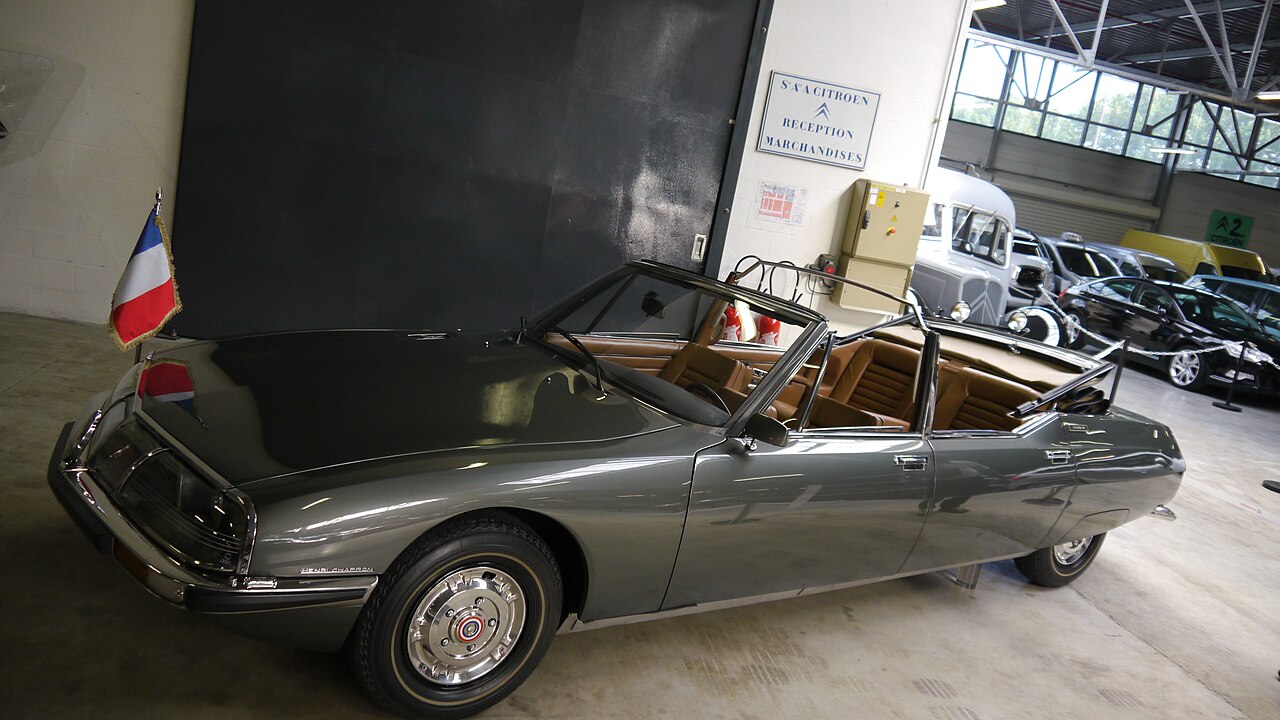
The 1972 Citroën SM Présidentielle gives the grand-touring SM an entirely different public role. Its open four-door body was built around ceremonial visibility, while the engineering had to accommodate the unhurried pace of a state parade.
Two commissioned cars, one specific programme
DS Automobiles records two identical SM presidential convertibles, announced on 12 May 1972. Their first official outing followed on 15 May during Queen Elizabeth II’s visit. The manufacturer gives a length of 5.60 metres and a 3.47-metre wheelbase, with a V6 and five-speed gearing adapted to sustained low-speed ceremonial use. The hydraulic soft top and folding interpreter seat belong to the special arrangement.
The number two describes the commissioned presidential pair. It is unrelated to the manufacturing total of the ordinary SM, and it does not identify which of the two appears in a photograph. The supplied image establishes the special body configuration, while the car’s individual service history would require identifying documents beyond a general museum view.
An open car designed to be seen
The photograph shows the long convertible from the front quarter. The passenger compartment extends well beyond the proportions suggested by a conventional sporting cabriolet. Chrome trim draws a continuous line along the side, and the open roof leaves the rear seating area plainly visible. A museum environment provides context without turning the display placard into a chassis certificate.
The design effect is especially clear when the car is compared with the closed DS limousine. The SM creates an elevated visual stage for its occupants through exposure rather than a tall formal enclosure. The open body also makes the length immediately legible: there is less roof volume to hide the relationship between the front compartment and the official seating area.
Parade engineering is a distinct requirement
A slow official procession places a different emphasis on the drivetrain than a grand tour. The source’s statement about adapted ratios is therefore more revealing than a headline power figure. It shows why the commissioned car should be discussed in its own functional terms. Comfortable controlled movement, visibility and coordination with the event become central to the design brief.
This does not justify inventing modern performance results for the presidential cars. A top-speed claim would add little to their purpose, and a museum photograph cannot reveal the transmission’s condition. A useful engineering record instead connects the period specification with workshop documentation, control details and records of maintenance during official service.
Preserving a ceremonial vehicle’s complete story
The SM’s public history and its physical history should travel together. Official-event photographs can show the occupants and route, while conservation records explain how the mechanism and interior survived between those appearances. Each kind of evidence answers a different question. Combining them gives the car a richer narrative than an isolated photograph of a famous passenger.
Readers can also examine the relationship between the special body and the standard SM design vocabulary. The long front, bright trim and distinctive face preserve a recognizable family character, even though the cabin serves a new task. That combination of recognizable marque identity and specific state function makes the Présidentielle a compelling collector archive subject.
Specifications and verified rarity
| Reference year | 1972 |
|---|---|
| Model / project | SM Présidentielle |
| Body / role | Four-door ceremonial convertible |
| Length / wheelbase | 5.60 m / 3.47 m |
| Powertrain | V6; five-speed transmission adapted for slow parade use |
| Seating arrangement | Official rear compartment and folding interpreter seat |
| Introduction | May 1972 |
| Rarity scope | Two identical commissioned SM presidential convertibles announced in May 1972. Scope excludes ordinary production SMs. |
| Exact manufacturing tally | 2 |
| Inventory reference | CIT-052 — Verified |
Frequently asked questions
How many SM presidential convertibles were commissioned?
The official account records two identical cars.
Were they ordinary two-door SMs?
No. They used a special four-door ceremonial convertible body.
Why was the gearing adapted?
The car needed controlled movement during slow official processions.
Does this photo identify one of the pair by chassis?
No individual chassis number is asserted from the general museum photograph.
What rarity or archive scope is verified?
Two identical commissioned SM presidential convertibles announced in May 1972. Scope excludes ordinary production SMs.
Who took the supplied photograph?
Klaus Nahr from Germany via Wikimedia Commons, under CC BY-SA 2.0. Keep the photographer, original-file link and licence credit with the image.
Related Citroën profiles
Sources and photo credits
Photograph: Klaus Nahr from Germany via Wikimedia Commons original file, CC BY-SA 2.0. Source photograph supplied without local cropping, retouching or text removal. A source-provided thumbnail is used where available. SM Présidentielle at the Citroën Conservatoire. The individual member of the commissioned pair is not assigned a chassis number.
Built in limited numbers
Two identical commissioned SM presidential convertibles announced in May 1972. Scope excludes ordinary production SMs.
Gallery
Specifications
Factory specifications may vary by model year, market and configuration.
Identity & production
- Official model
- SM Présidentielle