Audi quattro concept — 2010
The 2010 Audi quattro concept revisited the compact, muscular character of the Sport quattro with a published 300 kW five-cylinder turbo specification and a six-speed manual gearbox. Presented in Paris, it is a physical design and engineering study, distinct from the larger 2013 Sport quattro hybrid concept and from any numbered road-car edition.
The 2010 Audi quattro concept revisited the compact, muscular character of the Sport quattro with a published 300 kW five-cylinder turbo specification and a six-speed manual gearbox. Presented in Paris, it is a physical design and engineering study, distinct from the larger 2013 Sport quattro hybrid concept and from any numbered road-car edition.
Audi quattro concept — 2010 at a glance
| Manufacturer | Audi |
|---|---|
| Model / programme | quattro concept |
| Profile scope | Physical concept archive |
| Historical reference year | 2010 |
| Inventory reference | AUDI-036 |
| Engine reference | Published 2.5-litre turbocharged five-cylinder concept specification |
| Exact original object count | Unresolved; no numeric production badge populated |
| Manufacturer power reference | 300 kW |
| Manufacturer power reference | 408 PS; concept rating where applicable |
| Manufacturer torque reference | 480 Nm; concept rating where applicable |
| Object scope | Documented physical concept; no retail production series |
A modern interpretation of the quattro idea
Audi’s Paris launch record describes a heavily modified RS5-based study with a shorter wheelbase, a lower roof and lightweight body construction. Its published powertrain combines a longitudinal 2.5-litre turbocharged five-cylinder, 300 kW or 408 PS, 480 Nm and a six-speed manual gearbox. These are concept descriptions, not a guarantee of the equipment or output of an exhibit today. The fascination lies in how a contemporary vehicle proposal can evoke an earlier car without simply repeating its body. This profile treats that relationship as design history rather than a new homologation programme.
The published specification in context
The factory launch gives a 1,300 kg total weight and a 3.9-second acceleration reference from zero to 100 km/h. It also describes aluminium and carbon-fibre elements and the crown-gear centre differential in the quattro system. Those figures describe the announced study. They should remain labelled as manufacturer concept references, especially when the car appears in a static museum image. A collector archive can preserve the engineering ambition while leaving present running condition unresolved. There is no need to invent a contemporary test result to make the study interesting or to explain what Audi was exploring.
Why the silhouette makes the history readable
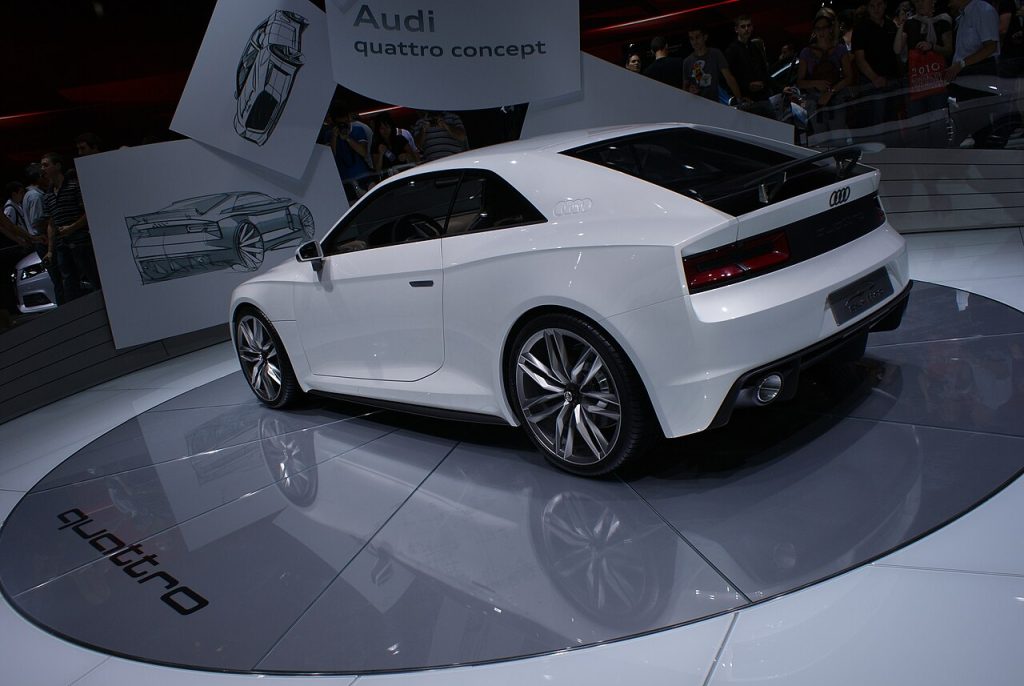
Look first at the relationship between roof, rear pillar and wheel arches. A design reference is strongest when it changes the way the whole car reads, rather than appearing only as a badge. In the bundled Paris photograph, the compact passenger compartment and pronounced body volume around the wheels invite comparison with the earlier Sport quattro. That is a visual interpretation, not proof that the physical structure is shared. A useful gallery would combine a side view, a front three-quarter view and an interior photograph. Each answers a different question about proportion, surface treatment or the driver’s relationship to the controls.
The manual gearbox as a concept choice
A manual transmission changes the way a performance proposal is communicated. It gives the driver a conspicuous role in selecting gears and provides a familiar focal point inside the cabin. That does not establish how an untested concept feels to drive. In an editorial account, it is more useful to explain the intention conveyed by the layout than to invent a first-hand driving impression. Compare the gearbox and engine packaging with the later hybrid study, where the technical discussion becomes more concerned with the interaction of combustion and electric propulsion. The two concepts answer related questions through different arrangements.
2010 quattro concept versus 2013 Sport quattro concept
These are separate archive subjects. The 2010 car’s five-cylinder proposal and the 2013 study’s hybrid system should never be collapsed into one specification sheet. A search result that loosely calls both cars a modern Sport quattro can obscure their dates and identities. Use the full name and year when labelling images or linking the profiles. In a comparative display, ask how each car treats the original’s visual memory and what each adds to the discussion. Neither concept inherits the production count, rally entries or historic eligibility of the earlier road car it recalls.
Rarity without an invented chassis census
The workbook labels this concept as one car. The reviewed launch establishes the programme and a physical show-car identity, but does not supply a complete census of prototypes, development vehicles and display objects. The exact production total therefore remains unset. That is consistent with treating the concept as an archive subject rather than a limited retail series. Repeated appearances at exhibitions do not prove the existence of multiple examples, just as a single visible exhibition object does not prove that no development object existed. A definitive count would need an object inventory with a clear definition of what is included.
A photograph is evidence of appearance
The bundled image is identified as the concept unveiled at the 2010 Paris motor show. It gives the article a dated physical reference rather than a computer rendering. The picture can support discussion of the visible body form, but it cannot independently prove the published power rating, material construction or present mechanical condition. Retain the original description and photographer attribution when preparing a replacement image. If a caption refers to a modern exhibition, do not relabel it as a period photograph. The date of the concept and the date of the exposure are separate pieces of useful information.
What an archive curator should record
A concept file should document the original presentation, subsequent exhibition movements, body and cabin conservation, and the distinction between functioning parts and display representations. Keep workshop records for any later mechanical work. A changed battery, control system or trim component may be reasonable conservation practice, but should not disappear from the object history. These are suggested documentation priorities, not assertions that this concept has received those changes. For a study, the completeness of the presentation can be historically important even when road registration, retail service intervals and ordinary production-car originality rules are inapplicable.
How to compare the study with the original Sport quattro
Begin with what can actually be observed: proportions, pillar treatment, wheel-arch emphasis and the visual placement of the cabin. Then add the documented engineering descriptions from each car’s own period. That sequence avoids projecting a modern interpretation backwards into the historic car. The earlier production subject has its own manufacturing and competition context; the concept has a presentation and development context. A strong article explains the conversation between them. It does not imply that a heritage-inspired shape gives the study a rally record or makes the original a preview of every later quattro technology.
Why the 2010 quattro concept remains worth studying
The concept offers a particularly clear way to explore the relationship between a memorable older design and a modern performance brief. Its value to an archive comes from that documented proposal and the surviving visual record. Visitors can follow the idea from the original Sport quattro through this study and into the later hybrid interpretation, while the R8 V12 TDI concept provides a contrasting engineering experiment. Those links help the reader understand that concepts are questions as well as objects. A proposal can be historically influential without becoming a customer model or receiving a retail production allocation.
Frequently asked questions
Was the 2010 Audi quattro concept a production model?
No. This profile covers the physical concept programme, not a retail model or a numbered customer edition.
What engine did Audi describe for the concept?
A longitudinal 2.5-litre turbocharged five-cylinder rated at 300 kW or 408 PS, with a six-speed manual gearbox.
Is it the same as the 2013 Sport quattro concept?
No. The 2013 hybrid study is a separate vehicle proposal with its own design and published specifications.
Was exactly one original chassis built?
The workbook says one; the reviewed launch does not establish a complete development-object census, so the exact numeric production field remains empty.
Explore related vehicle profiles
Sources
History and published specifications follow the linked manufacturer records. Visual comparisons, documentation questions and inspection priorities are editorial analysis. Photographs retain their original subject descriptions and separate rights records.
Photography and credit
Audi quattro concept at the 2010 Paris motor show, as identified by the photographer. Physical concept photograph; no customer production series. Photo: Guigui67320 / Wikimedia Commons · CC BY-SA 3.0. Wikimedia thumbnail resized from original; no cropping or color changes.
Why this machine matters
The 2010 Audi quattro concept revisited the compact, muscular character of the Sport quattro with a published 300 kW five-cylinder turbo specification and a six-speed manual gearbox. Presented in Paris, it is a physical design and engineering study, distinct from the larger 2013 Sport quattro hybrid concept and from any numbered road-car edition.
Built in limited numbers
The workbook labels this concept as one car. The reviewed launch establishes the programme and a physical show-car identity, but does not supply a complete census of prototypes, development vehicles and display objects. The exact production total therefore remains unset. That is consistent with treating the concept as an archive subject rather than a limited retail series. Repeated appearances at exhibitions do not prove the existence of multiple examples, just as a single visible exhibition object does not prove that no development object existed. A definitive count would need an object inventory with a clear definition of what is included.
Gallery
Specifications
Factory specifications may vary by model year, market and configuration.
Identity & production
- Official model
- Audi quattro concept — 2010
- Base model
- quattro concept
Powertrain & performance
- Engine
- Published 2.5-litre turbocharged five-cylinder concept specification