Aston Martin Vanquish Centenary Edition
The Vanquish Centenary Edition led Aston Martin’s 2013 anniversary series, combining the new flagship’s carbon-fibre-bodied design with commemorative finishes and numbered details. Its 100-car limit is retained as an announced ceiling. The original six-speed car must remain distinct from later eight-speed Vanquishes and the separate 2017 Ultimate programme.
The Vanquish Centenary Edition led Aston Martin’s 2013 anniversary series, combining the new flagship’s carbon-fibre-bodied design with commemorative finishes and numbered details. Its 100-car limit is retained as an announced ceiling. The original six-speed car must remain distinct from later eight-speed Vanquishes and the separate 2017 Ultimate programme.
Aston Martin Vanquish Centenary Edition at a glance
| Manufacturer | Aston Martin |
|---|---|
| Model / family | Vanquish II |
| Profile scope | Historic road-model archive |
| Historical reference year | 2013 |
| Inventory reference | AST-115 |
| Factory allocation limit | 100; completed census not independently certified |
| Historical engine reference | Original 2013 second-generation Vanquish V12; period 565 bhp reference, six-speed architecture |
The flagship that led the anniversary celebrations
Cottingham places the first Centenary Vanquish at Henniker Mews in London on 15 January 2013, followed by a Geneva public appearance in March. Those events made the flagship the first visible expression of the anniversary edition series. They also explain why it appears in photographs from the celebrations before the other models were individually presented. The historical reference is 2013, even if a particular customer car was registered later. A clear chronology should distinguish the model’s introduction, the edition’s unveiling and the delivery of an individual chassis, rather than compressing the whole story into one registration year.
Rarity: a 100-car limit with the completed census unconfirmed
Aston Martin’s magazine describes 100 examples for the Vanquish model line as part of the Centenary programme. This profile records that as a limit, not as an independently reconciled total of cars built and delivered. The difference is material when an edition is described as one of 100: the phrase can refer to a numbered allocation even when a complete chassis list is unavailable. A sill number supports the identity of that vehicle when the original paperwork agrees, but it does not establish every other completion. The rarity claim stays useful because the programme’s ceiling and the remaining census uncertainty are both visible.
Second-generation Vanquish design beneath the special finish
The factory heritage account identifies the underlying car with a newer VH architecture and One-77-inspired styling, including elongated side strakes and rear light blades. It is the later Vanquish generation, separate from the original Newport Pagnell model. The anniversary specification highlights an existing design rather than replacing it with a different coachbuilt body. That distinction helps a reader compare it with the later Vanquish Zagato coupe, whose visual identity comes from a separate collaboration. Both can be rare and collectible while representing different ways to create a limited Aston Martin: special execution of a flagship or a substantially different exterior design.
A graduated finish that should follow the individual specification
The specialist edition account describes silver shading across the body and the characteristic numbered silver details. The effect is best understood as craftsmanship applied to the car’s surfaces, not as an extra performance package. Reflections and viewing angle can make its appearance difficult to judge in a single image. A condition assessment should therefore examine the actual finish and compare it with the original order and repair history. If panels have been refinished, retain information about the intervention. The aim is a documented conservation story, rather than an unsupported assertion that every glossy silver Vanquish carries the same anniversary treatment.
Original V12 and six-speed specification before the later update
The 2013 factory owner manual identifies a 565 bhp V12 reference and the six-speed transmission architecture. Later brochures may illustrate the same generation with an eight-speed gearbox, so their date matters. This guide does not transfer those updated figures into the Centenary car. For a particular vehicle, the factory build and current mechanical records should establish what was delivered and what remains fitted. The anniversary name alone cannot answer those configuration questions.
The cabin is part of the commemorative specification
The manufacturer’s magazine describes the Centenary programme’s Deep Soft leather and silver-thread detail, along with numbered silver sill plaques. In the Vanquish, those materials contribute to the impression of a specially finished flagship. Their condition and provenance deserve the same attention as exterior paint. Compare any replacement upholstery with the original specification rather than assuming a fresh cabin is unchanged factory material. Document what was retained during work and what was renewed. This makes the car’s history intelligible to another collector, while avoiding a checklist that treats every visible commemorative component as conclusive evidence of original edition membership.
Assessing body repairs on a flagship with specialist materials
A conservation review should separate the exterior panels, underlying structure and attachment points, using a specialist familiar with the generation. Obtain evidence of previous repairs and their extent rather than relying only on a uniform paint finish. These are editorial inspection priorities, not a claim that the edition has a particular recurring defect. The commemorative treatment makes the finish historically relevant, but it cannot reveal what lies beneath. A useful report ties observed condition to the actual chassis and documents uncertainty where records are missing. That is more informative than describing the whole car as perfect or unrestored without supporting detail.
Presentation material and the history of a particular delivery
The original programme included a presentation box and commemorative accessories. Their presence can add context when they are connected to the same order, but a separately acquired box should be identified as such. Catalogue photographs, earlier invoices and correspondence can help trace that relationship. Inventory the pieces alongside the vehicle rather than allowing a collection of accessories to replace the chassis identity check. A supported delivery history can also explain later registration or a market-specific order. The value of this work lies in clarity: the reader should understand which parts of the story are established and which depend on a later seller’s account.
Centenary, Ultimate and Zagato are different collecting stories
The later Vanquish S Ultimate closed a different phase of the model’s life, while the Zagato coupe transformed its visual identity. The 2013 Centenary car commemorated a company anniversary near the beginning of this generation. Those purposes make the three profiles a useful connected comparison without suggesting one continuous edition. Readers can compare design, date, transmission period and population scope before deciding how an example fits a collection. The One-77 provides further context for the factory’s styling references. A rare flagship is most interesting when its specific historical role is preserved alongside the shared Vanquish name.
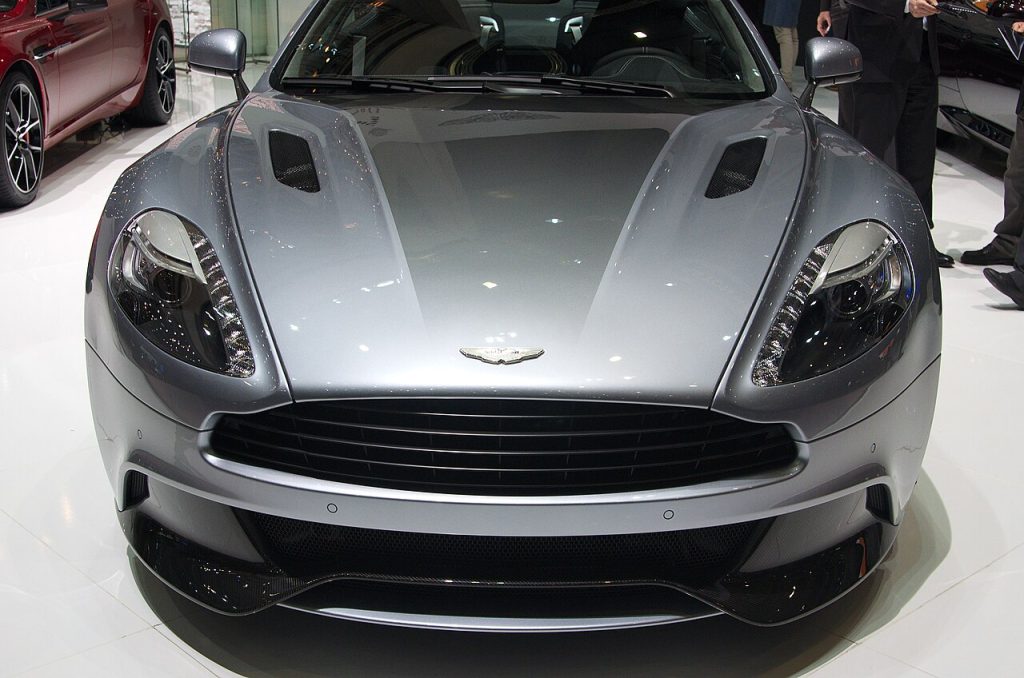
The Geneva photograph and its declared identity limit
The bundled image shows a Vanquish at Geneva in March 2013. The graduated-looking finish is visually relevant to the anniversary discussion, but the retrieved Commons description does not authenticate Centenary membership or a chassis serial. It therefore remains a clearly labelled family reference, with an exact-edition image publication hold. Photographer, source, licence and resizing disclosure are linked visibly. A better-supported replacement can refine that finding without altering the historical guide. The photograph’s event and date are useful evidence of what was shown, while original factory or edition documentation establishes the more specific identity claim.
Frequently asked questions
When was the Centenary Vanquish presented?
The specialist history places the first presentation on 15 January 2013 and the Geneva public appearance in March.
Does 100 establish the completed production total?
No. It is the announced model-line limit; a reconciled completed census is not supplied here.
Should later eight-speed figures be applied to it?
No. Period 2013 documents establish the earlier six-speed specification context.
Is the Geneva photograph independently authenticated as Centenary?
No. It is retained as a labelled family reference pending exact-edition identity evidence.
Explore related Aston Martin profiles
Sources
- Aston Martin Magazine: the 2013 Centenary programme and 100-per-model-line limit
- Tim Cottingham: Vanquish Centenary launch and original specification
- Aston Martin: second-generation Vanquish design and VH architecture
- Aston Martin 2013 Vanquish owner manual, reproduced by ManualsLib: original six-speed transmission
- Aston Martin 2013 Vanquish brochure: indexed 565 bhp specification; full PDF blocked
Historical claims follow the linked manufacturer, archive, specialist and catalogue records, with disputed findings retained. Inspection and collecting guidance is editorial analysis. Catalogue condition and custody statements remain dated to their sources.
Photography and credit
Vanquish photographed at the Geneva motor show in March 2013. Family reference pending verification of Centenary Edition identity; an authenticated licensed exact-edition image remains a publication hold. Photo: Clément Bucco-Lechat / Wikimedia Commons · CC BY-SA 3.0. Wikimedia thumbnail resized from original; no cropping or colour changes.
Why this machine matters
The Vanquish Centenary Edition led Aston Martin’s 2013 anniversary series, combining the new flagship’s carbon-fibre-bodied design with commemorative finishes and numbered details. Its 100-car limit is retained as an announced ceiling. The original six-speed car must remain distinct from later eight-speed Vanquishes and the separate 2017 Ultimate programme.
Built in limited numbers
Aston Martin’s magazine describes 100 examples for the Vanquish model line as part of the Centenary programme. This profile records that as a limit, not as an independently reconciled total of cars built and delivered. The difference is material when an edition is described as one of 100: the phrase can refer to a numbered allocation even when a complete chassis list is unavailable. A sill number supports the identity of that vehicle when the original paperwork agrees, but it does not establish every other completion. The rarity claim stays useful because the programme’s ceiling and the remaining census uncertainty are both visible.
Gallery
Specifications
Factory specifications may vary by model year, market and configuration.
Identity & production
- Official model
- Aston Martin Vanquish Centenary Edition
- Base model
- Vanquish II
Powertrain & performance
- Engine
- Original 2013 second-generation Vanquish V12; period 565 bhp reference, six-speed architecture
Sources and verification
- astonmartin.blob.core.windows.net
- astonmartins.com
- media.astonmartin.com
- www.manualslib.com
- autocatalogarchive.com