Aston Martin Coal Scuttle
Coal Scuttle is the foundational Aston Martin prototype associated with the marque’s earliest years and its 1915 registration. Its collecting importance is historical: the car is not authenticated as a presently surviving acquisition. Period photographs and records preserve its identity while its later fate remains unresolved.
Coal Scuttle is the foundational Aston Martin prototype associated with the marque’s earliest years and its 1915 registration. Its collecting importance is historical: the car is not authenticated as a presently surviving acquisition. Period photographs and records preserve its identity while its later fate remains unresolved.
Aston Martin Coal Scuttle at a glance
| Manufacturer | Aston Martin |
|---|---|
| Model / family | Aston Martin prototype |
| Profile scope | Historic prototype archive |
| Historical reference year | 1915 |
| Inventory reference | AST-001 |
| Object / count scope | One named historical prototype; survival unresolved |
| Historical engine reference | Coventry Simplex four-cylinder side-valve — historical reference |
| Displacement reference | 1389 cc; original programme reference, not current installed measurement |
Why Coal Scuttle matters to Aston Martin
A history of the marque begins with the transition from Bamford and Martin’s earlier motor-trade activity to a car carrying their own identity. Coal Scuttle belongs to that foundational stage. The nickname describes an appearance, not a marketed limited-edition specification. Its significance is therefore different from a later numbered customer model. A catalogue should explain the vehicle’s relationship to the origins of Aston Martin while preserving what the sources actually establish. A familiar founding story becomes more useful when dates, names and identification evidence can be checked rather than repeated as an undifferentiated legend.
The 1915 registration and an uncertain chassis label
The heritage account identifies the road registration as AM4656 and dates registration to 1915. Aston Martin’s specification describes A1 as a believed chassis identity, not an unqualified modern VIN. Retain that qualification when indexing the car. Development, registration and a photograph’s date can be different events, so a source image labelled with an earlier year does not automatically change the registration chronology. Early vehicles need a document-led timeline. A useful record should preserve the original wording around uncertain numbering rather than making a database field look more definite than the source.
A small four-cylinder engine in its own context
The manufacturer’s heritage entry gives a Coventry Simplex four-cylinder side-valve engine of 1,389 cc and a sporting two-seat body. These are historical reference specifications. They should not be merged with later Bamford and Martin engines or modern performance data under the same marque name. This modest technical description is sufficient to distinguish the foundational prototype from the more specialized racing cars that followed. Missing output, weight and speed fields remain blank. A clean archive can explain what is known without filling every modern specification box with estimates taken from another early Aston Martin.
Rarity: one named prototype is not a survivor count
This profile concerns one named historical vehicle. The inventory’s one-car shorthand does not establish that an authenticated example survives today, nor does it describe a retail allocation. Keep object scope separate from survival status. The missing-car account prevents the guide from presenting Coal Scuttle as a ready-to-buy collectible with an established present condition. Its archive interest remains substantial even when the material object is unlocated. Documents, photographs and an auditable identification history can carry the research record, while any future discovery would need an entirely new physical assessment.
The unresolved later fate
The specialist history reports a last road-registration trace in 1928 and describes the car as missing. Treat that as an attributed account, not proof of destruction or of survival in a particular collection. Do not invent an intervening sale, location or restoration to make the story feel complete. A gap is part of the evidence. If reliable new information appears, record who established it, which documents support it and how it connects to AM4656. This permits the archive to change responsibly without turning an appealing discovery narrative into accepted provenance before the physical and documentary links are tested.
What a rediscovery claim would need
A claimed rediscovery should be compared with original identification, construction details, period imagery, registration records and a coherent chain of custody. Specialists would need to distinguish original material, later repair and recreation. A shape resembling an old photograph is only an initial clue. Preserve the claimant’s evidence in its original form and keep unresolved findings visible. A responsible collecting description should explain precisely which historical object is being claimed. That method protects the car’s foundational meaning because authentication rests on connected evidence rather than the excitement attached to a famous missing name.
Reading photographs as historical evidence
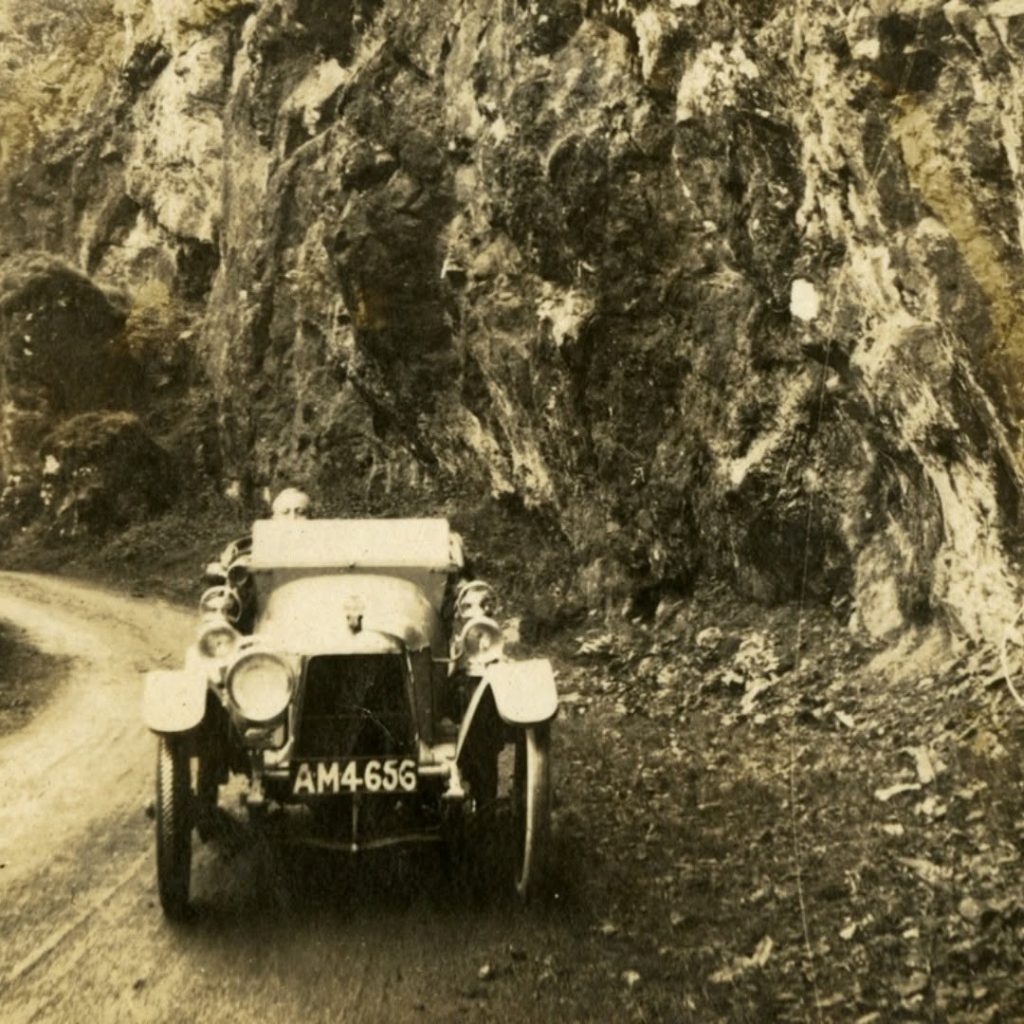
Period photographs can show body proportions, controls, wheels, people and registration markings, but each view has limits. Establish the image’s provenance and its dated context before using small details to identify a component or a modification. A modern scan can introduce contrast changes or obscure surface information. Avoid reconstructing a complete technical specification from one angle. Keep the full image alongside any annotated research copy so that a future reader can review the interpretation. For an unlocated vehicle, image handling is especially important because the photograph may be one of the principal surviving links to the object.
The supplied archival photo and its credit
The bundled image is source-identified as Coal Scuttle with AM4656 at Melfort Pass in Scotland. Commons attributes the material to the Jack Addis archive with an unknown photographer and assesses it as public domain. The caption retains that archive context without pretending that a catalogue date supplies the exact day of exposure. It is historical imagery of the subject, not a newly reconstructed vehicle. The visible source and public-domain information remain linked. This makes the photo useful to readers while preserving the difference between what the image shows and what its source metadata asserts.
Coal Scuttle compared with A3
Coal Scuttle represents the foundation story; A3 represents the oldest surviving Aston Martin identified by the Heritage Trust. Those descriptions answer different questions. The first historical subject and the oldest documented survivor should have separate records, connected by a useful link rather than combined into one car. Their physical histories and evidence differ. A reader following both guides can understand why a later prototype may be more accessible to inspection while an earlier one remains central to the marque’s beginnings. Survival does not rewrite chronology, and chronology does not establish current physical availability.
Recreation, reconstruction and original material
A recreation can communicate an early design without acquiring the identity of the original prototype. If a reconstruction is ever featured, state its maker, date, documentary basis and surviving original material separately. Do not apply Coal Scuttle’s history to a newly built object merely because the appearance is persuasive. This distinction allows museums and educators to use replicas honestly while preserving the archive’s authentication standard. For the original subject, any material claimed to survive must be documented on its own merits. A clear object description is more informative than a broad authentic label unsupported by a component history.
A research archive rather than an ownership promise
The useful collecting questions here concern identification, records and historical interpretation before they concern driving or purchase. There is no verified current condition report or established custody chain in this guide. Readers should use the linked sources to understand the scope of the history, then seek appropriate archival and specialist help for a specific claim. Missing technical and survival information stays visible. This preserves a meaningful rare-vehicle entry without offering an unsupported practical acquisition narrative. The car’s importance does not depend on inventing a market opportunity or describing mechanical systems that cannot presently be inspected.
Preserving a founding story that can be checked
Keep registration references, dated publications, image rights records and significant correspondence together. Separate contemporary evidence from later recollection, and note where two sources differ. A future editor should be able to trace an important statement to its origin rather than inherit an attractive paragraph with no supporting file. The best archive account identifies Coal Scuttle’s role and the limits of its known history. That combination gives readers a strong route into Aston Martin’s origins while leaving the missing physical object open to properly supported research.
Frequently asked questions
What is Coal Scuttle?
The foundational early Aston Martin prototype associated with registration AM4656 in 1915.
Is Coal Scuttle the oldest surviving Aston Martin?
Its later fate is unresolved. The Heritage Trust identifies A3 as the oldest surviving Aston Martin.
Is chassis A1 confirmed without qualification?
The manufacturer describes that identity as believed; the guide retains the qualification.
Is the photograph a recreation?
No. It is a source-identified archival Coal Scuttle image, with archive, photographer-status and public-domain credit.
Explore related Aston Martin profiles
Sources
- Aston Martin: Coal Scuttle heritage specification
- Tim Cottingham: Coal Scuttle chronology and missing-car account
Historical claims follow the linked manufacturer, archive, specialist and catalogue records, with disputed findings retained. Inspection and collecting guidance is editorial analysis. Catalogue condition and custody statements remain dated to their sources.
Photography and credit
Archival Coal Scuttle image showing registration AM4656, source-identified at Melfort Pass in Scotland; exact exposure date is not independently established. Photo: Unknown photographer / Jack Addis archive / Wikimedia Commons · Public domain (Commons source assessment). Original image supplied without visual changes.
Why this machine matters
Coal Scuttle is the foundational Aston Martin prototype associated with the marque’s earliest years and its 1915 registration. Its collecting importance is historical: the car is not authenticated as a presently surviving acquisition. Period photographs and records preserve its identity while its later fate remains unresolved.
Built in limited numbers
This profile concerns one named historical vehicle. The inventory’s one-car shorthand does not establish that an authenticated example survives today, nor does it describe a retail allocation. Keep object scope separate from survival status. The missing-car account prevents the guide from presenting Coal Scuttle as a ready-to-buy collectible with an established present condition. Its archive interest remains substantial even when the material object is unlocated. Documents, photographs and an auditable identification history can carry the research record, while any future discovery would need an entirely new physical assessment.
Gallery
Specifications
Factory specifications may vary by model year, market and configuration.
Identity & production
- Official model
- Aston Martin Coal Scuttle
- Base model
- Aston Martin prototype
Powertrain & performance
- Engine
- Coventry Simplex four-cylinder side-valve — historical reference