
Bentley Continental GT3-R
The Continental GT3-R is a two-seat road coupé inspired by Bentley’s return to GT racing. Announced in June 2014 with a worldwide limit of 300, it combines a 4.0-litre twin-turbo V8 with shorter gearing, reduced weight and a focused cabin. It is a distinct customer road model, separate from the Continental GT3 competition car.
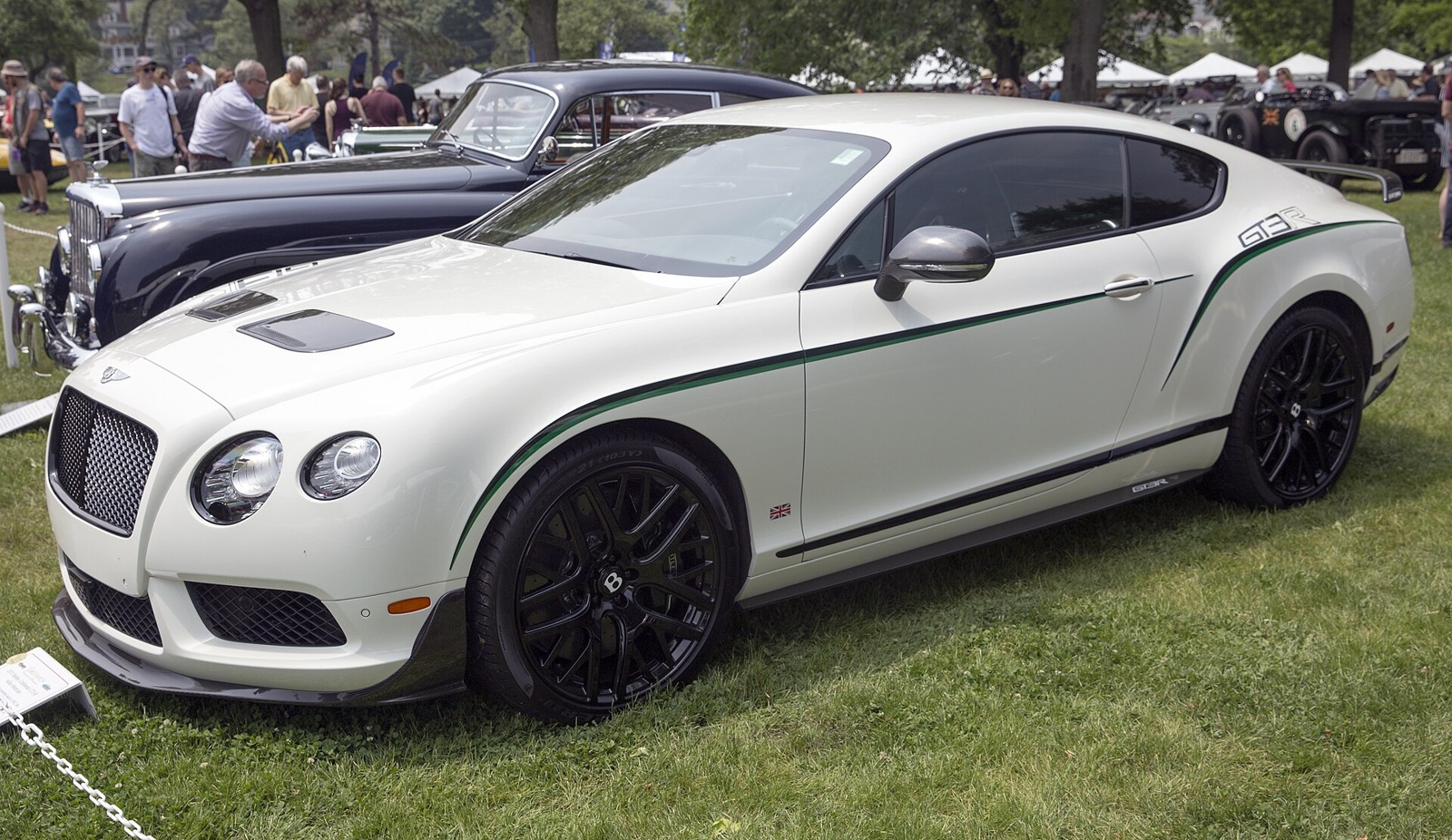
The Continental GT3-R is a two-seat road coupé inspired by Bentley’s return to GT racing. Announced in June 2014 with a worldwide limit of 300, it combines a 4.0-litre twin-turbo V8 with shorter gearing, reduced weight and a focused cabin. It is a distinct customer road model, separate from the Continental GT3 competition car.
Bentley Continental GT3-R at a glance
| Manufacturer | Bentley |
|---|---|
| Model / family | Continental GT |
| Profile scope | Limited motorsport-inspired road edition |
| Historical reference year | 2014 |
| Inventory reference | BEN-115 |
| Engine reference | 4.0-litre twin-turbocharged V8 |
| Announced edition limit | 300 — Announced worldwide road-car limit |
| Manufacturer power reference | 572 bhp; dated model reference |
A road car with a racing influence
GT3-R connects the Continental road-car family with Bentley’s contemporary racing activity. The name and appearance make that influence clear, but the customer car has a different purpose from a Continental GT3 built for competition. A useful archive keeps their identities and specifications separate. The road coupé retains a production-car setting while adopting a more focused brief. Its two-seat cabin, V8 engine and drivetrain changes are central to that brief. The profile should explain these choices directly rather than using the racing name as a substitute for describing what was actually changed on the customer model.
A June 2014 announcement and later customer cars
Bentley announced the GT3-R in June 2014 and described customer deliveries beginning later that year. Photographs and listings can identify individual cars by a 2015 model year, including the example pictured here. Those references do not require the launch to be moved to 2015. The archive uses 2014 as the introduction year and retains the photographed example’s identification in its caption. This is a helpful approach for limited programmes announced before the next model year. It keeps the manufacturer’s chronology visible while allowing each customer car to carry its own build, delivery and registration dates.
The worldwide programme was limited to 300
The manufacturer announcement restricts the road-car programme to 300 worldwide. That limit belongs to the Continental GT3-R, not to the competition GT3 or the broader V8 Continental family. This profile records it as an announced edition ceiling rather than a completed chassis census. The photographic creator’s description includes information about the individual pictured car, but it is not used to create an independently verified regional production total. Scope matters at both levels. A global edition limit explains the programme, while a car’s original build record supports its membership and particular specification within it.
The twin-turbo V8 specification
Bentley’s launch reference gives the 4.0-litre twin-turbo V8 580 PS, equivalent to the quoted 572 bhp, and 700 Nm. The two power units should remain clearly labelled rather than appearing as conflicting output figures. An eight-speed transmission and all-wheel drive complete the basic road-car reference. This is a useful example of why model specifications need their original units. Readers can compare the GT3-R with W12 Continentals more accurately when they understand the engine layout, output unit and drivetrain together. A smaller cylinder count alone does not explain the model’s purpose or the changes made around its engine.
Reduced weight and shorter gearing
The launch material describes a 100 kg reduction relative to the Continental GT V8 S and shorter gearing for the GT3-R. The comparison car matters: the weight figure should not be presented as a reduction against every Continental variant. Gearing also changes how the engine’s output reaches the road, so its role belongs alongside the power figure. These choices help explain the focused road-car brief without relying entirely on exterior graphics. For an archive record, retain the manufacturer comparison and original specification as dated references. They give the engineering story a clearer basis than a general claim that the edition was simply lighter and faster.
Two seats make the cabin part of the brief
The GT3-R removes the rear seating to create a two-seat interior. That is an important difference from more accommodation-focused Continentals. Photograph the space behind the front seats as well as the dashboard and seat trim, because the cabin layout explains one of the model’s defining choices. The reduced seating capacity is not just a decorative edition feature. It changes the way the car can be used and reflects the more concentrated road-driving brief. A complete profile should therefore give the interior configuration the same prominence as the racing-inspired exterior treatment and mechanical specification.
An exact GT3-R photograph with documented rights
The credited Commons photograph identifies a 2015 Continental GT3-R at Greenwich in 2019. Its source shows the actual road edition, with the characteristic exterior treatment visible in the image. The creator’s licence and attribution accompany the photo in the profile. This gives readers a traceable illustration rather than a racing GT3 photograph used as a stand-in. The caption also separates the vehicle’s model-year description from the later photographic event. That precision is useful in a long-lived archive, where images can otherwise lose their original context as they are reused across model and edition pages.
Why GT3-R deserves its own profile
GT3-R is worth separating from ordinary Continental GT V8 entries because its announced programme and coordinated changes establish a specific identity. The engine reference, gearing, weight comparison and two-seat cabin tell a coherent story. Compared with Diamond Series, it places greater emphasis on a focused road-car configuration; compared with ISR, it draws its theme from racing rather than a record event. These connections make the archive easier to explore. They also show why edition names should be attached to documented programmes and specifications, allowing each car’s purpose to remain clear instead of reducing every special Continental to a badge and a production limit.
Frequently asked questions
Is the GT3-R a competition GT3?
No. It is a customer road coupé inspired by racing, with its own production specification.
What was the announced limit?
300 road cars worldwide. A completed chassis census is not claimed.
Why do sources quote 580 and 572 for power?
The launch release gives 580 PS and 572 bhp: different units for the quoted output.
How many seats does it have?
Two. The rear seating was removed as part of the GT3-R’s focused road-car configuration.
Explore related vehicle profiles
- Bentley Continental GT Diamond Series
- Bentley Continental Supersports Convertible ISR
- Bentley R-Type Continental — H.J. Mulliner Fastback
Sources
- Bentley’s June 2014 GT3-R launch announcement reproduced by British Built Cars
- Bentley’s complete GT3-R launch release reproduced by Winding Road
Facts are sourced to the linked manufacturer, institutional and specialist records. Design comparisons and documentation suggestions are editorial analysis. Announced limits and completed production populations are labelled separately.
Photography and credit
2015 Continental GT3-R photographed at the 2019 Greenwich Concours d’Elegance; an authentic road-going GT3-R, not the competition GT3. Photo: Mr.choppers / Wikimedia Commons · CC BY-SA 3.0. Resized and JPEG encoded without cropping or content changes. Retain author attribution, a link to the source and license, and the stated changes. Where ShareAlike applies, redistributed adaptations retain the same license.
Why this machine matters
The Continental GT3-R is a two-seat road coupé inspired by Bentley’s return to GT racing. Announced in June 2014 with a worldwide limit of 300, it combines a 4.0-litre twin-turbo V8 with shorter gearing, reduced weight and a focused cabin. It is a distinct customer road model, separate from the Continental GT3 competition car.
Built in limited numbers
2014 launch distinguished from photographed 2015 model-year example. 300 worldwide announced limit. Regional numbered-car inscription not converted to verified regional census. Road GT3-R distinguished from competition GT3.
Gallery
Specifications
Factory specifications may vary by model year, market and configuration.
Identity & production
- Official model
- Bentley Continental GT3-R
- Base model
- Continental GT
Powertrain & performance
- Engine
- 4.0-litre twin-turbocharged V8
.jpg)