Aston Martin Vanquish S Red Arrows Edition
The Vanquish S Red Arrows Edition translated the Royal Air Force aerobatic team’s visual language into a ten-car Aston Martin Cambridge commission. Nine cars were sold to customers and Red 10 was raffled for the RAF Benevolent Fund. Its aviation details, dedicated accessories and documented charity story give the edition an identity beyond a red Vanquish S paint scheme.
The Vanquish S Red Arrows Edition translated the Royal Air Force aerobatic team’s visual language into a ten-car Aston Martin Cambridge commission. Nine cars were sold to customers and Red 10 was raffled for the RAF Benevolent Fund. Its aviation details, dedicated accessories and documented charity story give the edition an identity beyond a red Vanquish S paint scheme.
Aston Martin Vanquish S Red Arrows Edition at a glance
| Manufacturer | Aston Martin |
|---|---|
| Model / family | Vanquish |
| Profile scope | Historic road-model archive |
| Historical reference year | 2017 |
| Inventory reference | AST-136 |
| Original series total | 10 — Complete Vanquish S Red Arrows Edition commission, including Red 10 charity car |
| Historical engine reference | Naturally aspirated V12; Cambridge brochure 595 bhp reference |
A Cambridge commission with an aviation purpose
The factory’s April 2017 account identifies Aston Martin Cambridge as the commissioner and Q as the team responsible for the special edition. The Red Arrows connection gave the project a defined subject, reflected across body, cabin and accompanying material. That helps distinguish a documented factory commission from an ordinary car wearing similar colors. The collecting interest is the coherent project and its provenance, not simply a visual resemblance to an aircraft. A complete vehicle record should retain the original commissioned identity alongside any later changes in paint, trim or equipment.
Rarity: ten completed cars, not nine plus a retained car
Aston Martin’s 2019 retrospective states that ten Red Arrows cars were produced. Nine were sold to customers, and Red 10 was raffled, raising £1.46 million for the RAF Benevolent Fund. That resolves the inventory’s retained-car wording: the tenth example followed a charity route rather than remaining a retained factory car in the cited account. The completed edition count is ten, with the nine-car customer subset explained separately. These are different allocation histories within the same commission, not separate production populations to add together or use as competing worldwide totals.
The April 2017 introduction
The period brochure identifies a public launch on April 9 at the St Athan handover event, while the factory article was posted the following day. That is a useful example of an event date differing from a webpage date without creating a contradiction. The programme’s reference year remains 2017. Later retrospective language supplies information about completed production and the charity outcome, rather than moving the launch into 2019. A chassis-specific archive should add its own completion and handover dates when documented, keeping those details distinct from the wider project’s public introduction.
Vanquish S mechanics beneath the commissioned details
The Cambridge brochure identifies a 2017-model-year Vanquish S coupe as the base, with a 595 bhp V12 reference and eight-speed Touchtronic III. That places the commission within the later Vanquish S technical context, not the earlier six-speed Vanquish specification. The aviation treatment should not be used to invent an additional engine upgrade. Preserve the mechanical reference as the period programme specification, then establish the condition and retained configuration of any individual car through its service documents. The story becomes clearer when edition design and base-car mechanics are described as related but different layers.
Eclat Red and the smoke-trail theme
The factory account names Eclat Red and describes white and blue details recalling the team’s visual identity. These choices make the car recognizable, but the original color and graphics should still be checked against the individual build record. Repainting or replacing a marked part can change what survives without changing the documented origin. A useful preservation account would identify original material and later renewal separately. That gives a curator or buyer a more meaningful description than either assuming every red panel is untouched or dismissing the entire vehicle because some finish has been repaired.
Aircraft references inside the cabin
The factory describes green inserts, formation embroidery and aviation-inspired controls, while its later retrospective confirms switchgear incorporating material from a Hawk undercarriage leg. The significance of such details lies in their documented relationship to the commission. A loose component or similar fabric cannot authenticate a different car. When recording the cabin, compare retained details with the original build book and early images, noting any replacements. The theme works as a whole, so an archive benefits from views of the controls, seats and rear environment as well as an overall exterior photograph.
Pilot and aircraft identifiers need direct evidence
The period brochure describes edition-specific plaques and identifying details associated with the team. That makes a particular car’s numbering worth documenting carefully. A registration plate is not sufficient evidence to assign it a Red pilot number or the original charity identity. Use the appropriate original plaque, build file and handover record, retaining clear photographs of the identifiers. For a ten-car programme, it may be tempting to fill every identity from memory or a sale title, but a dependable record should distinguish a supported assignment from an appealing guess.
Accessories are part of the provenance trail
The factory announcement describes items such as helmets, luggage, models and a build book associated with the project. A collector should inventory what accompanies the actual car and document how those items relate to it. The absence of an accessory is a different question from the authenticity of the vehicle, and a loose presentation item does not establish edition membership elsewhere. Retain labels, photographs and original documentation where available. A complete accessory record can enrich the story of the commission while avoiding the assumption that every advertised package is still complete or entirely original.
Red 10 and the charity outcome
The charity history is an important part of the edition’s public significance. The factory retrospective records the raffle and fundraising result, giving the tenth car a distinct original allocation route within the same completed series. That outcome should be kept as a dated historical fact, not a claim that any red example photographed today is Red 10. Current ownership and condition would need separate evidence. This distinction lets the profile explain the charitable purpose fully without assigning private-car details that have not been retrieved or mistaking a fundraising vehicle for an additional example outside the edition.
Comparison with Spitfire 80 and Blades
The Spitfire 80 and Blades profiles explain the other Cambridge aviation commissions that the factory connects with this project. Together they show how a dealer-led idea could produce different bounded subjects within Q’s work. The themes and completed counts remain attached to their own editions. A collector interested in the group can compare the original design brief, documentation and accompanying material rather than viewing them as interchangeable aircraft-liveried cars. The Red Arrows story adds a particularly clear charity allocation, while each related profile retains its separate mechanical and historical context.
Inspection should follow the complete car
An assessment should establish factory edition identity and then review the actual Vanquish S: servicing, brakes, tires, cooling, transmission operation, carbon panels and retained cabin details. These are inspection priorities, not assertions that all ten cars share a defect. The dedicated finish, identifiers and accessories deserve their own condition record alongside the mechanical report. Document later repairs and changes so the next custodian can see what survived from the commission. A rare themed car is still an individual used or stored vehicle, and the quality of its history matters beyond the small production number.
The photograph is credited without a numbering assumption
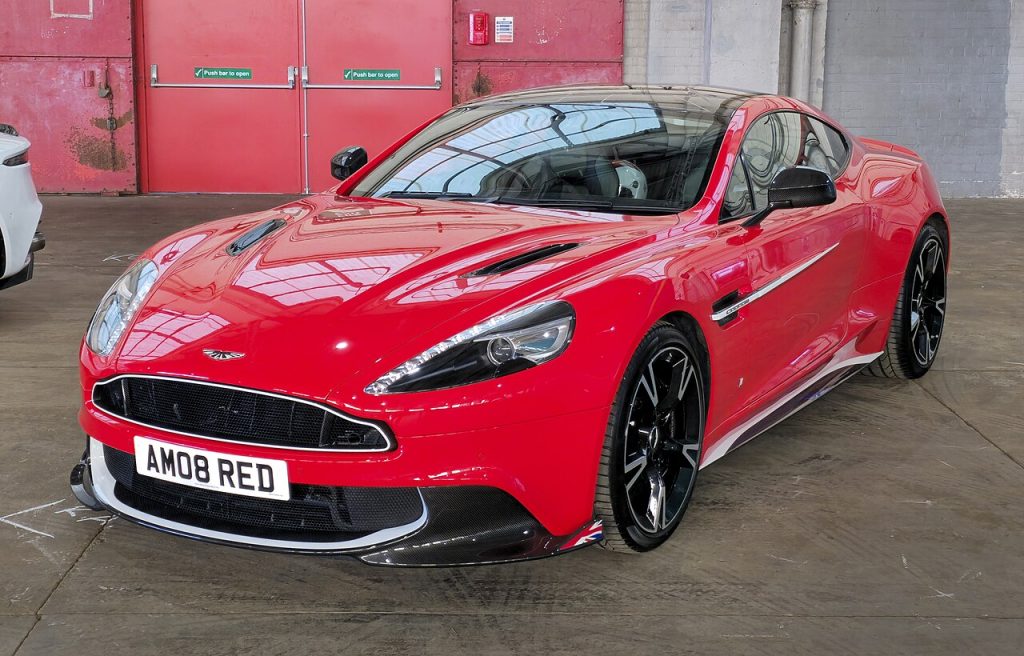
The bundled Commons image identifies a Vanquish S Red Arrows Edition photographed in April 2025. Its red finish and exterior details illustrate the subject, while the caption explicitly avoids using the visible registration to assign a pilot number, charity identity or current owner. Linked photographer, source and license details accompany the file. That gives the profile a real subject photograph with a traceable credit, without turning the picture into proof of unseen original documents. More detailed identifying views could supplement it later if they come with reliable source evidence and appropriate reuse permission.
Frequently asked questions
How many Red Arrows Edition cars were produced?
The factory retrospective confirms ten. Nine were sold to customers and Red 10 followed the charity raffle route.
Was the tenth car retained by Aston Martin?
The cited factory account says Red 10 was raffled for the RAF Benevolent Fund. The inventory’s retained-car wording is corrected.
What base car was used?
The Cambridge brochure identifies the 2017-model-year Vanquish S coupe with eight-speed Touchtronic III and a period 595 bhp V12 reference.
Does the photograph identify Red 10?
No such assignment is made. A registration or exterior view alone does not establish the original numbered-car identity.
Explore related Aston Martin profiles
- Aston Martin V12 Vantage S Spitfire 80 Edition
- Aston Martin V8 Vantage S Blades Edition
- Aston Martin Vanquish S Ultimate Coupe
Sources
- Aston Martin April 2017: Cambridge Red Arrows commission, design, accessories and charity allocation
- Aston Martin November 2019: ten Red Arrows cars completed and Red 10 charity raffle retrospective
- Aston Martin Cambridge Red Arrows brochure: edition design and Vanquish S technical reference
Historical claims follow the linked manufacturer, archive, specialist and catalogue records, with disputed findings retained. Inspection and collecting guidance is editorial analysis. Catalogue condition and custody statements remain dated to their sources.
Photography and credit
Source-identified Vanquish S Red Arrows Edition photographed in April 2025. The visible plate is not used to assign a Red pilot number, original charity identity or present owner. Photo: Calreyn88 / Wikimedia Commons · CC BY-SA 4.0. Wikimedia thumbnail resized from original; no cropping or colour changes.
Why this machine matters
The Vanquish S Red Arrows Edition translated the Royal Air Force aerobatic team’s visual language into a ten-car Aston Martin Cambridge commission. Nine cars were sold to customers and Red 10 was raffled for the RAF Benevolent Fund. Its aviation details, dedicated accessories and documented charity story give the edition an identity beyond a red Vanquish S paint scheme.
Built in limited numbers
Aston Martin’s 2019 retrospective states that ten Red Arrows cars were produced. Nine were sold to customers, and Red 10 was raffled, raising £1.46 million for the RAF Benevolent Fund. That resolves the inventory’s retained-car wording: the tenth example followed a charity route rather than remaining a retained factory car in the cited account. The completed edition count is ten, with the nine-car customer subset explained separately. These are different allocation histories within the same commission, not separate production populations to add together or use as competing worldwide totals.
Gallery
Specifications
Factory specifications may vary by model year, market and configuration.
Identity & production
- Official model
- Aston Martin Vanquish S Red Arrows Edition
- Base model
- Vanquish
- Worldwide production
- 10
Powertrain & performance
- Engine
- Naturally aspirated V12; Cambridge brochure 595 bhp reference