2015 Porsche Mission E — Original Electric Concept
Explore the Mission E — Original Electric Concept: history, verified identity, specification references, rarity evidence and real credited photos.
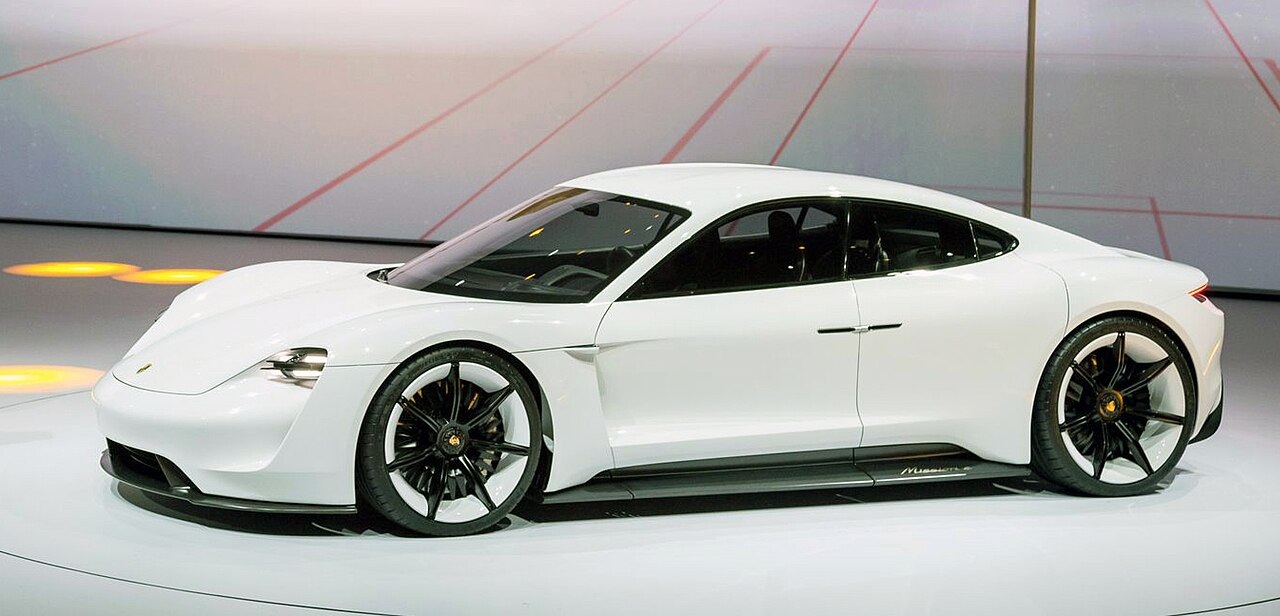
Porsche’s Mission E appeared at the 2015 Frankfurt show as a physical proposal for a four-door electric sports car. Its announced 800-volt architecture and rapid-charging ambitions made the engineering direction as important as the show-car shape. This Archive record follows the original concept, keeping its stated development targets separate from later production Taycan specifications. A real exhibition photograph illustrates the concept without treating a display object as a customer-delivered road vehicle.
An electric concept with a sports-car brief
The manufacturer’s 2015 presentation positioned Mission E as a four-door electric sports-car study. The physical concept combined a practical body format with proportions and details intended to connect it with Porsche’s existing design language. This is editorial interpretation of the visual proposition, not proof of a production decision or a completed market specification. The original concept deserves its own identity because its purpose, date and engineering targets differ from those of its later production successor.
Porsche: Mission E concept and engineering targets
Why 800 volts mattered in the proposal
Porsche’s announcement emphasised an 800-volt electrical architecture and the relationship between voltage, charging and performance. Those statements describe the proposed technical direction at the time of the concept reveal. They should not be presented as a test certificate for the photographed display car or as a guarantee of charging behaviour on every later production vehicle. When discussing electrical performance, retain the programme, date and source rather than borrowing figures from a newer Taycan variant.
Targets are different from certified outcomes
The launch material discussed more than 600 PS, a range exceeding 500 kilometres and an approximately fifteen-minute charging ambition to reach 80 percent. These were concept-era statements made in their contemporary testing and development context. The range is not a present-day WLTP result, and the charging description is not a universal real-world guarantee. This profile treats them as historical targets and leaves current consumer comparisons to production-model sources with the relevant test standard.
Porsche: Mission E concept and engineering targets
The physical design and exhibition record
The selected real photograph shows the Mission E concept in a physical-car display. Its value is to ground the design in an actual displayed object, while the source caption retains the setting. Exhibition appearances can document public reception and preservation without establishing additional builds. They also do not show whether every internal system operated exactly as the launch proposal described. Keep physical identity, announced engineering and later display condition as related but distinct layers of the record.
Porsche: Frankfurt 2015 presentation context
An Archive boundary for future updates
Concept images, production Taycans, digital illustrations and scale models should not be interchanged. Add future evidence through dated factory captions or collection records, preserving the original Mission E programme reference. No exclusive construction census is inferred from a single photograph or an exhibition description. This approach allows the page to explain an important electric-vehicle development milestone while avoiding unsupported customer-production totals, current technical certifications or claims that the display object is itself a road-homologated production car.
Specifications and identity reference
| Public debut | Frankfurt IAA, 2015 |
|---|---|
| Format | Four-door electric sports-car concept |
| Architecture announced | 800 volts |
| Concept output target | More than 600 PS |
| Concept range statement | More than 500 km; contemporary concept context |
| Charging ambition | Approximately 15 minutes to 80%; concept statement |
| Count category | Archive; not a customer series |
| Separate identity | Production Taycan |
Rarity and production scope
Verified physical 2015 Mission E concept programme. Performance, range and charging statements are historical concept targets, not present-day certified production results. No exclusive concept-build census or customer-production total is established.
This is an Archive record. Concepts, restored heritage vehicles, works cars and competition programmes are not added to customer road-production totals. A programme profile does not establish how many physical chassis were made, and repeated exhibition appearances do not create additional vehicles.
What the photograph represents
The physical Porsche Mission E concept photographed as a design-programme illustration. It is distinct from a production Taycan; the image does not establish a performance, range or charging test.
Related Porsche heritage profiles
- 2010 Porsche 918 Spyder — Original Geneva Concept
- 2013 Porsche 918 Spyder — Production Hybrid Supercar
Frequently asked questions
Is the concept’s range a current WLTP rating?
No. It is a historical concept statement in its contemporary development context.
Is a later Taycan photograph interchangeable?
No. The original physical Mission E is a separate subject.
What is the production-count boundary for this profile?
Verified physical 2015 Mission E concept programme. Performance, range and charging statements are historical concept targets, not present-day certified production results. No exclusive concept-build census or customer-production total is established.
Sources and further reading
Research checked 17 October 2026. Linked factory announcements and heritage records support the specifically attributed claims. Photographic descriptions identify the illustrated subject. Design analysis and suggested authentication steps are editorial interpretation.
Built in limited numbers
Verified physical 2015 Mission E concept programme. Performance, range and charging statements are historical concept targets, not present-day certified production results. No exclusive concept-build census or customer-production total is established.
Gallery
Specifications
Factory specifications may vary by model year, market and configuration.
Identity & production
- Official model
- Porsche Mission E — Original Electric Concept
Sources and verification
Source citations are being prepared for this profile.