2015 Porsche Boxster Bergspyder — 981 Prototype
Explore the Boxster Bergspyder — 981 Prototype: history, verified identity, specification references, rarity evidence and real credited photos.
Porsche’s Boxster Bergspyder transformed the 981 roadster into a single-seat lightweight feasibility car, recalling the 1968 909 hill-climb prototype. The manufacturer’s detailed history says the commission was issued in 2015 and records its public presentation at the 2019 Gaisberg event. This profile uses that development reference while preserving the later reveal date. It is a documented physical prototype, with no customer series or saleable production allocation inferred from its one-seat design.
A lightweight brief, not a customer option
Porsche’s historical account describes a feasibility exercise commissioned in 2015 to investigate a particularly light 981-based sports car. It was not an ordinary Boxster equipped with a published single-seat option package. The project’s public appearance came later, at the 2019 Gaisberg event. Keep commission, development and reveal dates distinct; a later exhibition year does not necessarily identify the start of the engineering work or turn the prototype into a newly launched production model.
Porsche: detailed Bergspyder development and 2015 commission
One driving position and a radically open cockpit
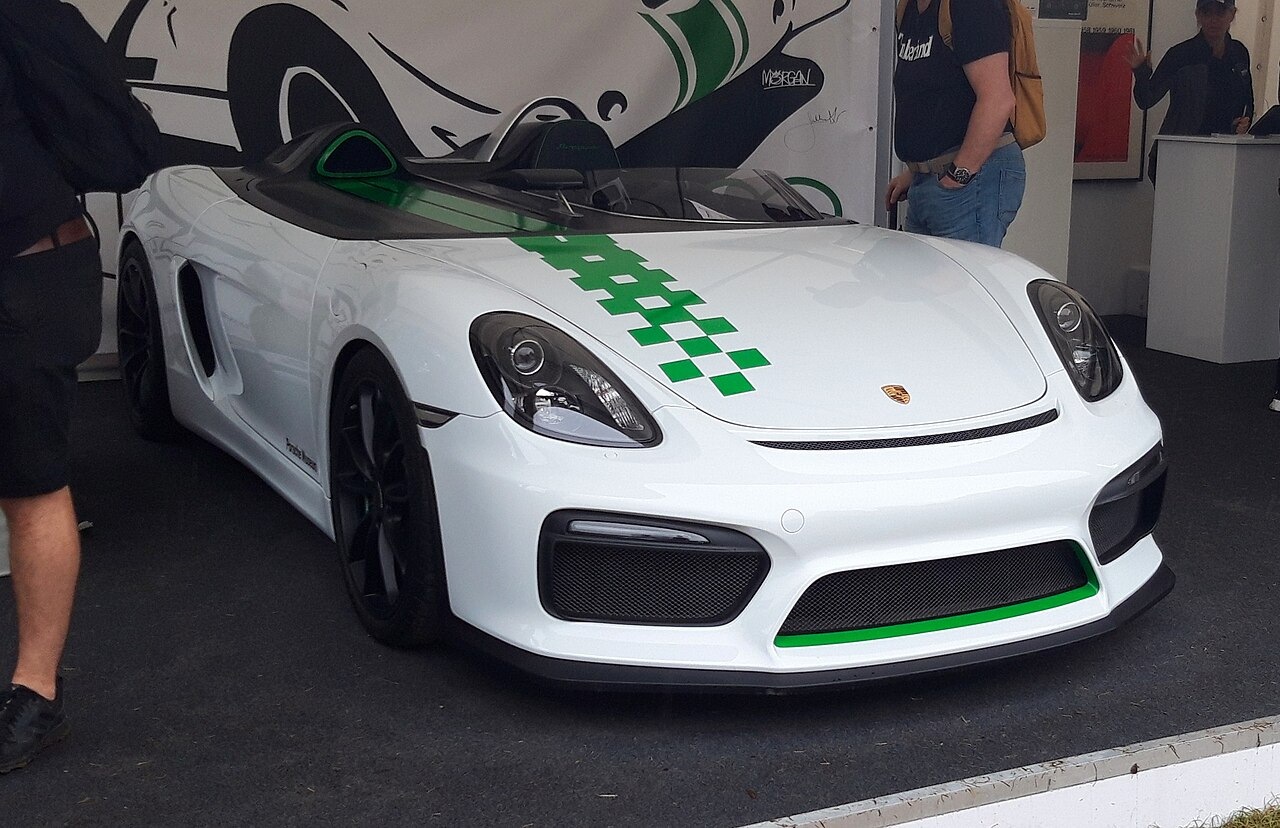
The Bergspyder removed the familiar passenger accommodation and full weather-protection arrangement. The unused side of the cockpit became part of the car’s storage solution, while the driver sat behind a small screen. These details explain why the car is visually distinct from a Boxster Spyder road model. They also make the photograph a valuable identification reference. The image illustrates the prototype’s later appearance, without independently verifying every internal lightweight measure described in the factory history.
The mass and engine references
Porsche’s detailed account gives a 1,130 kg weight reference and describes a 3.8-litre six-cylinder engine. Those figures belong to the feasibility vehicle’s documented configuration, not to every 981 or to a new measurement of the exhibited car. The editorial significance is the attempt to reduce mass and passenger equipment around a recognisable mid-engine roadster foundation. A present-day technical inspection would still need its own equipment, fluid and measurement conditions.
Porsche: detailed Bergspyder development and 2015 commission
The 909 connection without a shared identity
The Bergspyder name and stripped presentation refer back to the original 909 hill-climb experiment. They do not make the 981 prototype another 1968 competition chassis or transfer the older programme’s race record to it. This distinction keeps the heritage connection meaningful. The later car belongs to a separate engineering project, with a different chassis family and development context, even where exhibition material places the two vehicles together to explain the design inspiration.
Porsche: Gaisberg public presentation and 909 context
Keeping a prototype out of retail totals
The factory account describes the barriers to taking such a vehicle into series production. No customer programme is established by its appearance at a public event. An Archive record should therefore preserve the physical prototype, its commission history and later displays without creating a road-production allocation. For future updates, retain dated factory captions and any documented configuration changes. Repeated appearances of the same object do not establish additional builds or an exclusive all-development chassis census.
Specifications and identity reference
| Development reference | Commission issued in 2015 in detailed factory account |
|---|---|
| Public presentation | Gaisberg, 2019 |
| Base family | 981 Boxster |
| Layout | Single-seat lightweight feasibility car |
| Engine reference | 3.8-litre six-cylinder |
| Factory weight reference | 1,130 kg |
| Historical inspiration | 1968 Porsche 909 Bergspyder |
| Production status | Prototype; no customer series established |
Rarity and production scope
Verified physical 981 Boxster Bergspyder feasibility project. The detailed Porsche account dates its commission to 2015 and public presentation to 2019. Other design-history labels may use an earlier design reference; no exclusive all-development census or customer-production total is assigned.
This is an Archive record. Concepts, restored heritage vehicles, works cars and competition programmes are not added to customer road-production totals. A programme profile does not establish how many physical chassis were made, and repeated exhibition appearances do not create additional vehicles.
What the photograph represents
The 981 Boxster Bergspyder photographed at the 2019 Festival of Speed. A later appearance of the physical feasibility prototype, not a customer road model or a new weight measurement.
Related Porsche heritage profiles
Frequently asked questions
Was this a single-seat Boxster available to order?
The cited history describes a feasibility prototype rather than a customer series.
Why are 2015 and 2019 both used?
They refer to the commission and later public presentation, respectively.
What is the production-count boundary for this profile?
Verified physical 981 Boxster Bergspyder feasibility project. The detailed Porsche account dates its commission to 2015 and public presentation to 2019. Other design-history labels may use an earlier design reference; no exclusive all-development census or customer-production total is assigned.
Sources and further reading
- Porsche: detailed Bergspyder development and 2015 commission
- Porsche: Gaisberg public presentation and 909 context
Research checked 17 October 2026. Linked factory announcements and heritage records support the specifically attributed claims. Photographic descriptions identify the illustrated subject. Design analysis and suggested authentication steps are editorial interpretation.
Built in limited numbers
Verified physical 981 Boxster Bergspyder feasibility project. The detailed Porsche account dates its commission to 2015 and public presentation to 2019. Other design-history labels may use an earlier design reference; no exclusive all-development census or customer-production total is assigned.
Gallery
Specifications
Factory specifications may vary by model year, market and configuration.
Identity & production
- Official model
- Porsche Boxster Bergspyder — 981 Prototype
Sources and verification
Source citations are being prepared for this profile.