2013 Subaru BRZ tS
Explore the Subaru BRZ tS: history, verified identity, specification references, rarity evidence and real credited photos.
The first Japanese BRZ tS developed the rear-drive coupe through chassis, braking and response rather than an added turbocharger. STI’s 2013 programme reference is 500 cars, with equipment choices kept within the same complete-model family.
The 2013 Japanese programme is the specific subject
The heritage record identifies this first BRZ tS as a Japanese complete-car programme. Later BRZ tS models in other years or markets need separate records and should not inherit its 500 reference. A familiar model name can be reused across substantially different specifications. The profile therefore keeps year, market and generation together, providing a clearer identity than an undated label such as STI BRZ.
STI: 2013 Japanese BRZ tS heritage and specification
The original engine remains naturally aspirated
STI’s specification gives a 1,998 cc FA20 at 147 kW or 200 PS. This is a useful correction to the assumption that every STI-associated BRZ must be turbocharged. A later turbo conversion changes an individual car’s mechanical specification but does not rewrite what the original programme offered. Keep the factory engine reference, any modifications and current measured output in separate fields so the history remains clear.
The project focuses attention on chassis response
The heritage description names dedicated dampers, springs, flexible components and rear suspension links. As analysis, this makes tS a study in how a relatively light coupe responds to the driver, rather than simply a pursuit of a larger peak-power number. The specification should be read as a coordinated package. A normal BRZ fitted with one or two similar components does not automatically become a factory tS complete car.
STI: 2013 Japanese BRZ tS heritage and specification
Transmission and package choices stay inside the family
STI lists manual and automatic versions, with separate reference weights and GT Package distinctions. Those are specification branches within the programme rather than independent 500-car runs. An individual file should establish its original transmission and package before equipment comparisons are made. A large rear wing, special brakes or wheels can be changed later, so visible parts should support the original documentation rather than replace it.
STI: 2013 Japanese BRZ tS heritage and specification
The event photograph needs an honest scope
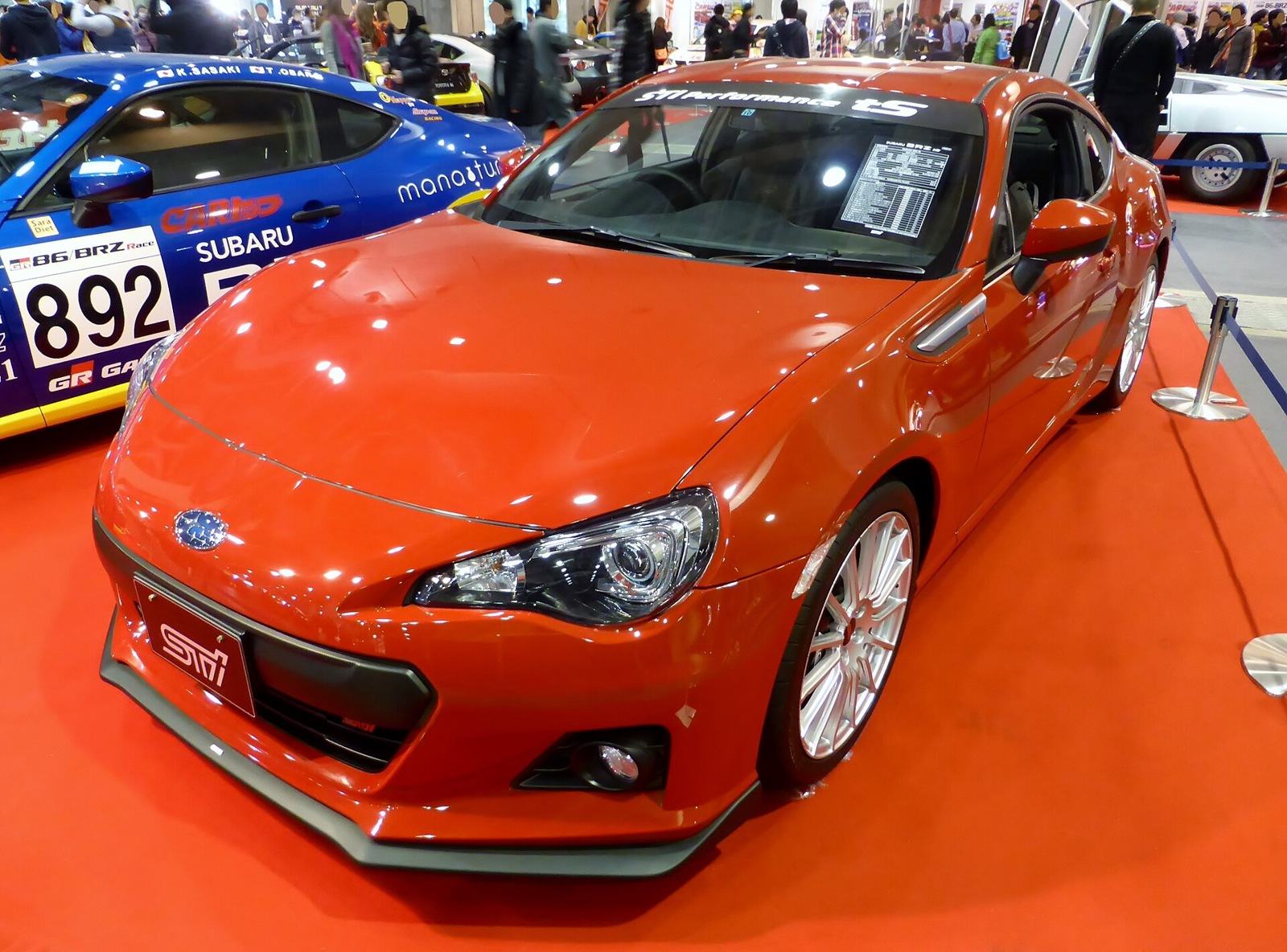
The included photograph is catalogued as a BRZ tS at Osaka Auto Messe 2014. It shows a customised event presentation, including orange paint and white wheels, and is not presented as proof of the factory-delivered 2013 colour and wheel specification. This qualification preserves a real model illustration without assigning every visible detail to the road-car brochure. A collector file still needs the original complete-car record and vehicle-specific evidence of its delivered form.
Specifications and identity reference
| STI heritage reference | 2013, Japan |
|---|---|
| Base family | First-generation BRZ ZC6 |
| Engine | FA20; 1,998 cc naturally aspirated boxer |
| Factory output | 147 kW / 200 PS |
| Transmissions | Six-speed manual or six-speed automatic |
| Shared programme reference | 500 units; package choices within the family |
Rarity and production scope
STI gives 500 for the 2013 Japanese BRZ tS programme. The figure is shared across its transmission and package choices rather than repeated for each. It is separate from later tS releases. The image is a catalogue-identified tS in a customised 2014 event presentation, not a claim that its orange finish and white wheels reproduce the standard delivered specification. No new completion or survivor census is claimed.
What the photograph represents
The photographer identifies this as a BRZ tS at Osaka Auto Messe 2014. The customised orange finish and white wheels are event-presentation details, not proof of the standard factory-delivered 2013 tS specification.
Related Subaru profiles
Frequently asked questions
Was the first BRZ tS turbocharged?
STI’s factory specification lists the naturally aspirated FA20 at 147 kW or 200 PS.
Does the orange show-car photo establish a standard factory colour?
No. The event presentation is explicitly qualified; the original brochure governs the delivered specification.
What is the production-count boundary for this profile?
STI gives 500 for the 2013 Japanese BRZ tS programme. The figure is shared across its transmission and package choices rather than repeated for each. It is separate from later tS releases. The image is a catalogue-identified tS in a customised 2014 event presentation, not a claim that its orange finish and white wheels reproduce the standard delivered specification. No new completion or survivor census is claimed.
Sources and further reading
Research checked 19 October 2026. Linked manufacturer heritage pages, factory announcements, official distributor publications and labelled contemporary coverage support the specifically identified claims. Photographic descriptions identify the illustrated subject. Design analysis and suggested authentication steps are editorial interpretation.
Built in limited numbers
STI gives 500 for the 2013 Japanese BRZ tS programme. The figure is shared across its transmission and package choices rather than repeated for each. It is separate from later tS releases. The image is a catalogue-identified tS in a customised 2014 event presentation, not a claim that its orange finish and white wheels reproduce the standard delivered specification. No new completion or survivor census is claimed.
Gallery
Specifications
Factory specifications may vary by model year, market and configuration.
Identity & production
- Official model
- Subaru BRZ tS
Sources and verification
Source citations are being prepared for this profile.