2009 Hyundai ix-Metro HND-5 Concept
Hyundai ix-Metro HND-5: 2009 urban hybrid concept history, faceted design, verified physical identity and a licensed, credited Frankfurt photo.
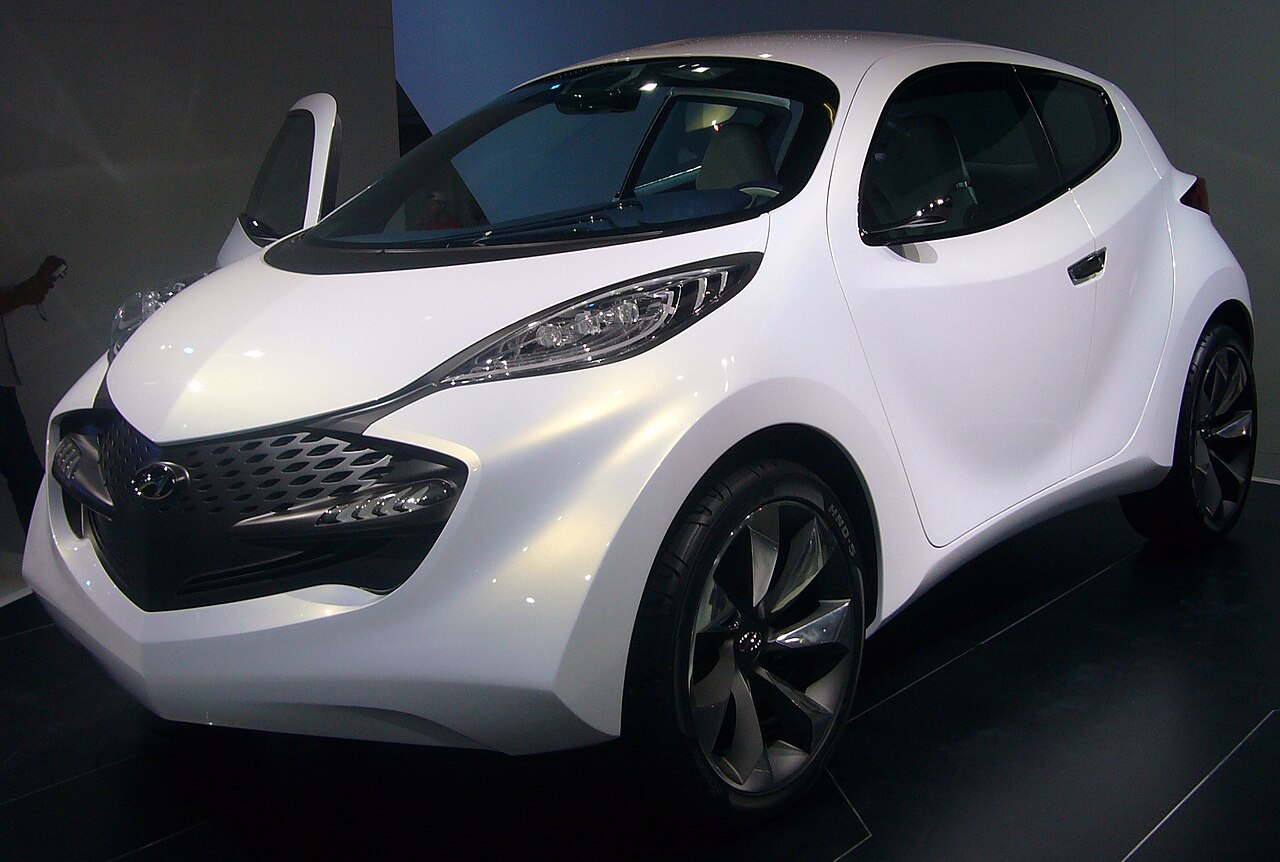
The 2009 Hyundai ix-Metro HND-5 Concept gives the small urban crossover a deliberately faceted, space-inspired character. Its physical show-car identity and hybrid brief make it a distinctive archive entry, rather than an ordinary production hatchback presented as a rarity.
Origins and the correct historical identity
Hyundai’s archive describes ix-Metro as the fifth Namyang concept, aimed at the sub-B urban crossover segment in 2009. The manufacturer identifies a hybrid brief and a space-travel theme, expressed through faceted surfaces, triangular lighting and a high beltline. The selected programme text does not establish an unambiguous installed engine output or transmission, so those fields remain unresolved rather than inferred from another small Hyundai.
Design: what makes ix-Metro HND-5 Concept distinctive
The white physical body uses angular surface changes to give a small vehicle a more assertive presence. In the supplied front-quarter view, the glazing and beltline create a distinct upper cabin, while the wheels and fenders give the lower body visual weight. As an editorial interpretation, the spacecraft theme works through geometry rather than literal imitation. The design asks how a compact urban vehicle can appear adventurous without relying on the size and proportions of a much larger SUV.
Engineering and the concept brief
An urban hybrid brief brings packaging and efficiency into the same limited footprint. Occupant access, luggage space and the propulsion system all compete for room, while a high beltline can affect the perception of visibility. Those are questions to investigate through cabin photographs and a period technical sheet. The current exterior image establishes the physical design, not a measured turning circle or a combined output. The profile therefore keeps the known architecture broad and the numerical engineering fields precise about what is missing.
Why this Hyundai belongs in the design archive
ix-Metro is useful in a collection because it records a strong alternative to smooth, flowing concept surfaces. The faceted design can be compared with other Hyundai studies as a visual experiment, provided the comparison is labelled as interpretation. Its appeal does not depend on pretending that an ix20 or i20 production car is the same subject. The concept gives the archive a concrete example of how designers can use a small body to explore a very different emotional and visual brief.
Recognising and documenting the physical subject
The supplied source identifies ix-Metro at Frankfurt in September 2009. The body and lighting configuration match Hyundai’s programme description. A future image set should include the side and rear, where the triangular theme can be compared across the whole vehicle. Cabin and display-label views would help document the urban-use brief. The model’s alternate i-Metro archive spelling is a naming variation within this record, not a reason to create another profile.
How to read the hybrid specifications
A hybrid description needs more detail than the presence of an engine and an electric motor. The route by which energy reaches the wheels determines whether an engine is a traction source, a generator, or both. Motor and combustion-engine ratings therefore cannot simply be added to create a combined output. The specification table keeps the documented concept architecture and any explicitly supported ratings separate. Values that were announced as design proposals retain that context; values not established for this particular show object remain unfilled.
For the collector, the practical value is a clear account of the idea the concept was built to communicate. Its body, passenger arrangement and display technology may have been as central to that idea as the propulsion system. To document it well, record the programme’s original explanation alongside dated photographs of the physical object. A later production hybrid can be a useful comparison, but its service information, homologated consumption or battery specification belongs to its own vehicle record. Shared vocabulary does not establish shared hardware.
Collector significance and future research
The value of a concept archive lies in preserving the relationship between an idea, the people who developed it and the object that made it visible. A strong collection record keeps the original name, reference year, credited photographs and source links attached to that relationship. If new photographs or factory documents emerge, they can add a show appearance, a construction detail or a later change without replacing the original identity. This is particularly useful for a car whose published pictures may span several exhibitions and whose name may have acquired different spellings.
The complete fabrication tally remains unknown here. Exhibition appearances do not provide a count: the same object can travel, and a programme may also produce models or development articles that are not visible publicly. The concept belongs in this archive because its physical identity is supported, rather than because a single surviving photograph implies that only one was made. A future tally should identify which objects it covers and the document establishing that scope. Until then, this profile provides the historical and photographic foundation for further documentation.
Reading the evidence for this profile
The original source links below identify the programme and the historical statements used in this article. The photograph has its own creator and licence record, separate from the manufacturer’s vehicle history. Keep both when transferring this profile into a collection catalogue. A manufacturing tally describes how many cars belong to a defined original programme; it does not measure how many survive, how many are publicly visible, or how many retain all their original components. Those individual questions require dated chassis and restoration evidence. The reference year likewise describes the programme’s introduction or named historic configuration, while the supplied caption states the photographed setting and any established individual identity. This lets future research expand the car’s history without blurring the scope of the record already assembled here.
Specifications and verified rarity
| Reference year | 2009 |
|---|---|
| Model / programme | ix-Metro HND-5 Concept |
| Body / role | Urban hybrid crossover concept |
| Programme designation | HND-5 / ix-Metro |
| Propulsion brief | Hybrid |
| Body brief | Sub-B urban crossover |
| Installed output / transmission | Unconfirmed from selected primary text |
| Exact manufacturing tally | Not established |
| Rarity evidence | Physical concept archive scope; tally unknown |
| Rarity scope | Verified physical Hyundai concept programme; complete fabrication tally unconfirmed. Included as Concept / Archive, without an invented one-car count or retail-production ceiling. |
| Inventory reference | HYU-089 — Verified |
Frequently asked questions
What is the ix-Metro programme?
A 2009 Namyang urban hybrid crossover study, designated HND-5.
Is it an ordinary ix20 or i20?
Those production models are distinct from the physical concept.
What is its design theme?
Hyundai describes space-travel inspiration and faceted, triangular forms.
Are exact engine ratings verified here?
The selected primary description does not establish them unambiguously.
What rarity or archive scope is verified?
Verified physical Hyundai concept programme; complete fabrication tally unconfirmed. Included as Concept / Archive, without an invented one-car count or retail-production ceiling.
Who took the supplied photograph?
Overlaet via Wikimedia Commons, under CC BY-SA 3.0. The original file and licence links accompany the image. Retain that credit when the photograph is uploaded, exported or reused.
Related Hyundai concept profiles
Sources and photo credits
Photograph: Overlaet via Wikimedia Commons original file, CC BY-SA 3.0. Source-provided photograph supplied without local cropping, retouching or text removal. A source thumbnail is used where available. Hyundai ix-Metro / HND-5 concept at Frankfurt in September 2009; exact concept body and triangular lighting theme are visible.
Built in limited numbers
Verified physical Hyundai concept programme; complete fabrication tally unconfirmed. Included as Concept / Archive, without an invented one-car count or retail-production ceiling.
Gallery
Specifications
Factory specifications may vary by model year, market and configuration.
Identity & production
- Official model
- ix-Metro HND-5 Concept