2004 Kia Sport Concept
Kia Sport Concept: 2004 Paris history, its original turbocharged hatchback brief, precise Rio Sport identity and credited photography.
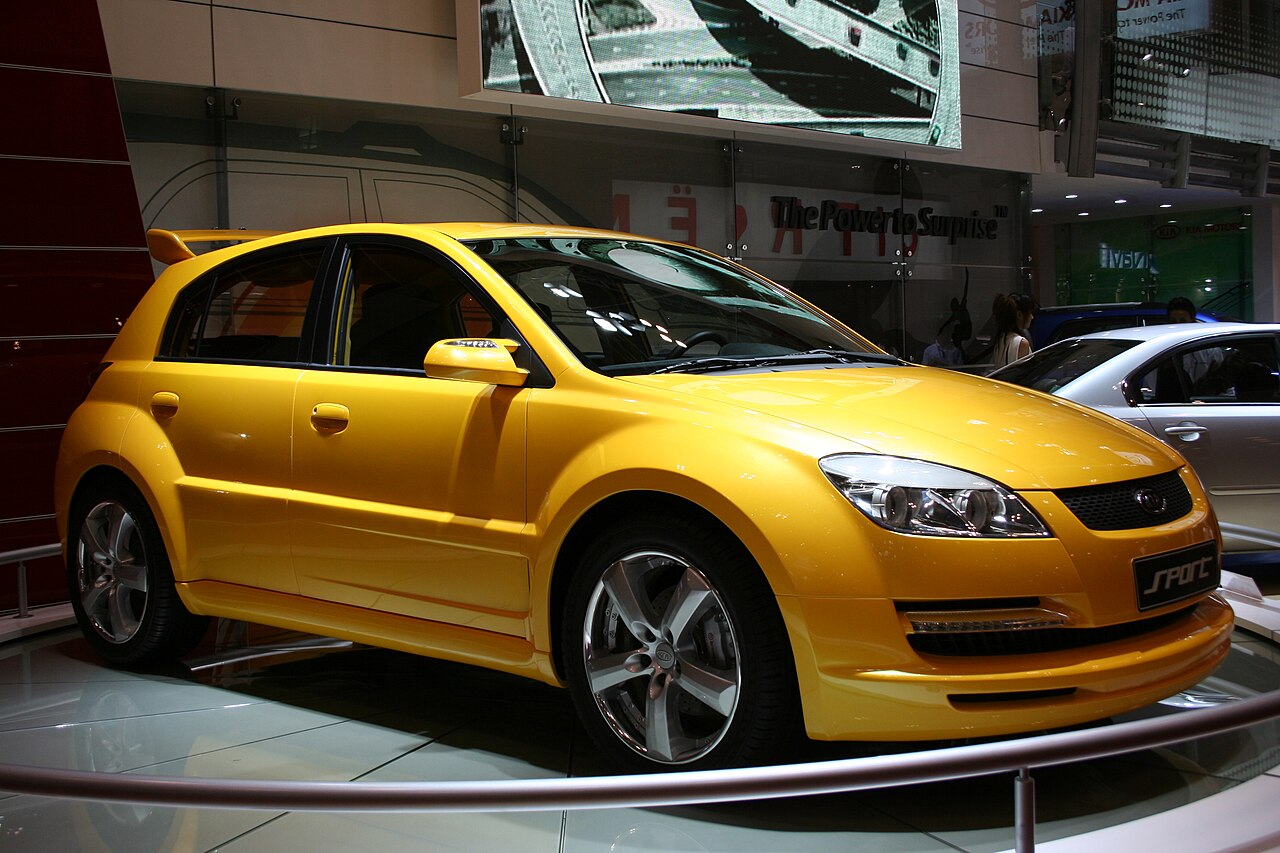
The 2004 Kia Sport Concept gives a small hatchback a deliberately assertive physical form. Its original Paris programme deserves a distinct archive identity, separate from both the Sportage SUV and later retail Rio variants.
Origins and the correct historical identity
Kia’s original Paris announcement identifies the compact Sport concept with a 2.0-litre turbo engine and electronically controlled five-speed automatic transmission. The manufacturer’s later design retrospective calls the programme Rio Sport. Both names refer to this sports-hatch study, not the separate Sportage fuel-cell vehicle discussed in the same show release. The complete fabrication tally remains unconfirmed.
Design: what makes Sport Concept distinctive
The supplied photograph shows a yellow five-door body with a deep front treatment, pronounced wheel areas and a substantial rear roof extension. Its silhouette remains recognisably compact, yet the details communicate a much more focused personality. That combination is the design attraction: the basic passenger-car form provides context for the exaggerated stance and carefully concentrated additions. The visible body is a stronger identifier than the ambiguous word Sport on its own.
Engineering and the concept brief
A turbocharged show-car brief does not establish that a later small hatchback carried the same hardware. Nor does a shared motor-show announcement make another vehicle’s hydrogen equipment part of this concept. The specification table keeps the original Sport programme together. Aerodynamic-looking additions are described as visible design features unless a correctly scoped technical record supplies their measured effect.
Why this Hyundai belongs in the design archive
Sport is useful to an archive as an early experiment in making a practical small car communicate enthusiasm. Its interest includes how colour, wheel placement and lower-body treatment work together. A collection can compare it with later performance-oriented Kia concepts while keeping its date and naming clear. The original programme is a physical design proposition, rather than a numbered retail edition inferred from one exhibition photograph.
Recognising and documenting the physical subject
MATSUOKA Kohei photographed the car in November 2005. The yellow body and visible configuration match the Sport concept. That later photographed appearance is kept separate from the 2004 Paris introduction. A future record could add the cabin and rear details, with each image carrying its creator and event evidence. The Sport and Rio Sport names are retained together so searches using either name lead to the same programme.
Reading a show-car specification
A concept specification describes a programme at a particular moment. Some details identify a physical component, some describe the intended vehicle architecture, and others set a target for a possible future model. Those distinctions matter especially for dramatic show cars, whose presentation may combine working mechanisms with design demonstrations. The specification table retains the manufacturer’s named proposal and leaves unsupported outputs or manufacturing totals unfilled. A later production car’s engine, transmission or acceleration time is not a substitute for evidence about this concept.
The body itself is a valuable technical document. Wheel placement suggests packaging priorities; cabin height and glazing show how visibility and occupant space were presented; openings and surface transitions reveal the designers’ approach to access and airflow. Those observations are interpretations of the visible design, rather than proof of a completed road test. Pairing them with the original programme description gives a collector a useful way to understand the car without assigning capabilities that the surviving records do not establish.
Collector significance and future research
The value of a concept archive lies in preserving the relationship between an idea, the people who developed it and the object that made it visible. A strong collection record keeps the original name, reference year, credited photographs and source links attached to that relationship. If new photographs or factory documents emerge, they can add a show appearance, a construction detail or a later change without replacing the original identity. This is particularly useful for a car whose published pictures may span several exhibitions and whose name may have acquired different spellings.
The complete fabrication tally remains unknown here. Exhibition appearances do not provide a count: the same object can travel, and a programme may also produce models or development articles that are not visible publicly. The concept belongs in this archive because its physical identity is supported, rather than because a single surviving photograph implies that only one was made. A future tally should identify which objects it covers and the document establishing that scope. Until then, this profile provides the historical and photographic foundation for further documentation.
Reading the evidence for this profile
The original source links below identify the programme and the historical statements used in this article. The photograph has its own creator and licence record, separate from the manufacturer’s vehicle history. Keep both when transferring this profile into a collection catalogue. A manufacturing tally describes how many cars belong to a defined original programme; it does not measure how many survive, how many are publicly visible, or how many retain all their original components. Those individual questions require dated chassis and restoration evidence. The reference year likewise describes the programme’s introduction or named historic configuration, while the supplied caption states the photographed setting and any established individual identity. This lets future research expand the car’s history without blurring the scope of the record already assembled here.
Specifications and verified rarity
| Reference year | 2004 |
|---|---|
| Model / programme | Sport Concept |
| Body / role | Sport-oriented compact hatchback concept |
| Introduction | Paris, 2004 |
| Published engine | 2.0-litre turbo |
| Published transmission | Five-speed automatic |
| Alternate programme name | Rio Sport Concept |
| Exact manufacturing tally | Not established |
| Rarity evidence | Physical concept archive scope; tally unknown |
| Rarity scope | Verified physical Kia concept programme; complete fabrication tally unconfirmed. Included as Concept / Archive, without an invented one-car count or retail-production ceiling. |
| Inventory reference | KIA-042 — Verified |
Frequently asked questions
Is Sport the Sportage fuel-cell concept?
They are separate subjects in the original show announcement.
What other name appears in Kia history?
Rio Sport.
When was the programme introduced?
Paris, 2004.
What transmission is in the original brief?
An electronically controlled five-speed automatic.
What rarity or archive scope is verified?
Verified physical Kia concept programme; complete fabrication tally unconfirmed. Included as Concept / Archive, without an invented one-car count or retail-production ceiling.
Who took the supplied photograph?
MATSUOKA Kohei via Wikimedia Commons, under CC BY 2.0. The original file and licence links accompany the image. Retain that credit when the photograph is uploaded, exported or reused.
Related Kia profiles
Sources and photo credits
Photograph: MATSUOKA Kohei via Wikimedia Commons original file, CC BY 2.0. Source-provided photograph supplied without local cropping, retouching or text removal. A source thumbnail is used where available. Kia Sport / Rio Sport Concept photographed by MATSUOKA Kohei in November 2005; the physical programme dates to 2004.
Built in limited numbers
Verified physical Kia concept programme; complete fabrication tally unconfirmed. Included as Concept / Archive, without an invented one-car count or retail-production ceiling.
Gallery
Specifications
Factory specifications may vary by model year, market and configuration.
Identity & production
- Official model
- Sport Concept