2002 Chevrolet Bel Air Concept
Explore the 2002 Chevrolet Bel Air Concept: history, design, production evidence and collector details, with a credited photo.
The 2002 Chevrolet Bel Air Concept turns a familiar heritage name into an open, contemporary design study. Its red body, bright grille and exposed passenger space make the proposal approachable before the observer reads a specification sheet.
History and model identity
Chevrolet’s own 2002 release documents the physical concept and its appearance at the Woodward Dream Cruise. It describes a four-passenger convertible with an egg-crate grille and bright windshield framing. These references establish a real show project with a public history. They do not establish an exact worldwide prototype manufacturing total, which is deliberately left unset in the archive record.
The name carries considerable historical weight, so the reference year is essential. This is the 2002 concept, rather than a restored production Bel Air from the earlier era. It can sit beside those cars in a heritage display, but its place is as a later interpretation. A concept can quote recognisable elements while rearranging them into a different body, a different scale of detail and a different public proposition.
Design, photographs and collector context
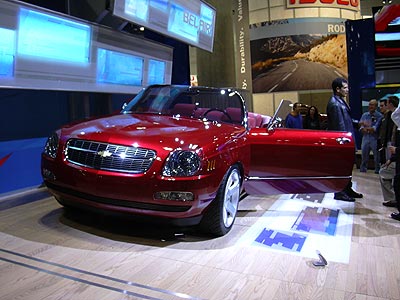
The supplied show photograph records the red convertible with its passenger-side door open. Bright grille work establishes a strong horizontal face, and the polished windshield surround gives the cabin a clear boundary even without a roof. The door position reveals how the interior relates to the outside surface. Exhibition lights create highlights across the bonnet and side, so those highlights should be read as photographic conditions rather than permanent decorative stripes.
This concept is most rewarding when discussed as an exercise in translating memory. The observer can follow the brightwork, open seating and broad face without assuming a direct production commitment. The visual continuity with older Chevrolet themes is an interpretation supported by the design’s appearance; a claim about an approved production successor would need a separate manufacturer decision. Keeping that distinction clear makes the historical page more useful.
Reading the design in context
The open passenger door changes the way this photograph is read. Instead of presenting a sealed sculpture, the image exposes the threshold between exterior and cabin. Follow the bright windshield framing down toward the door opening, then back to the large grille. Those elements arrange the car as a welcoming open-body proposal, with the passenger space taking a visibly important place in the composition. A closed-door side view would add another interpretation, showing how the body reads as a continuous surface. Both are worth retaining because they answer different questions. For a collection display, a period Bel Air image can sit beside the concept without requiring a claim that the two share their underlying construction. Ask the viewer to look at the use of brightwork, grille organisation and open space. That comparison explains how a heritage name can guide an entirely new design proposal, while allowing each object to retain its own reference year and physical identity.
Specifications and rarity
| Reference year / history | 2002 |
|---|---|
| Model / project | Bel Air Concept |
| Engineering context | Four-seat open-body Chevrolet design concept |
| Design and collector theme | A modern convertible interpretation of the Bel Air name |
| Production / archive scope | One documented original physical concept project. Exact worldwide prototype manufacturing total is not established and is left unset. |
| Exact scoped manufacturing tally | Unset; see scope description |
| Inventory reference | CHV-208 — Verified |
Building the individual collector record
An archive file should retain the manufacturer release, dated show appearances and the original image caption. Add views of the rear, cabin and closed door when available, because the main photograph emphasises the front and open passenger space. Record the physical object’s custody or display location only when an institution documents it. Catalogue the project as a concept with an unset global build total, and avoid treating repeated photographs at different shows as additional vehicles.
Documentary photograph
Red Chevrolet Bel Air concept on an exhibition stand, photographed by Matt; the open door and display setting are retained in the documentary image.
Frequently asked questions
Was this a real physical Chevrolet concept?
Yes. Chevrolet’s 2002 event release identifies the Bel Air concept and documents its public display. It is catalogued here as an original physical archive project.
How many prototypes were built worldwide?
An exact worldwide manufacturing total is not established by the cited reference. The archive identity is verified while that numeric field remains unset.
Is it an original-era production Bel Air?
No. The title identifies a 2002 convertible concept using the heritage name. Earlier production Bel Air models need their own year-qualified profiles.
What does the documentary image show?
It shows the red concept at an exhibition with the passenger door open, emphasising its bright grille, windshield frame and open cabin.
What production or archive scope applies to this Bel Air Concept?
One documented original physical concept project. Exact worldwide prototype manufacturing total is not established and is left unset.
Who took the photograph, and what credit must remain?
The supplied photograph is credited to Matt via Wikimedia Commons under CC BY 2.0. Its original file page and individual licence are linked in the photo credit. Keep the photographer name, source and licence visible when using the image; this version has no local retouching or cropping.
Sources and photo provenance
Related Chevrolet profiles
Continue the chronology with 2001 Chevrolet Corvette Z06 and 2003 Chevrolet SS Concept. Compare each page’s named production or project scope alongside its own documentary photograph.
Built in limited numbers
One documented original physical concept project. Exact worldwide prototype manufacturing total is not established and is left unset.
Gallery
Specifications
Factory specifications may vary by model year, market and configuration.
Identity & production
- Official model
- Bel Air Concept